Clear Sky Science · en
Effector conformational plasticity enables lineage-specific secretion via Hcp heterohexamers in gut symbionts
Microbial duels inside the human gut
Our intestines are home to dense communities of microbes that constantly jostle for space and food. To survive, some bacteria wield molecular weapons that can puncture and poison their rivals, subtly shaping which species thrive in the gut. This study uncovers how a common human gut symbiont, Bacteroides fragilis, customizes a tiny injection apparatus so it can deliver specific toxic proteins into neighboring bacteria with remarkable precision.
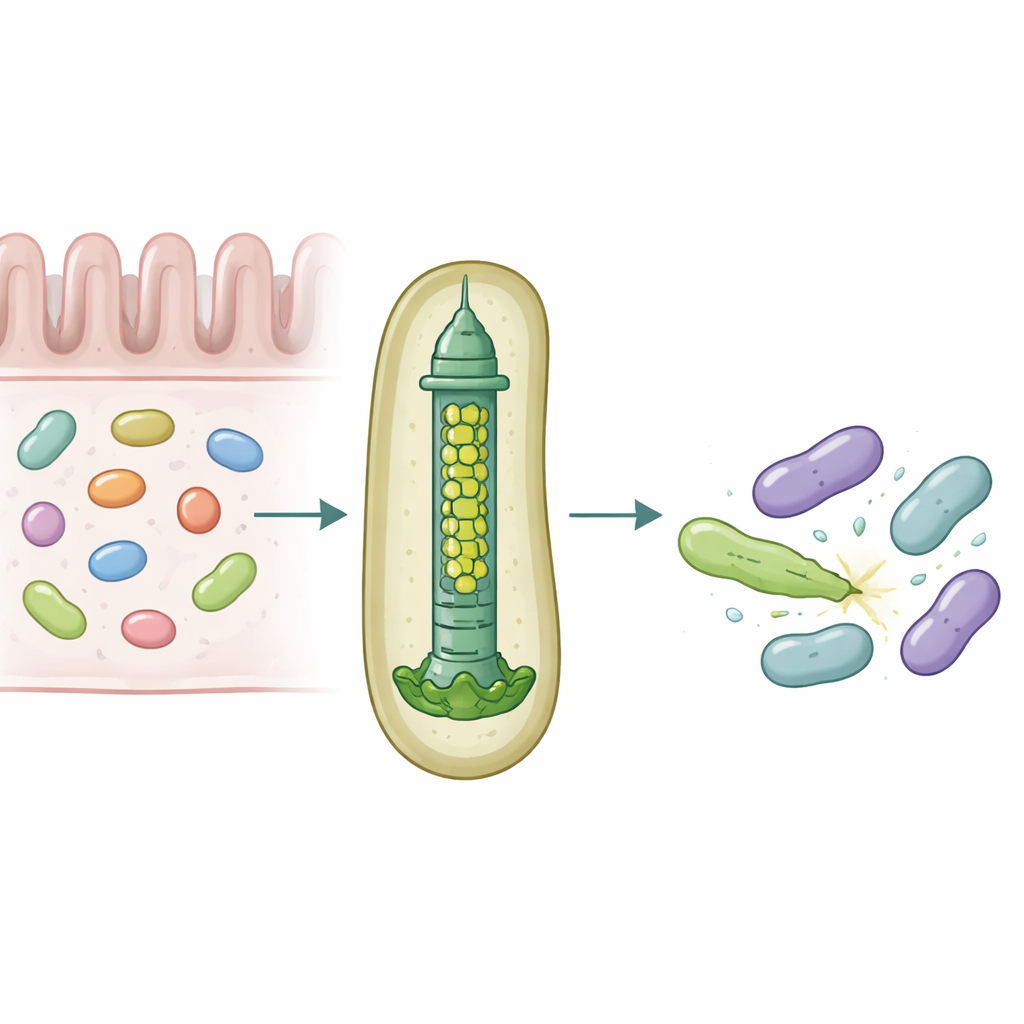
A microscopic spear gun for bacterial warfare
Many Gram-negative bacteria use a device called the Type VI Secretion System, a spring-loaded structure that works like an inverted phage tail, to fire toxic "effectors" into nearby cells. A central part of this system is a tube built from stacked rings of a protein called Hcp. In most species each system has one form of Hcp, yet B. fragilis from the human gut carries five different hcp genes in a single locus. The biological reason for this apparent redundancy was unknown, especially because this system is unusually potent at killing closely related bacteria in lab and animal models.
Specialized rings built from mixed parts
The researchers combined mouse colonization experiments, mixed bacterial cultures, and protein biochemistry to dissect the roles of these Hcp variants. They found that only three—Hcp1, Hcp2, and Hcp3—are required for efficient killing by a particular effector called Bte1. Hcp1 forms the main tube of the secretion machine, as expected. Hcp2 and Hcp3, however, do something different: they assemble together into a mixed six-part ring, a heterohexamer, that cannot form from either protein alone. Using cryo–electron microscopy, the team showed that these heterohexamers are made of four Hcp2 and two Hcp3 units arranged in a symmetric ring, creating a rigid pore that can engage Bte1 but does not mix with Hcp1 rings.
Shape-shifting cargo and a lock-and-key fit
High-resolution structures of the Hcp2–Hcp3 ring bound to Bte1 revealed that the effector must dramatically rearrange parts of its shape to fit snugly inside the central channel. Several of its α-helices swing by tens of degrees to avoid clashing with the protein tube, demonstrating what the authors call conformational plasticity. When they engineered a disulfide bond to lock one of these helices in place, Bte1 could no longer bind the ring efficiently, and its killing activity dropped in competition assays. Detailed mapping of the contact surfaces pinpointed specific amino acids on both Hcp2 and Hcp3 that are essential for binding and secretion. Mutating just one residue on either partner was enough to disrupt delivery without breaking the ring itself.
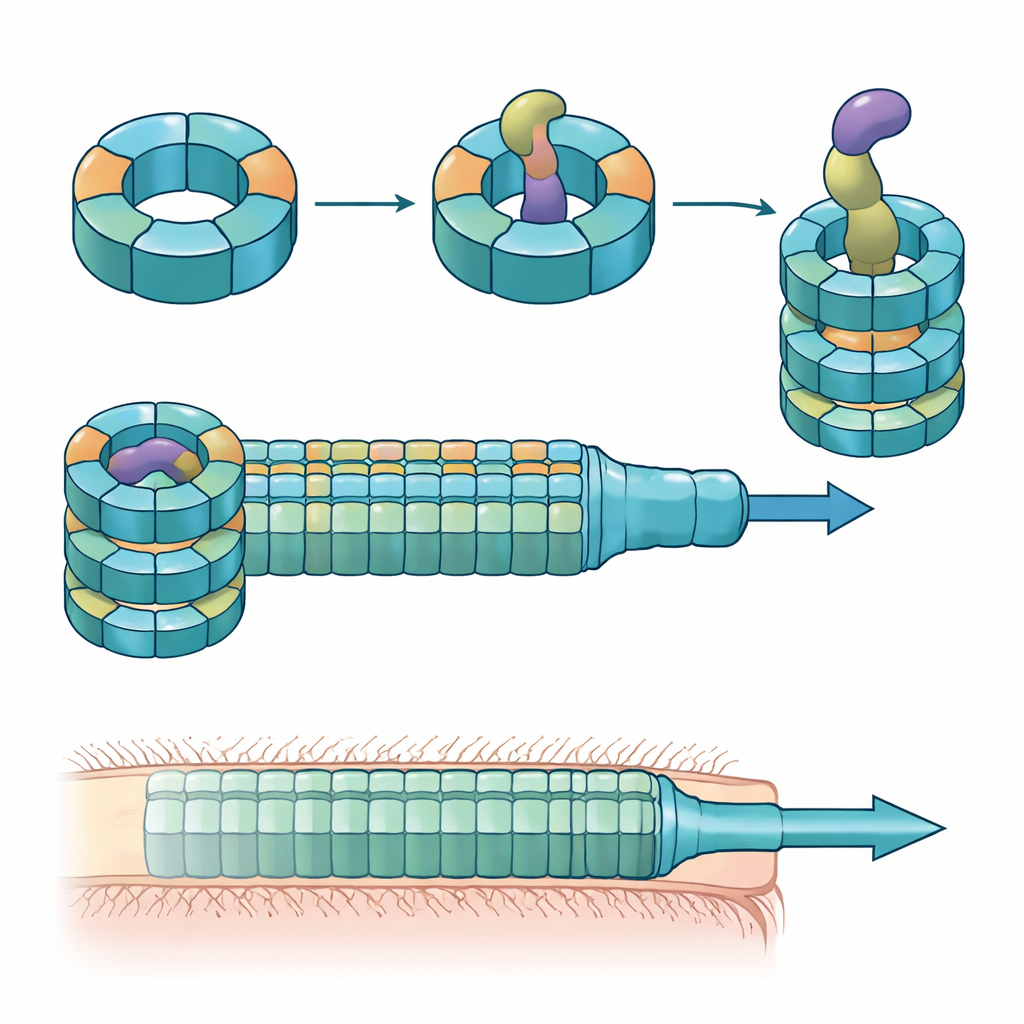
Co-evolving rings and toxins across gut lineages
The team then asked whether this mechanism is unique to one strain or shared across B. fragilis lineages. By comparing Hcp2–Hcp3 pairs and their nearby effector genes from dozens of strains, they found that each lineage carries a characteristic effector in a variable region of the locus and a matching Hcp2–Hcp3 pair. Cross-swapping these pairs between strains showed that each mixed ring only recognizes its own effector, even though different rings can still assemble structurally. Hcp3, in particular, contains highly variable patches on the inner surface of the ring that act as the main determinant of which effector can bind. Despite this sequence diversity, the effectors themselves share a conserved N-terminal fold that docks into the ring like a reusable module, while their C-terminal toxic domains differ widely.
Why this shape-matching system matters
Together, these findings outline a "lock-and-key" co-evolutionary model: the inner surface of the Hcp2–Hcp3 ring provides a lineage-specific lock, and the conserved N-terminal module of each effector serves as a key that has been subtly reshaped in different strains. Effector proteins can flex and refold just enough to thread through the ring without jamming the tube, allowing relatively large or complex toxins to be delivered through a narrow channel. This work explains how gut symbionts fine-tune their molecular spearguns to deploy distinct toxins against microbial rivals, and it suggests that by rewiring these lock-and-key interfaces, researchers might one day engineer Type VI systems as programmable delivery platforms for beneficial molecules in microbial communities.
Citation: Zheng, S., Li, W., Fan, L. et al. Effector conformational plasticity enables lineage-specific secretion via Hcp heterohexamers in gut symbionts. Nat Commun 17, 2994 (2026). https://doi.org/10.1038/s41467-026-69309-z
Keywords: type VI secretion system, Bacteroides fragilis, bacterial competition, protein conformational plasticity, microbiome engineering