Clear Sky Science · en
Alternatively activated macrophages cause DNA damage through an arginase 1-mediated bystander effect and promote epithelial cell transformation
Hidden Helpers That Can Harm
Most of us think of immune cells as guardians that fight infections and help keep tissues healthy. This study reveals a surprising twist: a common type of “healing” immune cell in the colon can quietly damage the DNA of nearby cells and push them toward cancer. Understanding how this happens may change how we look at early colon cancer risk and how we might one day prevent it.
Immune Activity in a Seemingly Healthy Gut
Colon cancer usually develops slowly, starting with small growths called polyps before turning into full-blown tumors. Long before clear signs of inflammation appear, the colon can be in a low-level “simmering” state of immune activity. In this state, immune cells are active even though the tissue still looks normal under the microscope. Prior work showed that one kind of immune cell, called M1 macrophages, can damage DNA in nearby cells and promote cancer-like changes. The new research asked whether another, more “healing” type of macrophage, known as M2, might also play a role in this early transformation.
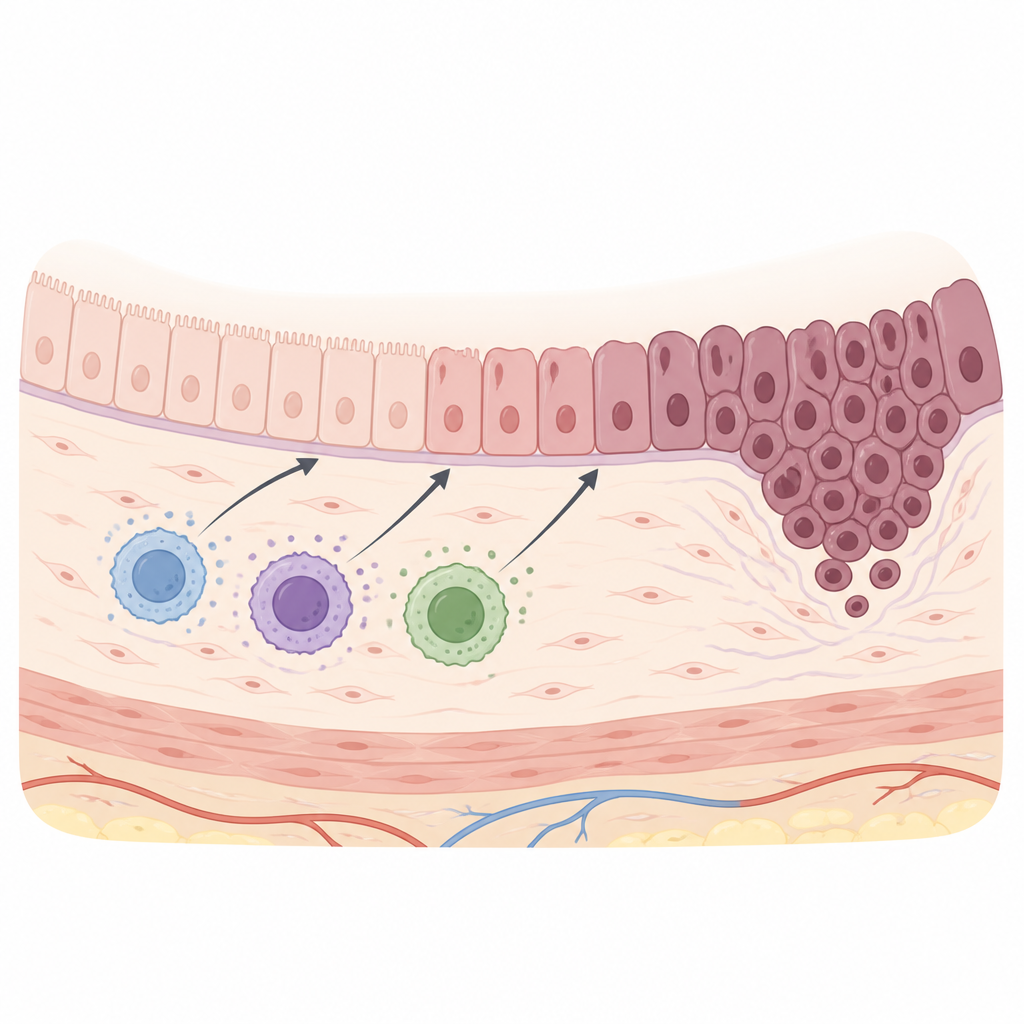
When Healing Cells Turn Dangerous
The researchers grew mouse colon cells together with different types of macrophages, but separated them so they could not touch. Even without direct contact, colon cells exposed to both M1 and a specific subtype of M2 cells showed clear signs of broken DNA strands and activated repair systems. Over repeated exposures, these colon cells began to behave like cancer cells when placed into mice, forming fast-growing, poorly organized tumors. This showed that certain M2 cells, thought to be mainly soothing and anti-inflammatory, can instead drive long-term genetic damage and transformation.
A Chemical Chain from Nutrient to DNA Break
The team then tracked down how these M2 cells cause harm. They focused on a key enzyme called arginase 1, which M2 cells release. Arginase 1 converts a nutrient, L-arginine, into another molecule, L-ornithine. The colon cells take up L-ornithine and feed it into their own internal machinery that handles “polyamines,” small molecules important for cell growth. As this polyamine pathway runs faster, it produces hydrogen peroxide, a reactive chemical that can injure DNA. Blocking arginase 1 in the macrophages, or blocking steps in the polyamine pathway, or mopping up hydrogen peroxide inside colon cells all sharply reduced DNA damage. Adding L-ornithine alone, without macrophages, was enough to boost DNA injury, confirming this chain of events.
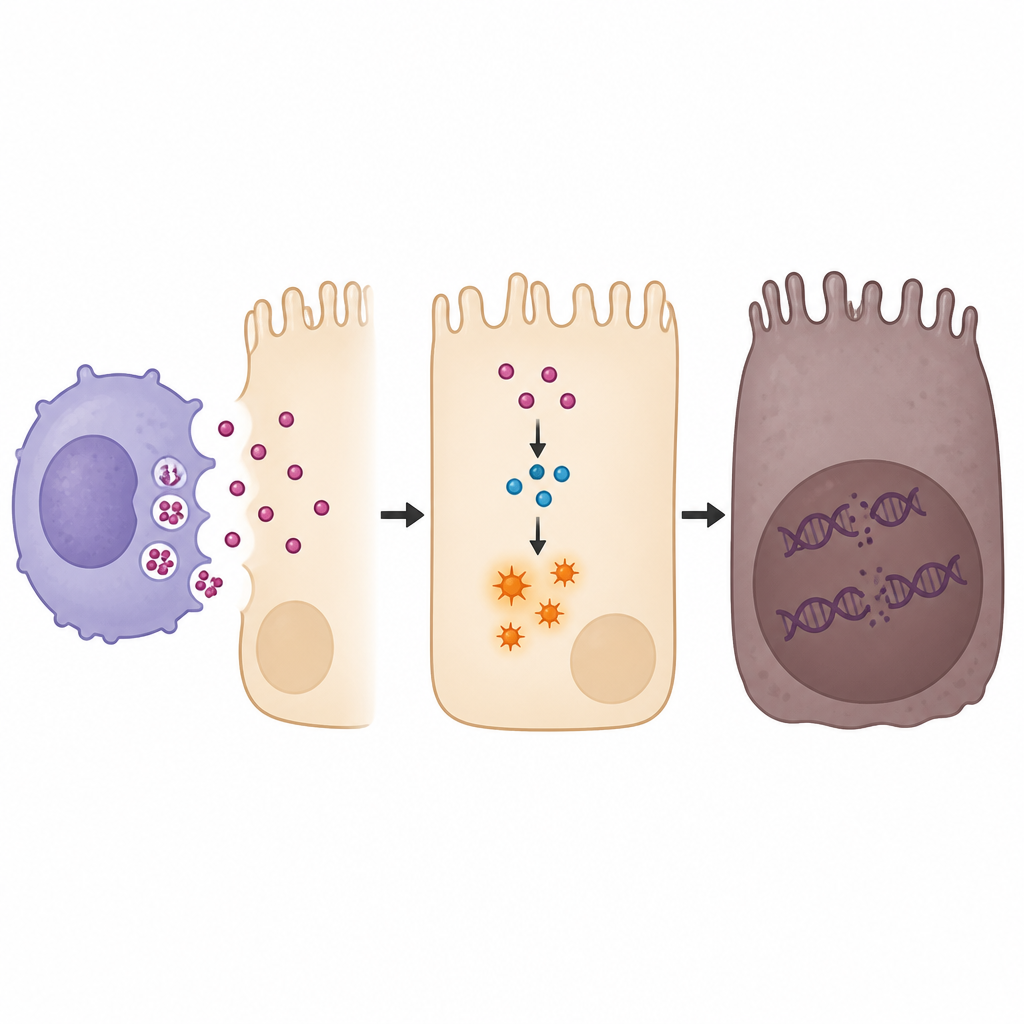
Macrophages in Human Colon Tissue
To see if this process might matter in real people, the scientists examined colon tissue from healthy adults, people with polyps, and patients with very early colorectal cancer. Using detailed fluorescent staining, they identified macrophages with M1-like, M2-like, and mixed M1/M2 features. Surprisingly, normal-looking colon tissue from screening patients had the highest numbers of activated macrophages, including many that carried arginase 1. In those same samples, more epithelial cells showed markers of DNA damage and active DNA repair. As tissue progressed from normal to polyp to early cancer, the total number of activated macrophages dropped, but the balance shifted toward more M2-like cells.
What This Means for Colon Cancer Risk
Taken together, the findings suggest that “healing” macrophages in the colon can, under the wrong conditions, become silent drivers of cancer initiation. By boosting a normal growth pathway inside nearby cells, they indirectly raise levels of hydrogen peroxide, which in turn nicks and breaks DNA. Over years, these injuries and repairs can accumulate and help push cells toward transformation, even when the colon still appears healthy. This work points to arginase 1 and related metabolic steps as possible future targets for reducing early colon cancer risk, while also reminding us that not all helpful cells are harmless.
Citation: Undi, R.B., Sutton, M.M., Becker, E. et al. Alternatively activated macrophages cause DNA damage through an arginase 1-mediated bystander effect and promote epithelial cell transformation. Oncogenesis 15, 19 (2026). https://doi.org/10.1038/s41389-026-00611-7
Keywords: colorectal cancer, macrophages, DNA damage, arginase 1, polyamine metabolism