Clear Sky Science · en
Psychotropic medications and their interactions with subcortical brain volume in bipolar disorder: An ENIGMA mega-analysis
Why Brain Changes Matter in Bipolar Disorder
Bipolar disorder is usually treated with combinations of powerful psychiatric medications, but their long-term effects on the brain are still being untangled. This study asks a simple but important question: how do commonly prescribed mood stabilizers, antipsychotics, antidepressants and related drugs relate to the size of key deep brain structures involved in mood and thinking? Using thousands of brain scans from around the world, the researchers show that different drug types are linked to subtly different patterns of brain volume, and that lithium may partly counter some of the negative changes seen with other medicines.
Looking Deep Inside the Brain
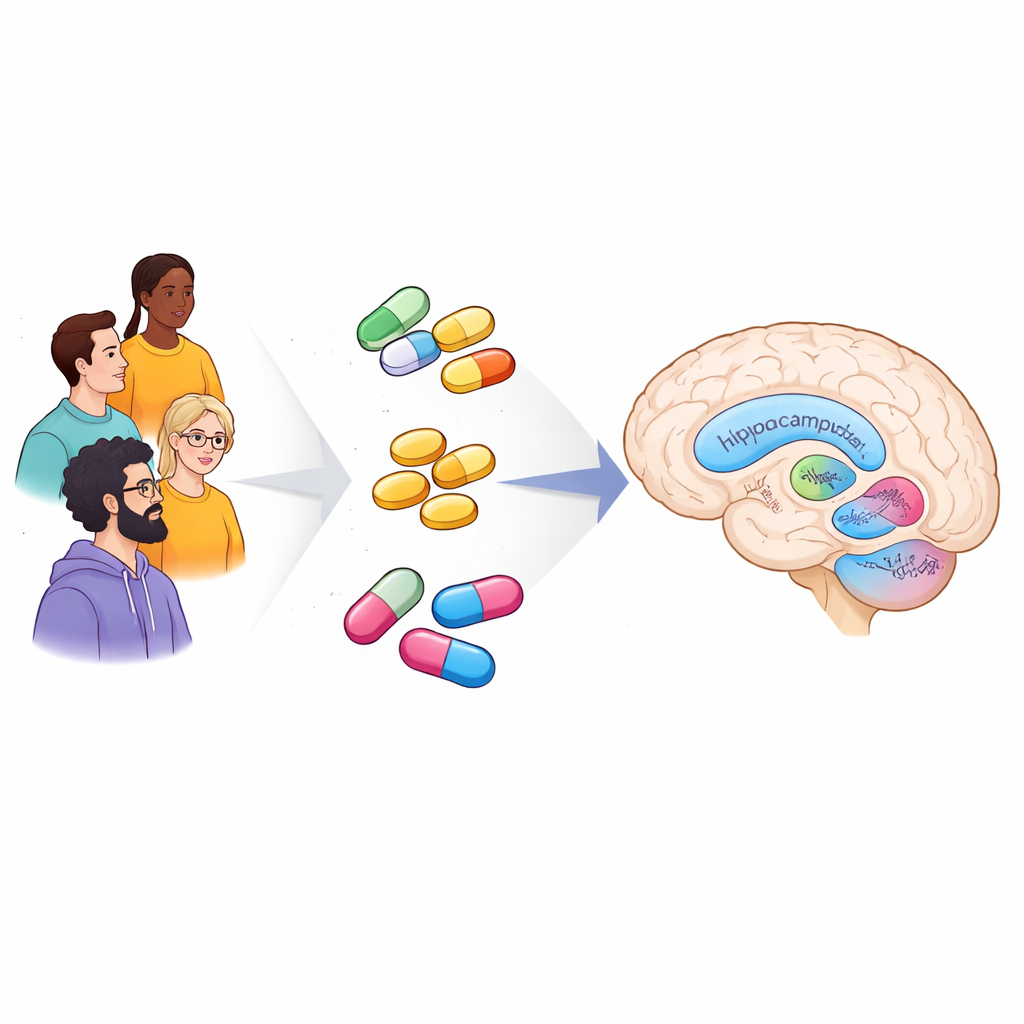
The team focused on subcortical regions, the deep structures that help regulate emotion, motivation, memory and movement. These include the hippocampus (important for memory and mood), thalamus (a relay hub), amygdala (emotion), basal ganglia (movement and habits), and the brain’s fluid-filled ventricles. Previous bipolar imaging studies have often disagreed, partly because they used different methods and small samples. Here, 34 research groups joined forces within the ENIGMA Bipolar Disorder Working Group, pooling MRI scans from 2,664 people with bipolar disorder and 4,065 healthy volunteers. All images were processed with the same open protocols so that measurements of brain volume could be directly compared across sites.
Medications Versus the Illness Itself
The researchers first asked whether people with bipolar disorder who were not taking any psychiatric medication at the time of scanning looked different from healthy controls. These unmedicated patients showed only mild differences: slightly larger ventricles and a modest increase in putamen volume, along with smaller overall skull volume that may reflect early-life brain development. In contrast, patients taking one or more psychotropic drugs showed a clearer pattern: larger ventricles and smaller hippocampus and thalamus, with the strongest differences in those taking two medications at once. This suggests that medication exposure and/or more severe, long-lasting illness is associated with subtle shrinkage in key mood-related structures, though cause and effect cannot be firmly separated in this kind of study.
Different Drug Classes, Different Brain Patterns
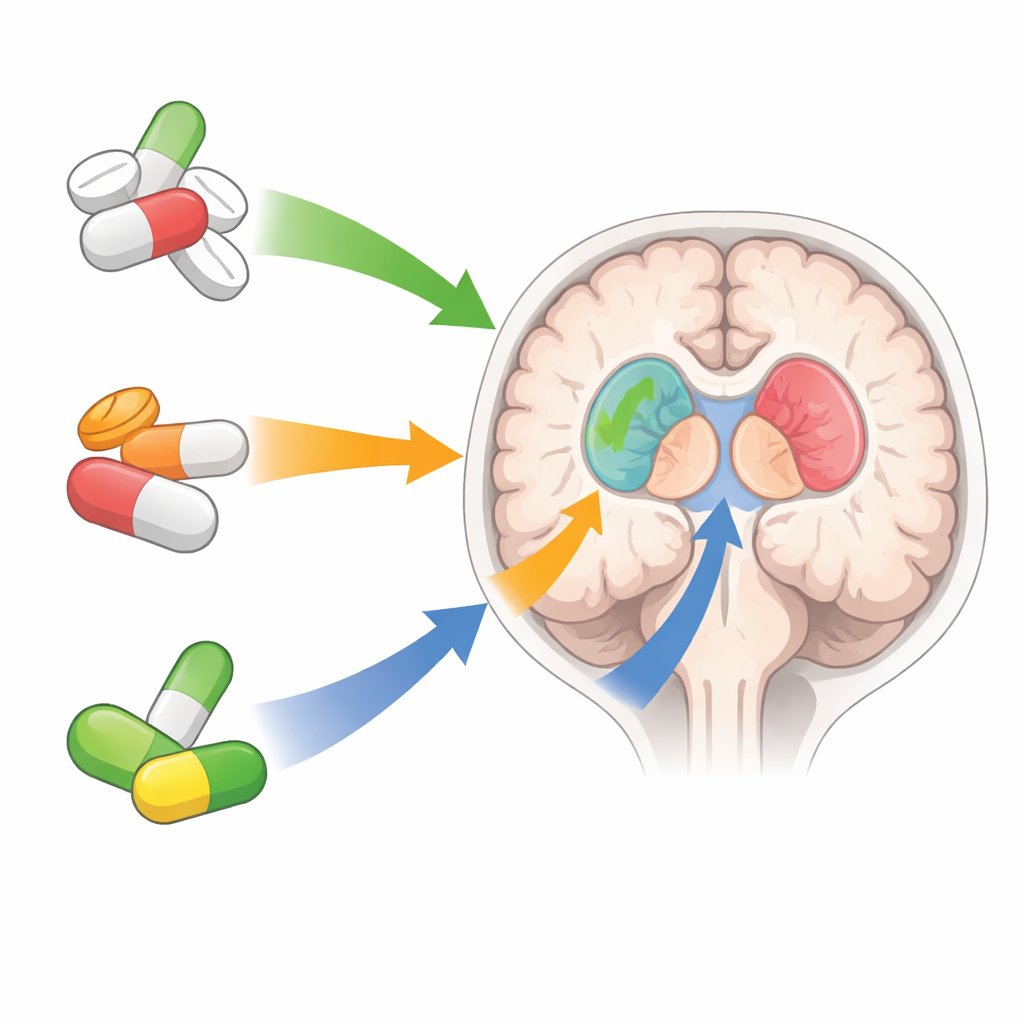
Next, the team examined specific medication groups using both traditional labels (lithium, antiepileptics, antipsychotics, antidepressants) and a newer, more precise system that classifies drugs by how they work on brain chemistry. Lithium users had slightly larger thalamus volume than healthy controls and larger hippocampus than bipolar patients not on lithium, fitting with earlier hints that lithium may support or preserve brain tissue. In contrast, antiepileptic mood stabilizers and antipsychotics were linked to smaller hippocampus and thalamus and larger ventricles. When the researchers broke antiepileptics down by mechanism, these negative associations were driven mainly by valproate, whereas drugs that act as ion-channel blockers showed little or no volume change. Among antipsychotics, those that block dopamine and other monoamine receptors together were tied to smaller hippocampus and larger ventricles, while partial dopamine–serotonin agents were associated with slightly larger basal ganglia.
Interplay Between Lithium and Other Medicines
Because lithium has long been suspected to have neuroprotective properties, the team tested whether it might soften the impact of other drugs on the brain. In patients taking antiepileptic mood stabilizers, adding lithium appeared to weaken the link between these drugs and smaller hippocampal volume. No similar moderating effect was found for other brain regions or medication combinations. Importantly, more severe illness—earlier onset, more episodes, more hospitalizations—was also related to somewhat smaller subcortical volumes, and this relationship was not explained away by medication status. This means both the course of the disorder and the drugs used to treat it may contribute, in overlapping ways, to the structural differences seen in the brain.
What This Means for People Living With Bipolar Disorder
For non-specialists, the key message is that the medications used to manage bipolar disorder are linked to small but measurable differences in deep brain structures, and these patterns differ by drug type. Valproate-like antiepileptics and certain antipsychotics are tied to reduced volume in mood-related regions and enlarged ventricles, while lithium is associated with relatively larger hippocampus and thalamus and may partially offset some of these reductions. These findings do not prove that any medication harms or protects the brain on its own, because people with more severe illness are more likely to receive particular drugs and combinations. Instead, the study highlights how complex the relationships are between illness, treatment and brain structure, and it underlines the need for long-term, randomized studies that track both brain scans and real-world functioning to guide safer, more effective care.
Citation: King, S., O’Connor, J., Corley, E. et al. Psychotropic medications and their interactions with subcortical brain volume in bipolar disorder: An ENIGMA mega-analysis. Mol Psychiatry 31, 2941–2953 (2026). https://doi.org/10.1038/s41380-025-03432-z
Keywords: bipolar disorder, brain imaging, psychotropic medications, lithium, subcortical volume