Clear Sky Science · en
Matching fingerprints on sculptures by the “Bernini of the North”
Hidden Clues in Ancient Clay
When we look at historic sculptures in a museum, we usually focus on the figures and stories they depict. But some of the most revealing details are almost invisible: the faint traces of the artists’ own hands. This study shows how preserved fingerprints and palmprints in clay sculptures from the 1600s can be read much like crime‑scene evidence, opening a new way to understand who actually made these works and how busy workshops really functioned.

The Sculptor Behind a Grand City Hall
The research centers on eight terracotta models made in the Amsterdam workshop of Artus Quellinus the Elder, a leading sculptor sometimes called the “Bernini of the North.” These fired‑clay reliefs and sketchy fragments were trial versions for the huge marble decorations of Amsterdam’s 17th‑century Town Hall, now the Royal Palace. Although the finished stone carvings are well documented, it has been far less clear how much Quellinus himself, versus his many assistants and pupils, shaped the preparatory clay models. Because those models were handled while the clay was soft, they captured tiny ridge patterns from fingers and palms that now offer a rare, physical link to the people who worked the material.
Turning Artworks into Fingerprint Evidence
The team treated the sculptures almost like a cold case. First, conservators carefully inspected the front, back, and edges of each object under strong angled light, looking for the fine ridges that form fingerprints. Every possible mark was photographed and mapped on overview images of the sculpture. An initial round of images—often taken with a smartphone—revealed many impressions but lacked the sharpness needed for detailed analysis. In a second campaign, forensic fingerprint examiners joined the sessions, using a high‑resolution camera, macro lens, and controlled lighting. They focused only on marks with good potential and advised on camera angles and light direction to make ridge patterns stand out clearly in the photos.
A Forensic Workflow in the Museum
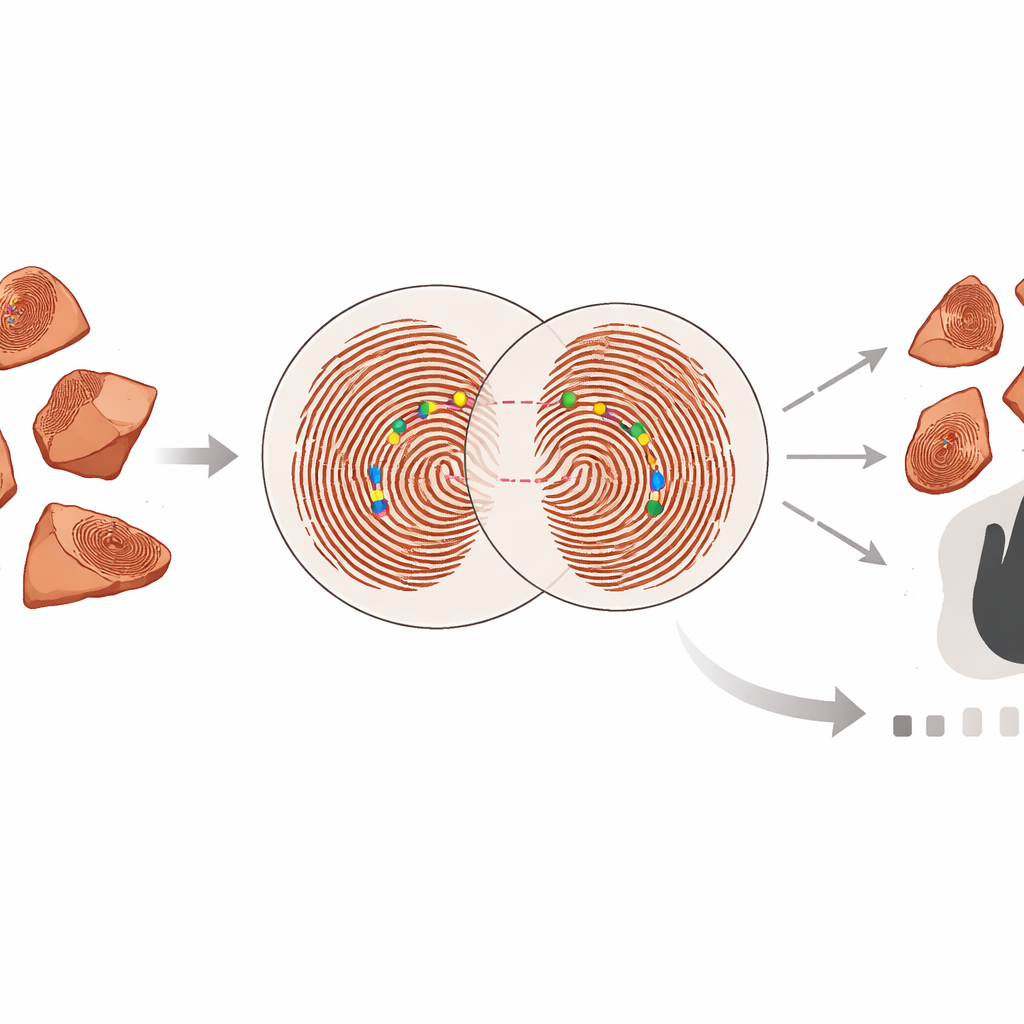
The researchers then applied a standard forensic protocol, similar to those used in accredited crime laboratories. Two independent experts examined each photographed mark, assessing its clarity, whether it came from a finger or palm, and whether it was suitable for comparison. They searched for distinctive features—such as where a ridge splits into two or ends abruptly—and compared marks within and across sculptures. Using a probability‑based framework, they judged how likely it was that two impressions came from the same hand versus different hands. Across the eight sculptures they documented 28 fingerprints, nine palmprints, and three clusters of fragmentary marks, most located on the unfinished backs and edges where the clay had not been smoothed for display.
Matching Prints and Tracing Hands
From this collection, four strong pairs of matching fingerprints were found, each pair lying on the same object. One pair on a sketch fragment for an overdoor scene showed a distinctive spiral pattern and 14 shared details, making it extraordinarily likely to have come from one person. Another pair formed a “double tap,” where the same fingertip touched almost the same spot twice. A third match, on a relief of a sea god carrying a nymph, shared not only ridge details but also a small scar in the same place—an especially telling feature. A fourth match appeared on the front of a relief showing a sea maiden on a mythical sea horse, an unusual case where marks survived on the visible side. In several cases, the position of the prints in heavily worked areas strongly suggests the master’s own hand; in others, they may belong to anonymous helpers. All images and annotations have been placed in an open database so future comparisons—with more sculptures by Quellinus and his circle—can gradually tie specific print patterns to specific individuals.
Why These Tiny Traces Matter
For a layperson, the key message is that even faint, partial fingerprints in centuries‑old clay can be read with modern forensic methods, much like those used in criminal investigations. Instead of serving as simple proof that a great master touched an object, these marks reveal a more complex picture of shared labor in large workshops. By building a growing reference library of prints from many sculptures, researchers hope to map who worked where, when, and on what, and to gain a richer understanding of the teams behind famous artworks. In this way, the barely visible ridges pressed into soft clay more than 350 years ago are becoming a new tool for writing the history of art.
Citation: Sero, D., van der Mark, B., Lubach, A. et al. Matching fingerprints on sculptures by the “Bernini of the North”. npj Herit. Sci. 14, 214 (2026). https://doi.org/10.1038/s40494-026-02490-y
Keywords: art fingerprints, terracotta sculpture, forensic art analysis, art workshop practice, cultural heritage science