Clear Sky Science · en
The evolution of international innovation collaboration trajectories and patterns from a global value chain perspective
Why the global innovation race matters to everyone
Everyday products from phones to medicines depend on ideas and components that cross many borders before reaching us. This study looks at how countries team up to invent new technologies along these global production chains, and how those partnerships are quietly reshaping who gains most from the world economy.
Two main ways countries choose partners
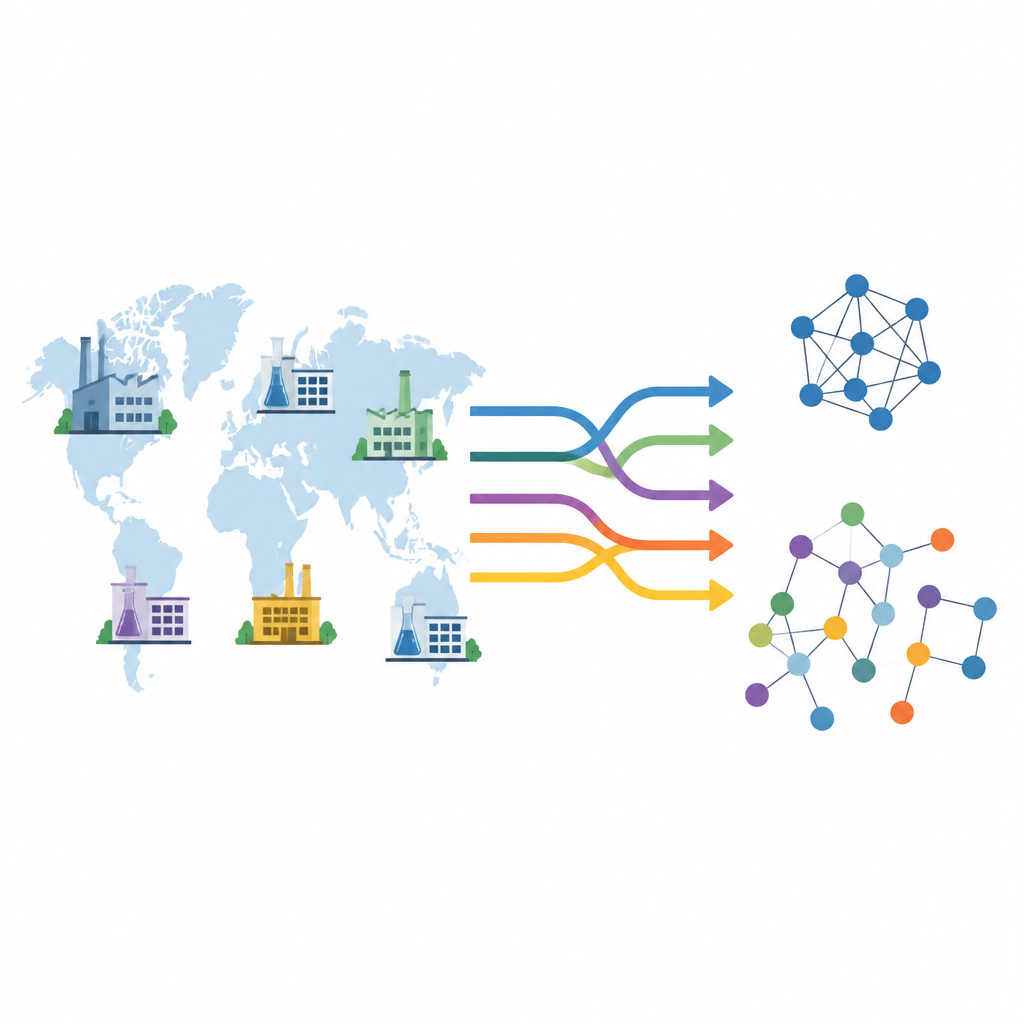
The authors focus on how countries sit in global production lines, known as global value chains, and how that position shapes their choice of innovation partners. Countries that specialise in early, high value stages like advanced research are described as upstream, while those focused on assembly and basic manufacturing are downstream. The study defines two broad collaboration styles. In centralized collaboration, countries at similar stages mainly work with one another, forming tight clusters of like with like. In decentralized collaboration, upstream and downstream countries mix more freely, linking very different roles in the chain.
Measuring the world’s patent teamwork
To move beyond anecdotes, the researchers built new numerical indicators using a large global patent database from 2011 to 2021, combined with existing measures of each country’s position in global value chains. They counted how often inventors from different countries appeared together on the same patent and classified these partnerships by whether they linked similar or different positions in the chain. A location style measure allowed them to separate sheer volume of cooperation from underlying patterns, so that small and large economies could be meaningfully compared across time, countries and industries.
How the global pattern has shifted over a decade
At the worldwide level, collaboration in value chains first spread out and became more decentralized, peaking around 2019, as emerging economies joined innovation networks. After that, the pattern swung back toward concentration, with partnerships clustering more strongly among similar countries. Upstream nations, mostly rich economies with strong research bases, tended to favour centralized ties with one another, strengthening technological clubs. Downstream nations, often developing countries, were more likely to seek diverse links with upstream partners, but these ties could be fragile and uneven. The picture also varied by sector. Chemicals and chemical products stayed heavily upstream and centralized, electrical and optical equipment cycled between more concentrated and more open patterns, and machinery was largely downstream and decentralized for most of the period.
Winners, strugglers and changing roles
Looking country by country, the study finds that many advanced economies use stable centralized collaboration to reinforce existing strengths, but risk getting locked into narrow paths. Some emerging economies, such as China and India, shifted from more closed to more open collaboration as their industries upgraded. Others became stuck either in tight, low level clusters or in scattered, low commitment partnerships. Comparisons of China and the United States highlight different strategies. The United States combines upstream strength with a mix of tight alliances and broad links, using decentralized ties in areas like textiles and general manufacturing to tap cheaper production and wider markets. China, meanwhile, shows a stronger tilt toward centralized collaboration in many sectors as it climbs the value chain, but still relies on decentralized ties in recycling related manufacturing where a wide spread of partners and applications is useful.
What this means for future innovation choices
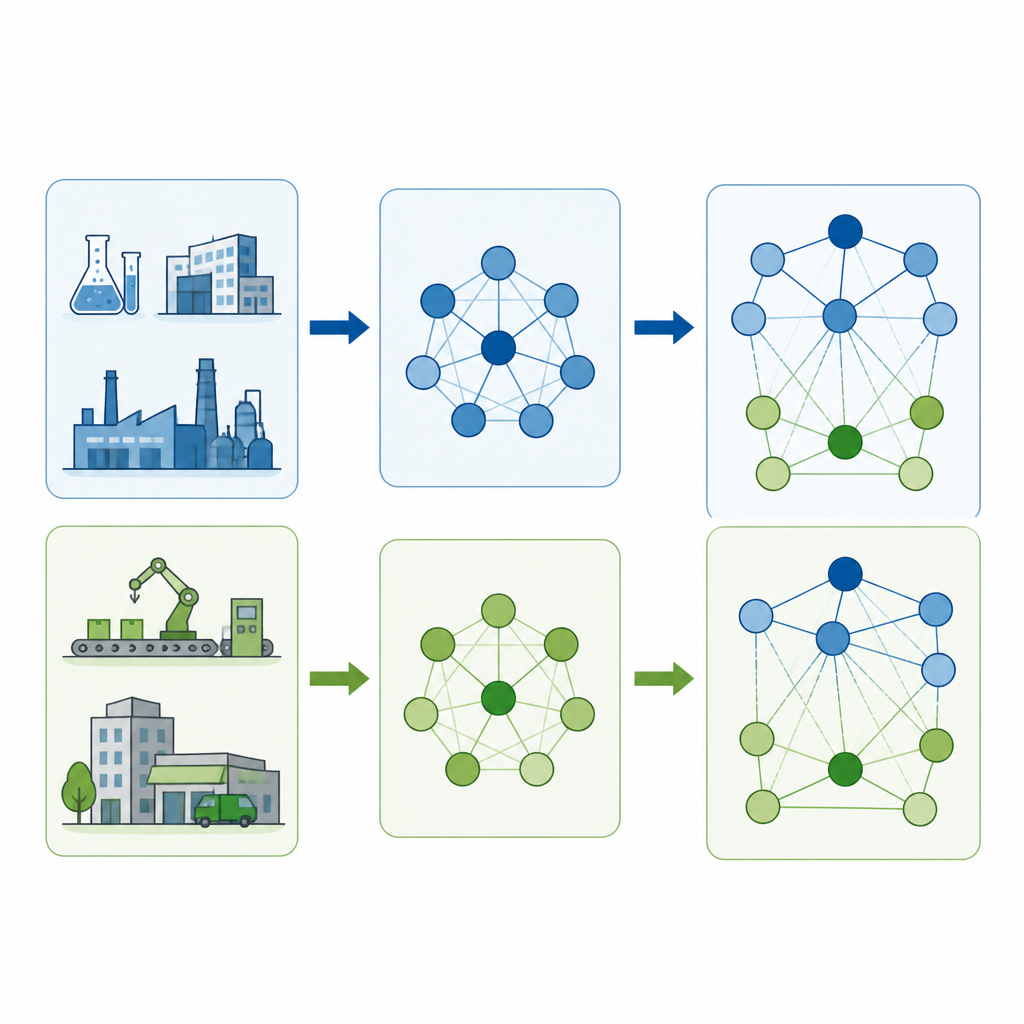
The authors conclude that how countries choose their innovation partners along global value chains has real consequences for who moves up or stays stuck. Centralized collaboration can help leading countries and core sectors pool resources and keep an edge, but it can also foster technological monopolies and narrow thinking. Decentralized collaboration opens doors for latecomers and spreads know how more widely, yet may be unstable and hard to absorb without strong local capabilities. For policymakers, the message is to balance these two styles, building enough openness to support shared progress while guarding against both low end traps and rigid technological clubs.
Citation: Wang, Y., Li, Q., Cao, Q. et al. The evolution of international innovation collaboration trajectories and patterns from a global value chain perspective. Humanit Soc Sci Commun 13, 725 (2026). https://doi.org/10.1057/s41599-026-07074-6
Keywords: global value chains, innovation networks, international collaboration, patent analysis, technology policy