Clear Sky Science · en
Research on the application and evaluation of Mongolian saddle culture in kumis packaging design based on AIGC
A new look at a traditional drink
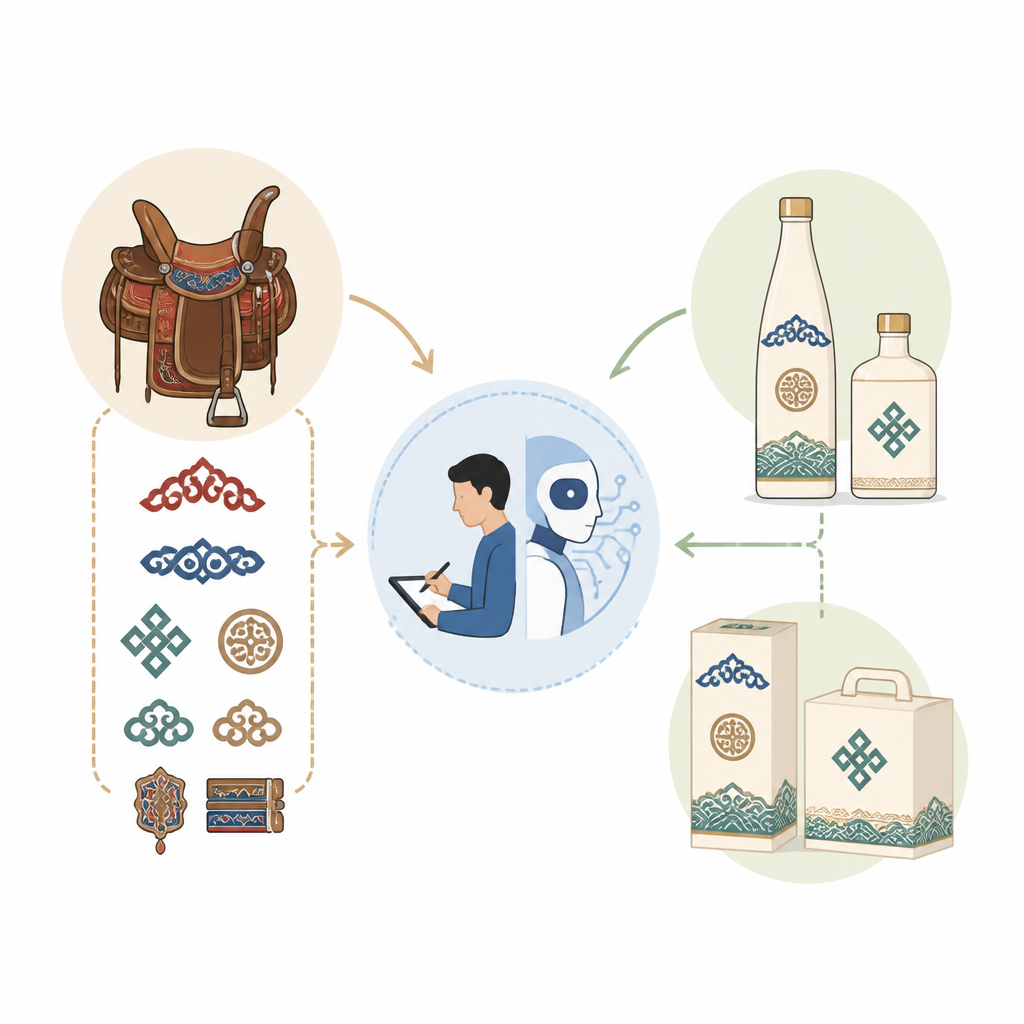
Kumis, a fermented mare’s milk long enjoyed by Mongolian herders, is quietly entering supermarket shelves far from the grasslands. Yet its bottles and boxes often look generic, giving little hint of the culture behind the drink. This study asks how designers and artificial intelligence can work together to create kumis packaging that is both practical and deeply rooted in Mongolian saddle craftsmanship, helping an endangered heritage speak to modern consumers.
Why packaging and culture matter
As kumis reaches a broader audience, its packaging must do more than simply hold liquid. The authors found that many current designs borrow a few motifs but scatter them without a clear story, making it hard for shoppers to sense what makes Mongolian culture distinctive. At the same time, traditional saddle making, recognized as national intangible cultural heritage in China, is under pressure from urbanization and fading craft traditions. The researchers saw packaging as a bridge: if designers could translate the form, colors, and patterns of Mongolian saddles into appealing bottles and boxes, kumis could stand out on the shelf while also keeping this craft visible in everyday life.
Listening to people who use and make kumis
The team first collected real-world needs for kumis packaging. They interviewed twenty people, including experienced packaging designers, kumis marketers, Mongolian cultural experts, saddle artisans, and both Mongolian and non-Mongolian consumers. Using a structured decision method, they ranked what mattered most. Strong leak proof and break resistance came first, followed by a clear sense of regional identity, attractive shape, easy to read product information, and a simple but high quality feel. Cultural elements were not an afterthought: people wanted packaging that clearly signaled “Mongolian grassland” while still being convenient and safe to use.
Turning saddles into design building blocks
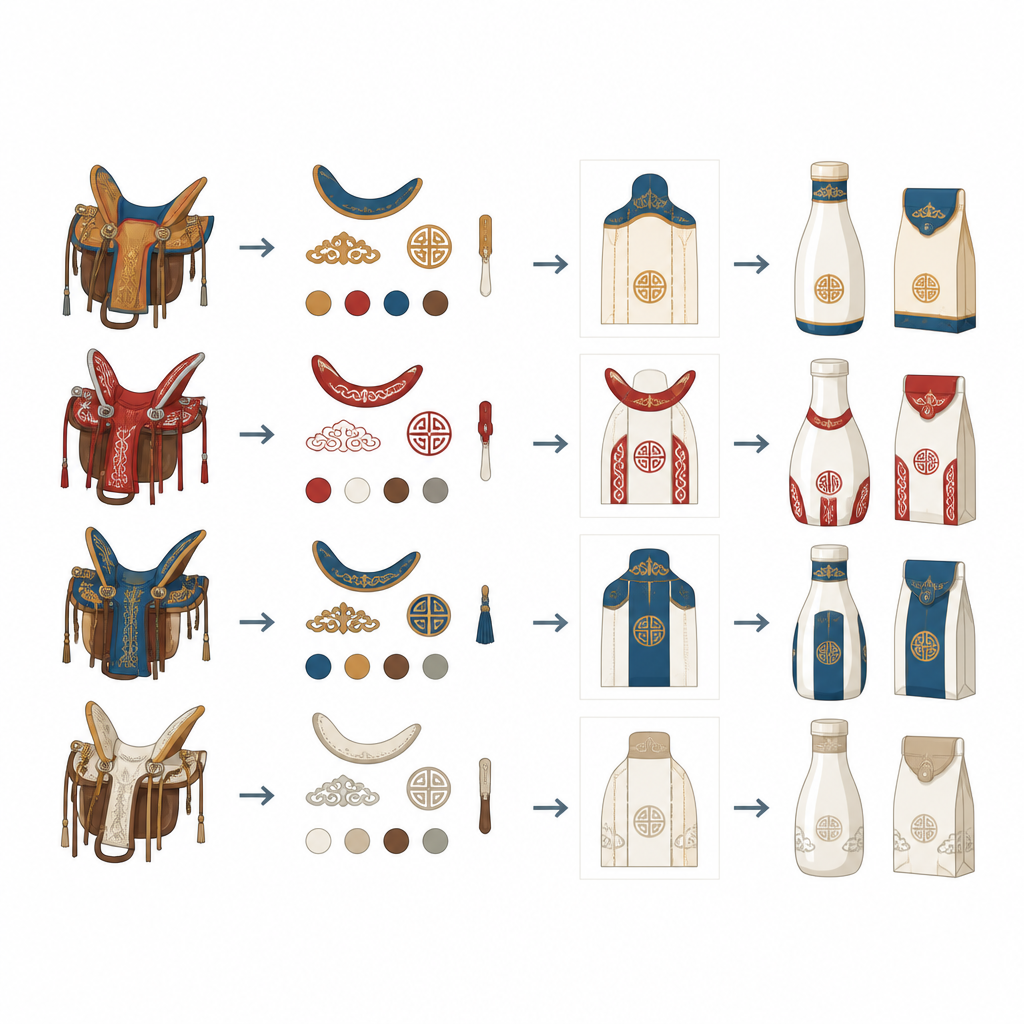
Next, the researchers treated Mongolian saddles themselves as a design library. From museums, workshops, and field visits they gathered over a hundred saddle images and selected thirty eight as representative examples. With saddle makers and culture scholars, they broke these down into four kinds of visual ingredients. First were overall forms, such as the curved front and back of the saddle. Second were color schemes based on the five auspicious hues common in Mongolian art. Third were recurring patterns like knot shapes, animal figures, and flowing plant motifs. Fourth were material cues, including carved wood, leather, felt, and metal. These ingredients were simplified into outlines, color sets, and pattern lines that a computer system could work with while still echoing the original craft.
Human and AI sketch together
Armed with this cultural toolkit and the ranked design needs, the team turned to an image generating system called Stable Diffusion. They wrote prompts that stressed the most important functions, such as sturdy and protective containers, while also asking for specific saddle inspired features in shape, color, pattern, and texture. They fed the system both text prompts and reference images of saddles. The AI produced many possible package images, which the designers then screened and refined through repeated runs. In the end, three distinct kumis packaging concepts emerged, each clearly echoing saddle forms and decoration but reimagined as contemporary bottles and gift boxes.
Checking if the designs really work
To judge the results, experts used a fuzzy scoring method that allows for nuanced opinions on looks, function, culture, and environmental impact. All three concepts were rated “satisfactory,” scoring especially well on cultural expression while still meeting expectations for strength and usability. The authors note that the AI tended to highlight striking colors and motifs more than deep symbolic meaning on its own, so human guidance and cultural expertise remained essential. Rather than replacing designers or artisans, the AI acted as a fast sketch partner that could explore many variations while people decided which ones felt true to Mongolian heritage.
What this means for tradition and design
In everyday terms, the study shows that smart tools can help give a traditional drink a face that fits both its roots and today’s market. By carefully analyzing what users need, breaking a heritage object into simple visual pieces, and guiding an AI system with that knowledge, designers created kumis packages that look protective, attractive, and unmistakably Mongolian. The work suggests a broader lesson: when used responsibly and with community input, generative AI can help keep living traditions visible and adaptable, turning familiar products on the shelf into quiet carriers of cultural memory.
Citation: Zhao, Z., Wang, X., Wang, M. et al. Research on the application and evaluation of Mongolian saddle culture in kumis packaging design based on AIGC. Humanit Soc Sci Commun 13, 649 (2026). https://doi.org/10.1057/s41599-026-06948-z
Keywords: kumis, Mongolian culture, AI design, packaging, intangible heritage