Clear Sky Science · en
Does spatial research achieve true justice? From a systematic literature review of studies on urban space and residents’ perceptions
Why the feel of a city matters
When you walk down a shady street or wait by a noisy highway, you do not just see buildings and trees; you feel safe or uneasy, relaxed or stressed. This article explores how those everyday feelings connect to deeper questions of fairness in cities. By reviewing hundreds of recent studies, the authors ask whether today’s high-tech research on urban space truly supports more just cities, or whether key ideas about justice are still missing from how we study and design urban life.
How people and places shape each other
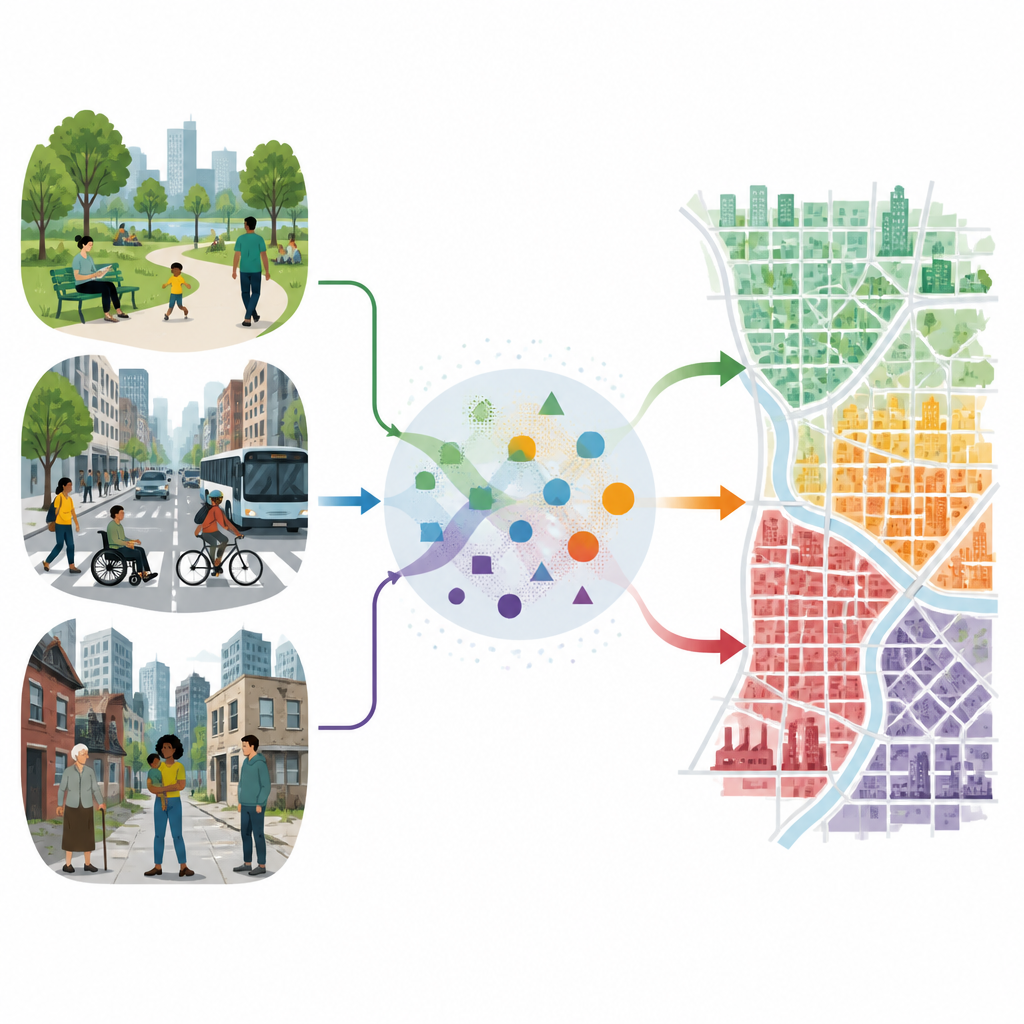
The review starts from a simple idea: people experience cities through perception. Urban spaces, such as streets, parks, and transit stops, provide the raw sights, sounds, and layouts that our senses take in. Our brains then turn this information into judgments about comfort, safety, beauty, or belonging. Those judgments influence how we behave, from choosing walking routes to deciding where to live or socialize. Over time, this loop between environment, perception, and behavior helps shape patterns of use, value, and investment across the city.
Looking at perception through many lenses
To understand this loop, the authors scanned three major research databases and selected 393 studies published between 2019 and 2024. These studies came mainly from Asia and Europe and drew on ideas from geography, psychology, sociology, and politics. The authors divided urban space into two types: the physical city that can be mapped and measured, and the “perceived environment” that exists in residents’ minds. They also grouped perception into four kinds: raw bodily sensations, psychological feelings such as satisfaction or fear, awareness of social ties, and digital “social sensing” data, such as posts, ratings, and location traces.
From clipboards to big data and artificial intelligence
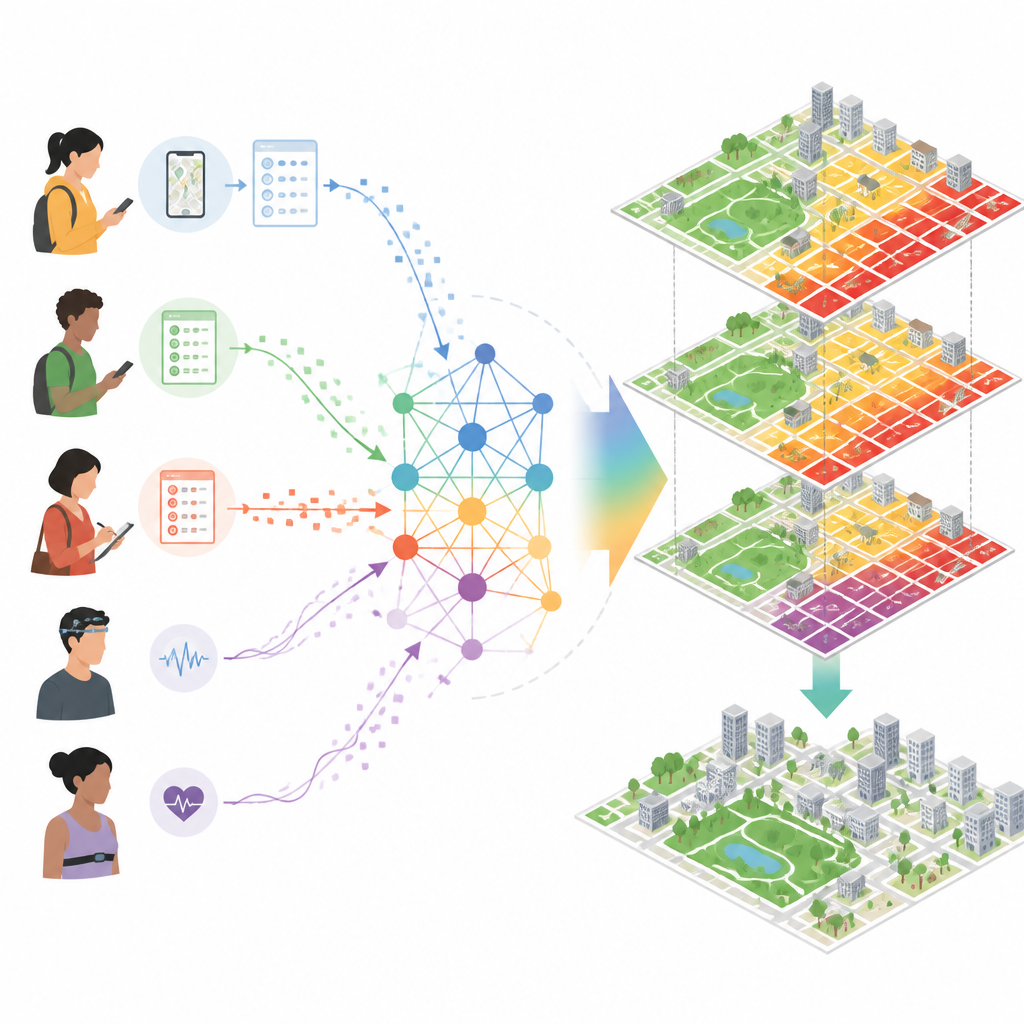
The review shows a rapid shift in research methods. Traditional studies often treated space as a backdrop for people’s opinions collected by surveys or interviews. In newer work, space becomes an active ingredient in how perception is measured and explained. Researchers now use sensors, street-view images, and social media data, feeding them into machine learning models that link what people feel to specific features such as greenery, building height, or traffic. This makes it possible to map emotions and preferences across whole cities, turning scattered impressions into colorful pictures of how different neighborhoods are experienced.
Justice, inequality, and what current research misses
The authors then ask whether this growing body of work actually tackles justice. Many studies compare experiences between groups divided by age, income, gender, or health, or show how positive or negative feelings cluster in space. Yet these differences are often treated merely as factors to be controlled, not as central questions. Much of the work focuses on whether conditions are equal, such as equal access to parks, rather than on justice, which also asks how disadvantages arise and how cities might actively support those who are worst off. Spatial methods rarely combine social group differences and geographic patterns in a way that reveals how unfair treatment is produced and maintained.
Toward cities that feel fair to live in
In conclusion, the article argues that advances in artificial intelligence and big data have transformed urban perception research but have not yet fully delivered on the promise of spatial justice. To get there, the authors call for research that joins social and spatial inequalities in a single framework, uses technology in partnership with real residents, and guides planners and policy makers before designs are built, not only after problems appear. If cities can learn to treat residents’ perceptions as vital evidence, rather than background noise, they will be better equipped to make streets, parks, and neighborhoods that not only function well on paper but also feel fair and welcoming in everyday life.
Citation: Mi, X., Yu, F., He, Y. et al. Does spatial research achieve true justice? From a systematic literature review of studies on urban space and residents’ perceptions. Humanit Soc Sci Commun 13, 638 (2026). https://doi.org/10.1057/s41599-026-06871-3
Keywords: spatial justice, urban perception, city planning, artificial intelligence, social inequality