Clear Sky Science · en
Excessive white male privilege biases the measurement of intersectional wage discrimination
Why pay gaps matter to everyone
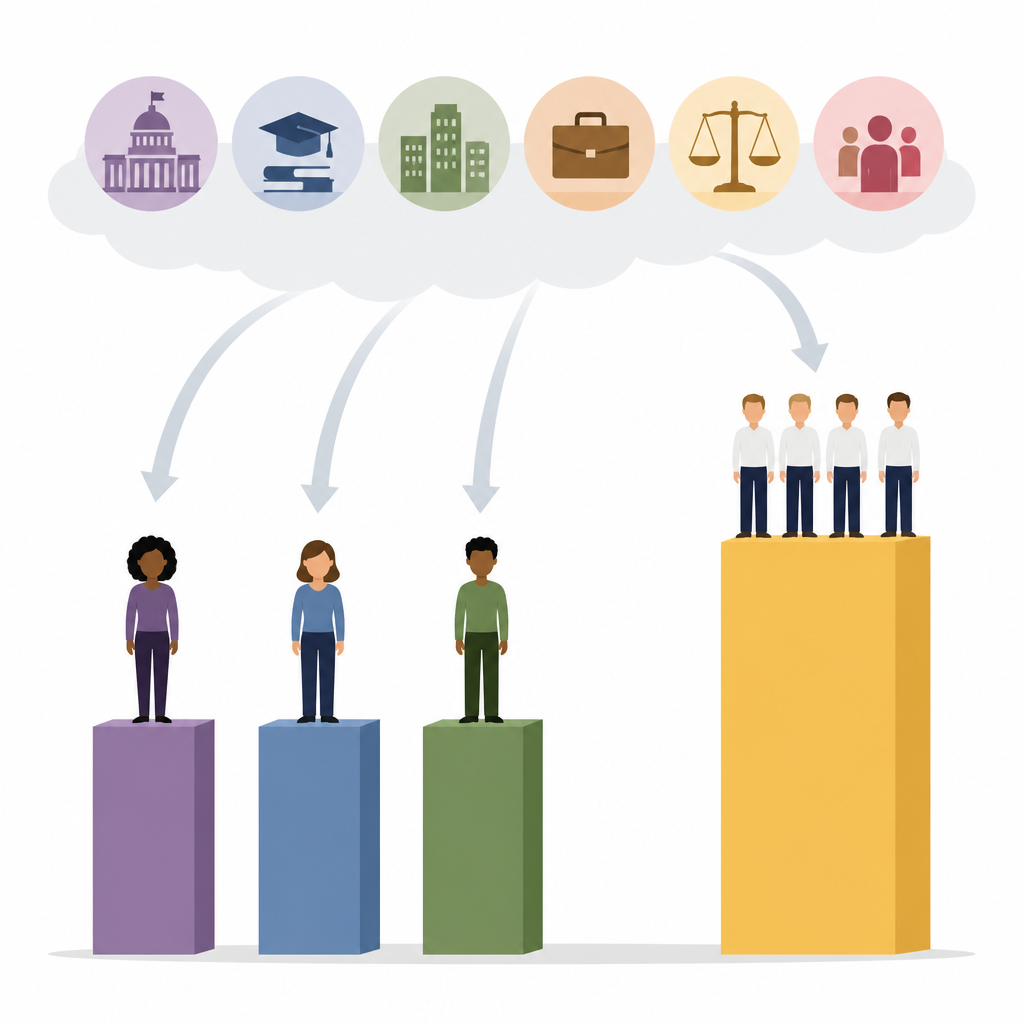
Who earns how much money, and why, affects not just individual lives but whole societies. This article looks at pay gaps between groups in the United States, asking a pointed question: are women of color mainly hurt by extra discrimination, or are white men mainly helped by extra advantages? The answer changes how we understand fairness at work and how we might design policies that most people would support.
Rethinking how we see overlapping identities
For years, many studies have examined "intersectional" discrimination, the idea that people who belong to more than one marginalized group, such as Black women, face special hurdles that cannot be explained by gender or race alone. These studies often compare everyone’s wages to white men’s wages, and then split the overall gap into separate gender and race parts. The remaining part is treated as an extra penalty hitting multiply marginalized workers. The authors show that this way of measuring is fragile because it quietly assumes that white men are just a neutral yardstick, not a group that might receive its own special boost.
Separating penalties from extra advantages
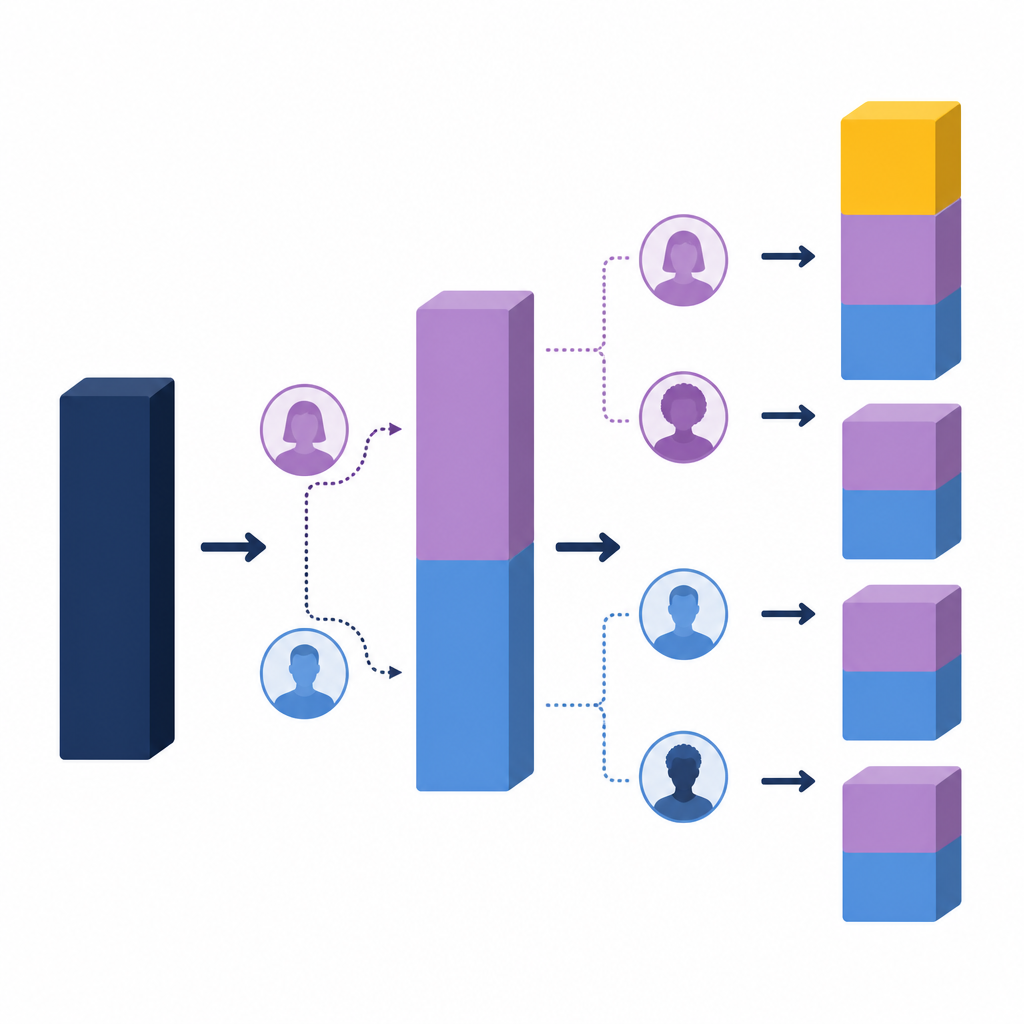
The researchers propose a clearer way to break down wage differences using simple tree diagrams. In their setup, any gap between groups can be written as the sum of three pieces: a gender effect, a race effect, and an interaction effect. Crucially, this interaction can be read in two different ways. One reading treats it as an extra penalty on multiply disadvantaged groups, like Black women. The other treats it as extra privilege for those who are advantaged on several dimensions at once, in this case white men. The authors show mathematically that these two readings are tightly linked: what looks like a penalty for Black women, under one convention, can show up as excess privilege for white men under another.
What the data say about wages
Using long-run US wage data, and also drawing on previous work where wages were adjusted for education, age, and occupation, the authors apply their new decomposition. They consistently find strong evidence that white men enjoy an income boost beyond what can be explained by the usual gender and race gaps, but little evidence for an additional intersectional penalty on Black women’s wages once this extra boost is taken into account. Over time, this white male premium has fallen slightly, but the trend is so slow that, if it continued unchanged, it would take well over a century for the excess privilege to disappear on its own.
Using privilege as a tax base
The article then asks what could be done with this insight in terms of public policy. If we treat the extra earnings that white men receive as a form of privilege, it becomes a natural tax base. The authors show that, in theory, taxing only this excess portion and redistributing it to everyone else would leave all non–white male groups better off, creating room for a broad political coalition. They explore three simple rules: giving every non–white man the same cash amount, raising all their incomes by the same percentage, or following a “poorest first” approach that lifts Black women up to the other groups before sharing any remaining gains. In all three cases, inequality falls without reducing the income of any group except white men.
What this means for fairness debates
In plain terms, the study suggests that much of what looks like extra punishment of women of color in wage data may instead be extra reward for white men. This does not mean that intersectional discrimination does not exist in hiring, in unpaid care work, or in other areas of life. It does mean that, when we talk about wage gaps, we should pay close attention to how advantages at the top are measured and labeled. By naming and quantifying white male privilege directly, the authors offer a tool that can help researchers, activists, and policymakers design fairer pay systems and build coalitions to support change.
Citation: Schulz, J., Agoha, C.E., Gebhard, A. et al. Excessive white male privilege biases the measurement of intersectional wage discrimination. Humanit Soc Sci Commun 13, 631 (2026). https://doi.org/10.1057/s41599-026-06822-y
Keywords: wage inequality, intersectionality, white male privilege, gender pay gap, racial pay gap