Clear Sky Science · en
Factors influencing accessibility in judicial institutions for people with disabilities: a study of the Serbian judicial system
Why court access matters to everyday life
When people cannot get into a courthouse, understand what is happening there, or communicate with judges and staff, their basic rights are at risk. For people with disabilities, these barriers can turn the promise of equal justice into an empty phrase. This paper looks closely at how well judicial institutions in Serbia are meeting the needs of people with disabilities, and which practical steps most strongly influence whether courts actually become more accessible in real life.
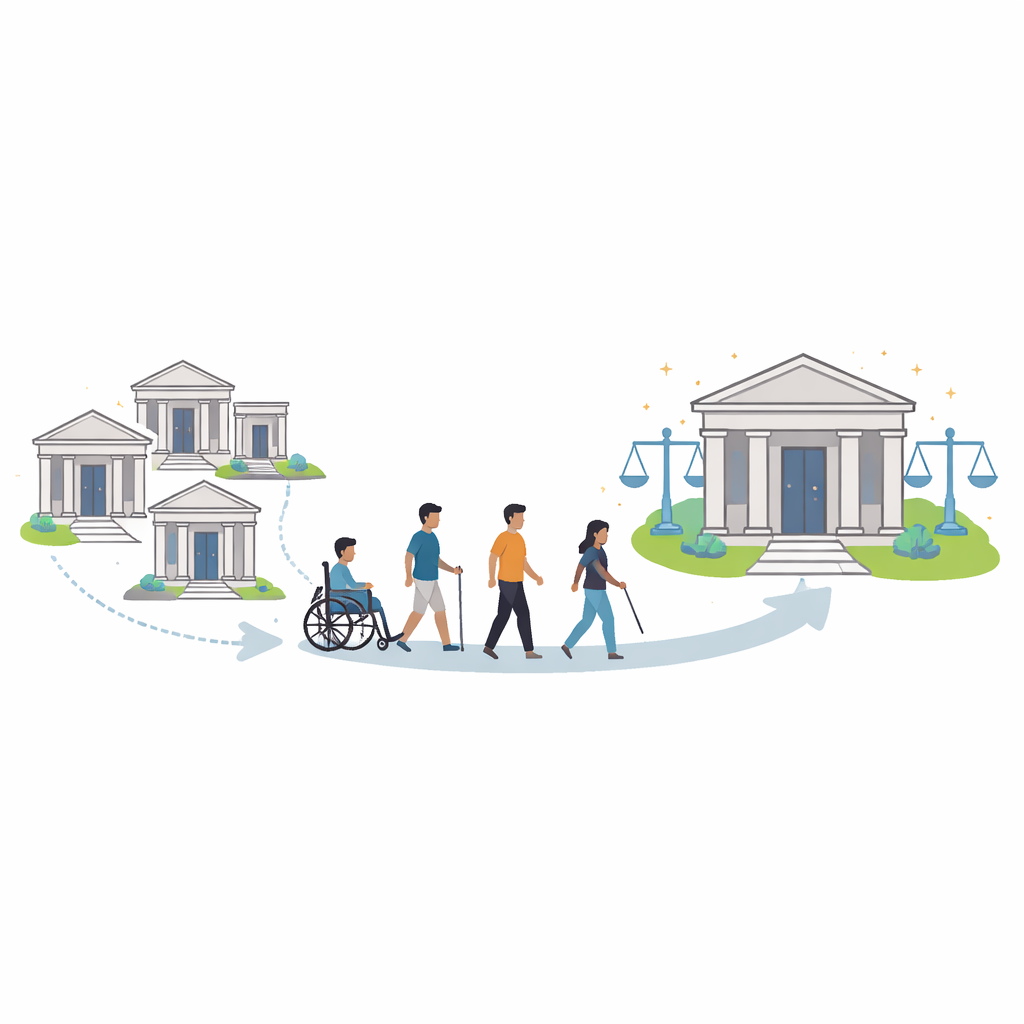
Taking a nationwide look at the courts
The researchers surveyed 233 judicial institutions across Serbia, including various levels of courts and public prosecution offices. These are the bodies that people most often turn to when they need to defend their rights, settle disputes, or seek protection. The survey asked simple but revealing questions: Are services adapted for people with disabilities? Are staff familiar with rules on making buildings and services accessible? Have any specific changes, such as ramps or communication tools, been introduced? And have people with disabilities themselves asked for adaptations?
What people with disabilities currently face
The answers paint a worrying picture. Only about one in six institutions said their services were fully adapted for people with disabilities, while more than a quarter admitted they had not adapted them at all. In most court types, at least three out of four institutions reported that services were either not adapted or only partly adapted. Physical spaces showed uneven progress: entrances were somewhat more accessible, but hallways, courtrooms, service counters and related areas lagged behind. Very few institutions had a clear plan or strategy to improve accessibility, and only a small minority had communication equipment, trained staff, or employees with disabilities themselves.
Knowing the rules makes change more likely
A central insight of the study is that familiarity with accessibility standards strongly increases the chances that courts will adapt their services. The authors focused on standards that describe how public buildings should be arranged so people with disabilities can use them. Using statistical models, they showed that institutions already implementing concrete adaptations were several times more likely to offer accessible services. Likewise, when staff were familiar with public premises standards, the probability that services would be adapted rose significantly. A second analysis found that both knowing these standards and receiving specific requests from people with disabilities made it much more likely that institutions would actually implement changes such as ramps, adjusted procedures, or communication support.
How requests and concrete steps reinforce each other
The study’s path analysis highlights a chain of influence. Familiarity with accessibility standards directly supports two things: putting adaptations in place and shaping services that work better for people with disabilities. Requests from users also matter—once an institution receives a concrete request, it is more likely to start adapting its premises and services. Yet the survey shows that such requests are still relatively rare, and that many institutions remain poorly informed. This creates a cycle where limited awareness and few requests slow progress, while the absence of visible adaptations may discourage people with disabilities from approaching the courts in the first place.

Steps toward fairer access to justice
The authors conclude that, despite some isolated improvements, accessibility in Serbia’s judicial institutions remains far from sufficient and reflects deeper structural obstacles. Their findings point to clear priorities: improve training so that court staff understand accessibility standards; invest in modifying buildings and services; strengthen cooperation with organizations of people with disabilities; and encourage people to request adaptations when they are needed. By turning legal guarantees into practical measures—ramps, clear procedures, flexible testimony options, and accessible communication—judicial institutions can move closer to delivering genuine equal access to justice for all.
Citation: Masliković, D., Tomić, B.M. & Kadijevich, D.M. Factors influencing accessibility in judicial institutions for people with disabilities: a study of the Serbian judicial system. Humanit Soc Sci Commun 13, 477 (2026). https://doi.org/10.1057/s41599-026-06762-7
Keywords: access to justice, disability rights, court accessibility, Serbian judicial system, inclusive public services