Clear Sky Science · en
Soil degradation in Europe is projected to accelerate under changing land use and climate
Why the Ground Beneath Our Feet Matters
Europe’s soils quietly support our food, water, and climate, yet they are under increasing strain. This study asks a simple but pressing question: as the climate warms and land use shifts, will European soils become more or less able to do their job? By combining future climate projections with maps of how farms, forests, and grasslands may change, the authors estimate where soils are most at risk of decline—and where smart land management could actually help them recover.
Taking the Pulse of Europe’s Soils
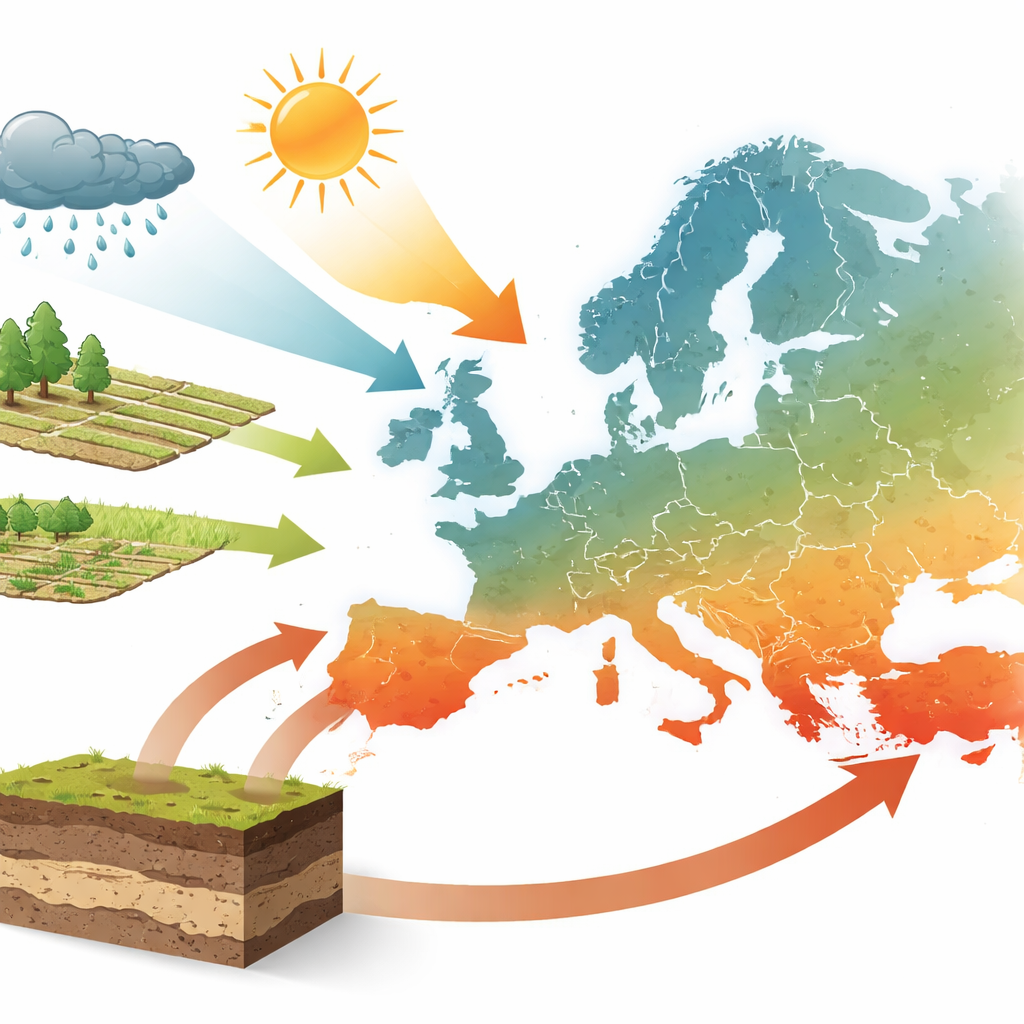
Instead of tracking a single problem like erosion or pollution, the researchers built a combined score they call a soil degradation proxy. It blends four key signals: how fast soil is being washed away, how salty it is, how acidic or alkaline it is, and how much organic carbon it holds—a rough measure of its richness and life. Using thousands of soil samples collected across the European Union and the United Kingdom, they trained a machine-learning model to learn how this score depends on climate, land cover, and basic soil traits such as texture and slope.
What Today’s Map Already Shows
The current picture is far from uniform. Cooler northern countries like Estonia and Finland tend to have lower vulnerability scores, suggesting more resilient soils. In contrast, many parts of southern Europe, including Spain, Italy, and Cyprus, show higher values linked to stronger erosion, drier conditions, and long histories of intensive land use. A broad pattern emerges from northeast to southwest, shaped both by natural differences in climate and terrain and by human pressures such as farming, fertilizer use, and deforestation over centuries.
Looking Ahead to a Warmer Century
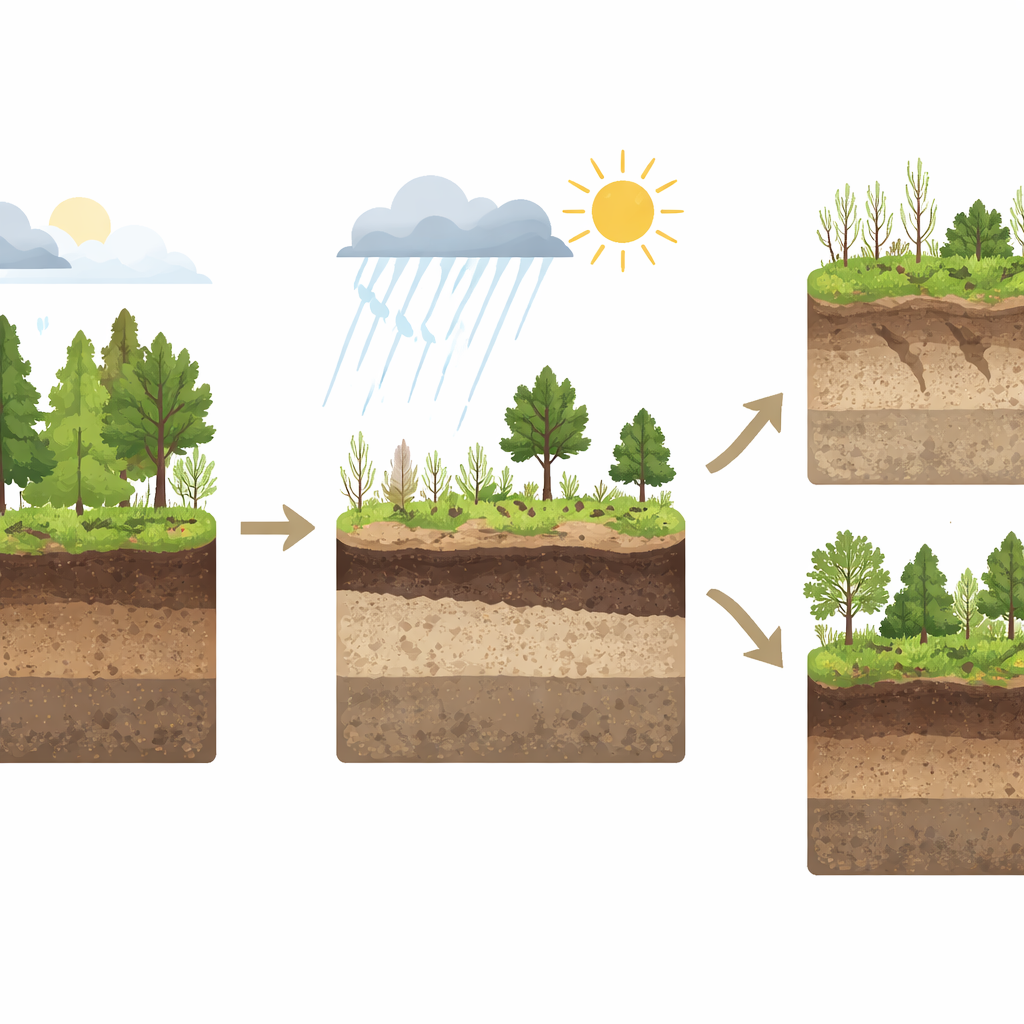
To peer into the future, the team used climate simulations from 18 global models under two greenhouse-gas pathways: a moderate one and a high-emissions one. They also included detailed scenarios of how cropland, forests, and natural vegetation might expand or contract. By late century, they project that roughly six in ten monitored sites could become more vulnerable under the high-emissions path. Cold forest regions in northern Europe stand out as emerging hotspots, where heavier downpours and warmer temperatures are expected to speed up erosion and break down organic matter, thinning the dark, carbon-rich topsoil. At the same time, some regions in southern and central Europe may see small improvements where croplands are projected to shrink and be replaced by shrubs and grasslands, giving soils a chance to rebuild carbon and move toward more balanced acidity levels.
What Drives Change: Climate, Land Use, or Both?
By rerunning their model while freezing either climate or land use in place, the authors teased apart which factor dominates in different regions. They find that most increases in vulnerability, especially in forests and colder climates, are driven mainly by climate change—warmer air and more intense rainfall events. In contrast, many of the projected decreases are tied to land-use shifts, such as cropland abandonment and forest or shrub regrowth, which can shield soil from erosion and gradually rebuild its organic content. Even under strong warming, these beneficial land-use changes remain visible in the results, suggesting that local choices on how land is managed can still make a real difference.
Limits, Uncertainties, and What We Can Do
The study does not claim to predict exact rates of erosion or carbon loss, and it cannot fully separate natural soil differences from human-caused damage. It relies on one type of machine-learning model and one main dataset for future land use, so the details of the maps could shift as new information becomes available. Still, the broad pattern is clear: climate change alone tends to push soils toward greater stress, especially in the north, while smarter land management can ease pressure in some regions. For a layperson, the takeaway is straightforward: if we want secure harvests, cleaner water, and healthier ecosystems in Europe, we cannot treat soil as an afterthought. Protecting and restoring it—through measures such as reforestation, reduced tillage, and careful fertilizer use—will be essential to keep the ground beneath our feet functioning in a warmer world.
Citation: Afshar, M.H., Hassani, A., Borrelli, P. et al. Soil degradation in Europe is projected to accelerate under changing land use and climate. Commun. Sustain. 1, 56 (2026). https://doi.org/10.1038/s44458-026-00064-4
Keywords: soil degradation, climate change, land use, Europe, sustainable agriculture