Clear Sky Science · en
An electrically controlled bistable oscillator based on liquid crystal elastomer
Machines That Move Themselves
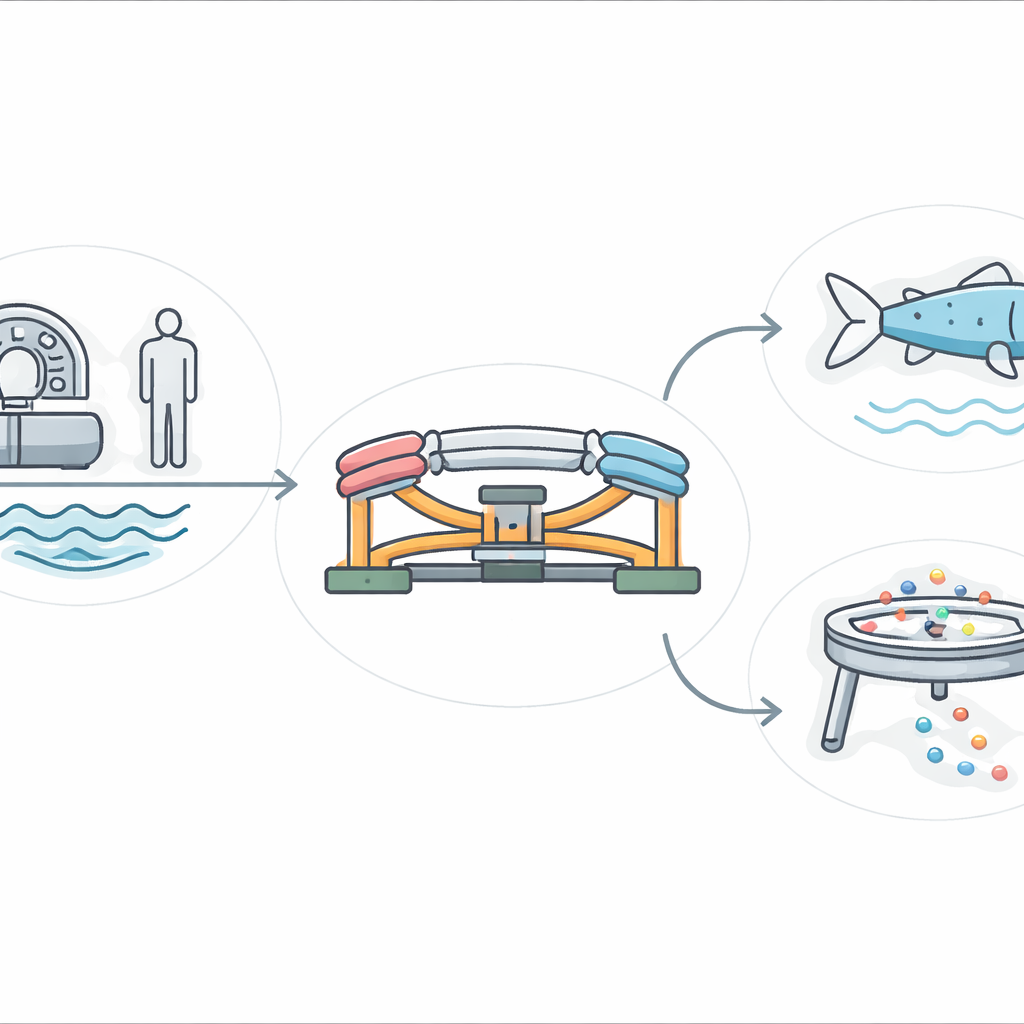
Many of the machines that keep our factories, hospitals, and laboratories running rely on electric motors and electronics to move back and forth in a steady rhythm. But in places filled with strong magnetic fields, deep underwater, or even inside the body, those same electronics can become bulky, unreliable, or unsafe. This study introduces a new kind of self-beating mechanical "heart" made from soft, rubbery materials that can oscillate on its own using only a simple battery, opening doors to smarter, more resilient devices that work where conventional motors struggle.
A Soft Engine With Two Resting Positions
At the core of the work is a small mechanical device called a bistable oscillator, which has two preferred resting positions instead of one. The authors build this device around a central rocking bar braced by two pre-curved plastic beams, like a tiny seesaw held between flexible springs. On each side of the bar they attach a strip of a special material known as a liquid crystal elastomer, which behaves a bit like an artificial muscle: when electrically heated, it contracts; when it cools, it relaxes and lengthens. A sliding contact underneath acts as a purely mechanical switch that decides which side is powered at any moment. Together, these pieces form a closed loop where motion and heating continually drive one another without any digital controller.
How Soft Muscles Make the System Click
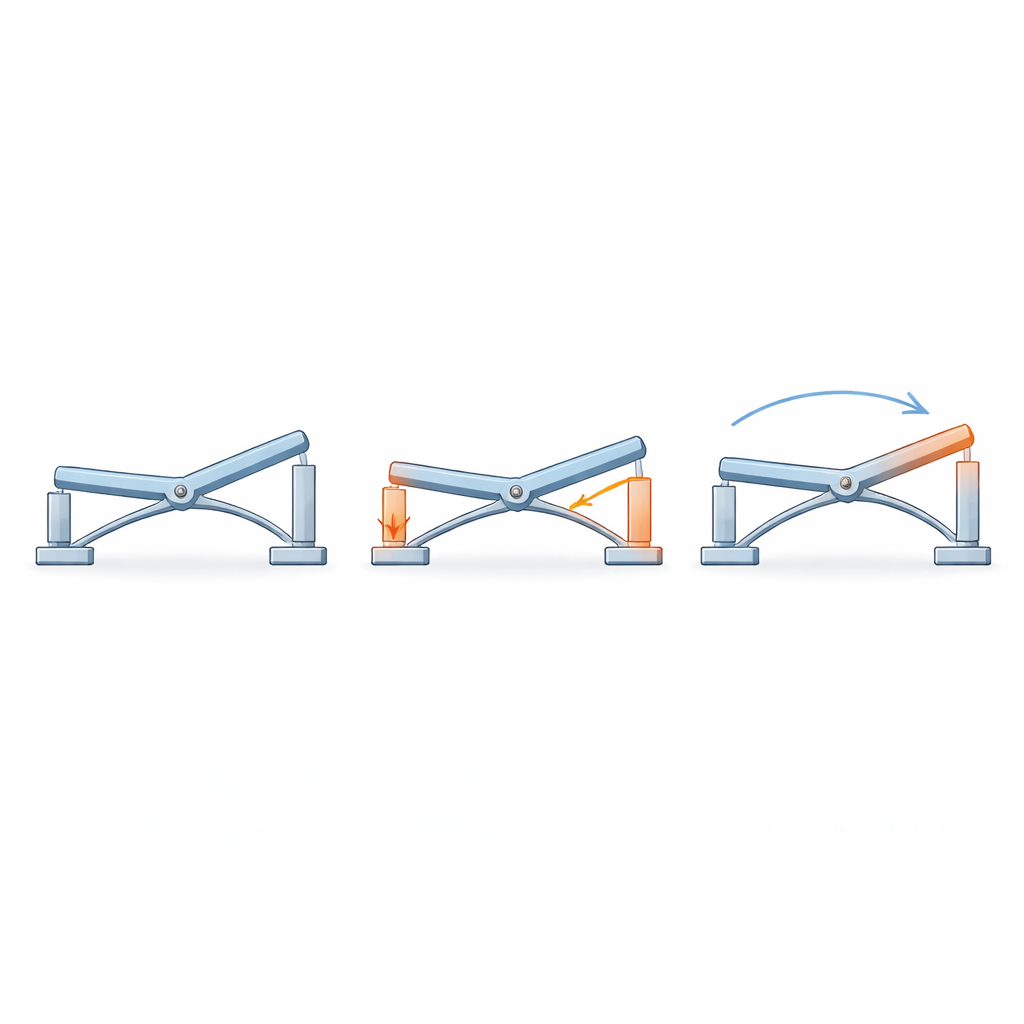
When one liquid crystal strip is heated by a low, constant voltage, it slowly contracts and pulls the rocker toward its side. As the rocker tilts, the pre-curved beams bend and store elastic energy, much like winding a spring. Once a critical angle is reached, the beams suddenly snap through to the opposite shape, releasing their stored energy in a quick, powerful motion that flips the rocker to its other stable position. This rapid change also shifts the sliding contact so that power is cut from the first strip and delivered to the opposite one. The process then repeats in reverse: the newly powered strip heats and contracts, builds up energy in the beams, and triggers another snap. In this way, a steady direct-current input is automatically turned into back-and-forth motion and a pulsed electrical signal, all governed by the device’s own mechanics.
Tuning Strength, Speed, and Endurance
The researchers carefully tested how the artificial muscles and supporting structure behave. By varying the driving voltage, they showed that the liquid crystal strips can deliver large, reversible contractions and forces, enough to reliably trigger snapping without damaging the beams. Computer simulations helped them select the right length, thickness, and stiffness of the curved plastic beams so that the device would have two stable states with a well-defined energy barrier between them. Experiments revealed that the oscillator could maintain its swing angle and period over many cycles with only minor changes, demonstrating good durability. They also mapped out how voltage and film thickness control heating and cooling times: higher voltage and thicker films shorten the heating phase, while cooling remains comparatively slow, ultimately limiting the maximum frequency. This understanding provides design rules for dialing in how fast and how strongly the oscillator moves.
From Robotic Fish to Self-Sorting Machines
To show what this soft engine can do, the team built a small robotic fish with the oscillator driving a flexible tail. A tiny battery inside the 3D-printed body supplied constant power, while the snap-through mechanism turned slow heating into sharp tail flicks in water. Video analysis showed that the fish advanced in a stepwise fashion: long pauses as energy accumulated, followed by sudden bursts of motion when the tail snapped. Next, the researchers linked two oscillators so that they took turns snapping in mirror-image fashion, purely through a clever arrangement of mechanical switches and wires. Finally, they assembled three oscillators beneath a perforated disc holding mixed balls of two sizes. The phase-shifted vibrations shepherded smaller balls through the holes while leaving larger ones behind, achieving automatic size-based sorting with no sensors or microchips.
Why This Matters for Future Smart Devices
This work shows that it is possible to build compact, low-voltage, and highly cooperative mechanical systems that think with their structure instead of with electronics. By combining soft artificial muscles with cleverly shaped beams and simple sliding contacts, the authors create an oscillator that stores and releases energy efficiently, resists electromagnetic interference, and can be chained together for complex tasks like swimming and sorting. In plain terms, they demonstrate a new way to make machines that move and coordinate themselves, using only their own geometry and material properties. Such mechanically intelligent systems could eventually power soft robots, medical tools, and industrial devices that must operate safely and reliably in places where traditional motors and control circuits cannot.
Citation: Liu, H., Yan, B., Zhou, R. et al. An electrically controlled bistable oscillator based on liquid crystal elastomer. npj Soft Matter 2, 10 (2026). https://doi.org/10.1038/s44431-026-00026-9
Keywords: soft robotics, artificial muscles, mechanical oscillators, liquid crystal elastomers, electronics-free control