Clear Sky Science · en
Peak carbon sequestration rate reached on the Loess Plateau plantations
Why aging forests in a dry land matter
China’s Loess Plateau is famous for its huge tree‑planting campaigns that have helped hold soil in place and pull carbon dioxide from the air. But most of those man‑made forests are now middle‑aged or old, and the region is getting drier in places. This study asks a simple but crucial question for climate policy: when do these plantations take in carbon fastest, and how long can they keep doing so as water becomes scarce?
Where the planted forests are today
Using a mix of satellite images, climate records, and drones, the researchers created a detailed map of forests across the Loess Plateau. They found that plantations now make up nearly 60 percent of the forest area, and most of those trees are deciduous species that shed their leaves each year. The age picture, however, is lopsided. More than 70 percent of plantation area is older than 25 years, and only a small share counts as young or middle‑aged. That means the region’s tree cover reflects a big pulse of planting that began in the late 1970s and 1980s and has slowed in recent years.
How much carbon these forests are taking up
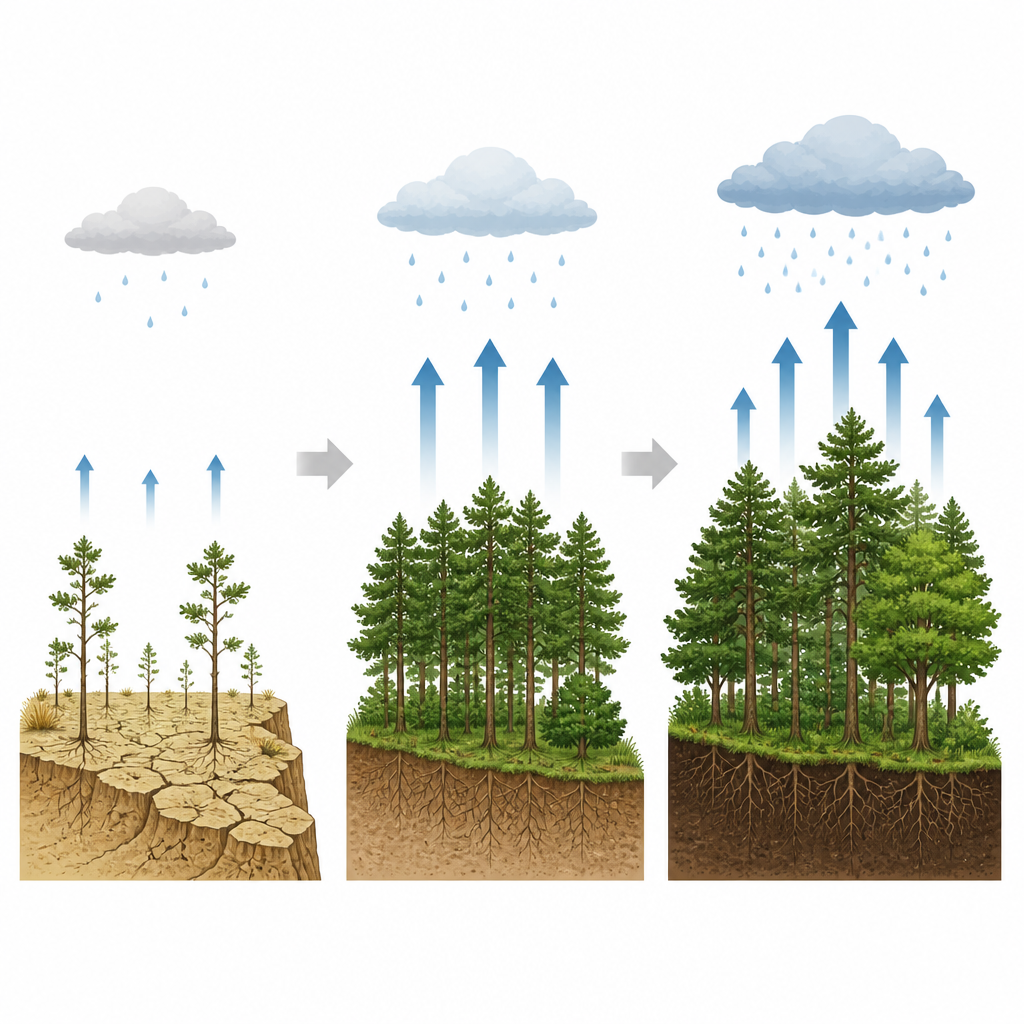
The team then estimated how much carbon the plantations currently absorb, using a model that combines plant growth with carbon released from soils. They found strong contrasts across the landscape. Forests in the wetter southeast and south‑central parts of the Plateau show very high net carbon uptake, while the drier northwest contributes much less. Deciduous plantations generally pull in more carbon than evergreen ones, especially in areas with higher rainfall. Where yearly rain stays below about 400 millimeters, carbon uptake is modest and fairly steady; once rainfall passes that level, the carbon gain rises sharply, particularly for deciduous stands.
When forests reach their carbon peak
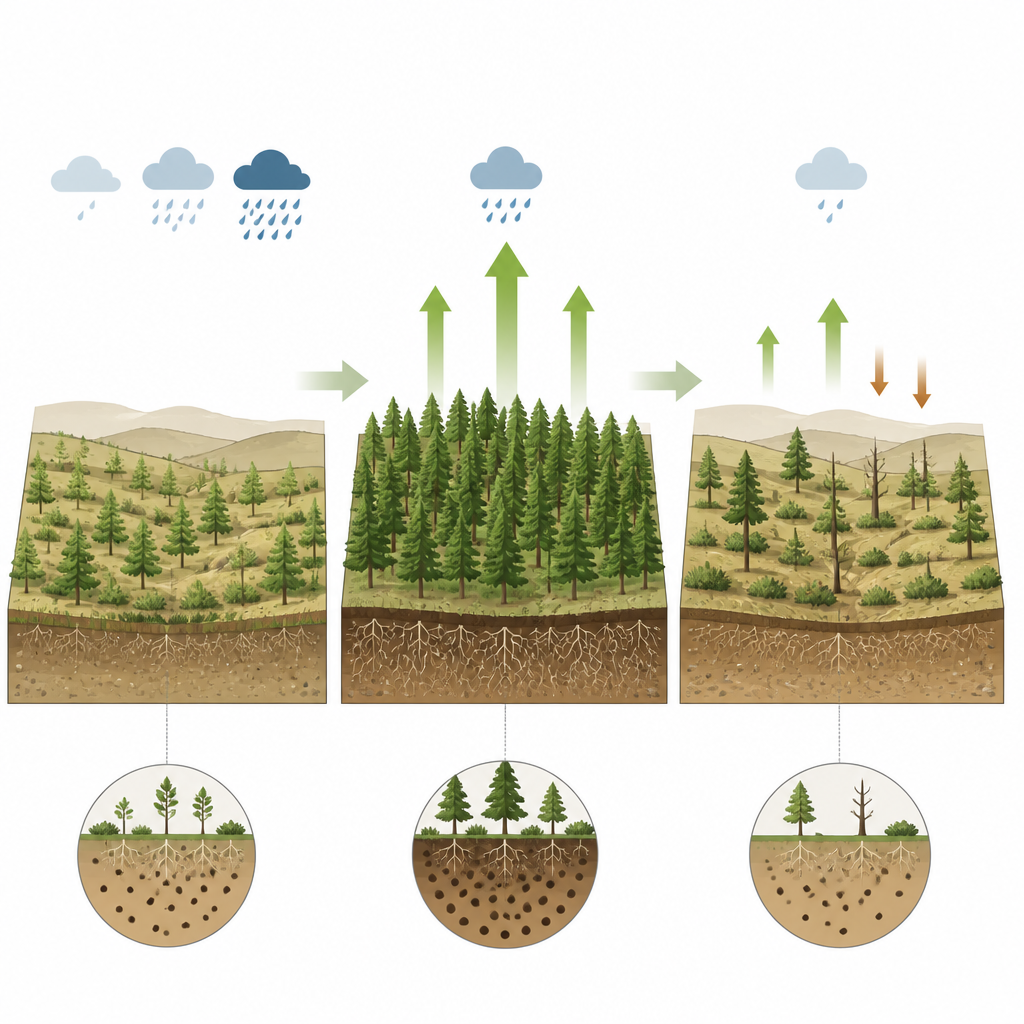
Forests do not store carbon at the same pace throughout their lives. By tracking stand age against net carbon uptake, the researchers found a clear rise‑and‑fall pattern. Young plantations absorb carbon rapidly as they grow, then reach a peak, and later level off or decline as they age. In the driest parts of the Plateau, evergreen plantations hit their peak after about 13 years and deciduous stands after about 18 years. In wetter zones, the peak comes later, often after 20 years or more, and at a higher rate of carbon uptake. On average, many plantations across the Plateau seem to pass their most active carbon‑absorbing phase at around 20 years of age, although the exact timing depends on rainfall and tree type.
What the future may look like without new plans
Because so many plantations are already mature or older, the study’s forward look to 2060 is sobering. If current management continues, most plantation forests on the Plateau will have moved well past their carbon peak within the next few years. The models suggest that by 2060 the region’s plantations could lose the equivalent of about 4.8 teragrams of carbon in annual sink strength compared with today. Deciduous plantations, which now provide much of the carbon benefit, are projected to show the sharpest declines, while evergreens lose less but also store less carbon overall.
Rethinking tree planting for a changing climate
The authors conclude that simply planting large areas of trees once is not enough to sustain a strong carbon sink in drylands like the Loess Plateau. Long‑term success will depend on renewing the age structure of forests, matching species to local rainfall, easing pressure on soil water, and increasing tree diversity. In practice, that could mean gradually replacing aging water‑hungry plantations with better‑adapted native species, and timing new planting so that not all forests age together. The framework used here, which links forest age, rainfall, and carbon uptake, could help other dry regions around the world design more durable tree‑planting strategies that support climate goals.
Citation: Jia, X., Ge, W., Han, J. et al. Peak carbon sequestration rate reached on the Loess Plateau plantations. Commun Earth Environ 7, 423 (2026). https://doi.org/10.1038/s43247-026-03419-w
Keywords: Loess Plateau, plantation forests, carbon sequestration, dryland afforestation, forest age