Clear Sky Science · en
Urban areas in the United States experience substantial wildfire impacts
Why City Dwellers Should Care About Wildfires
Wildfires are often pictured as remote blazes racing through forests and mountains, far from major cities. This study shows that image is only half true. By combining detailed fire reports with maps of where people live in the United States, the authors reveal that many of the most damaging and deadly wildfires actually strike in and around urban areas. For anyone living in a town or city, this work reframes wildfire as a threat not just to distant landscapes, but to neighborhoods, homes, and lives.
Fires Along a Rural-to-City Spectrum
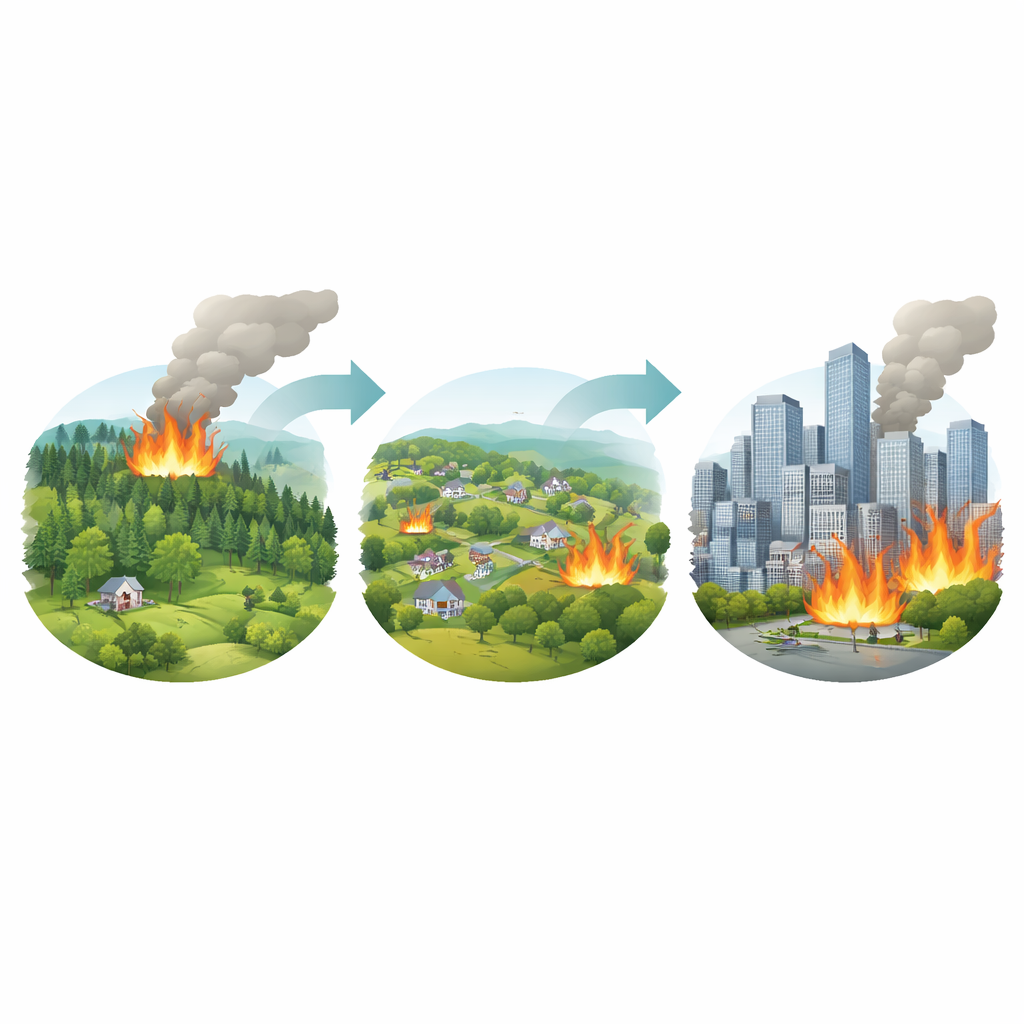
Instead of treating places as simply “rural” or “urban,” the researchers used a four-step spectrum: rural, small town, micropolitan (small cities and large towns), and metropolitan (big urban areas). They linked every significant wildfire reported between 1999 and 2020 to the census tracts it burned, and then to where those tracts sit on this spectrum. This allowed them to compare not just how often fires occur, but how much land they burn, how many buildings they destroy, and how often they kill people in different kinds of communities.
Land Burned Versus Homes Lost
The study finds a striking split between where land burns and where people and buildings are harmed. Rural areas see the largest burned area overall—nearly two and a half times more land burned in rural tracts than in metropolitan ones. These fires often cover huge swaths of grassland or forest, especially in the Northwest and Southwest, where dry climates, flammable vegetation, and rugged terrain help large fires spread. By contrast, most of the devastation to homes and lives happens in more urbanized places. Nearly three quarters of all buildings destroyed by wildfire between 1999 and 2020 were in metropolitan or micropolitan tracts. Fatal fires were also far more likely to occur in big city regions than in sparsely populated rural areas.
Regional Hotspots of Destruction
When the authors broke the country into climate regions, the pattern became even clearer. Rural parts of the Northwest stood out for enormous burned areas, reflecting large fires in forests and rangelands. Yet the biggest toll on buildings and neighborhoods fell on the metropolitan and micropolitan Southwest, which includes California and nearby states. There, both the total number of damaged tracts and the rate of buildings destroyed per unit of land were much higher than anywhere else. In the Southeast, many fires damaged at least one structure, but extreme, high-loss events were less concentrated than in the Southwest, where a relatively small number of megafires produced extraordinary destruction.
Hidden Urban Fires in the Data
A key message of the paper is that past research has largely missed these urban and small-area fires. Widely used wildfire datasets either focus on modeled risk in vegetation, which downplays buildings as fuel, or include only large burned areas, which automatically filters out many fires near populated zones that are quickly suppressed. By using the ICS-209-PLUS database—an incident-report system that tracks any wildfire significant enough to require organized response—the authors capture many smaller but societally important events. They show that more than half of all destructive wildfires, meaning fires that destroyed at least one building, were too small in acreage to appear in a major satellite-based dataset that many demographic studies rely on.
Wildfires Are Not Just a Rural Problem
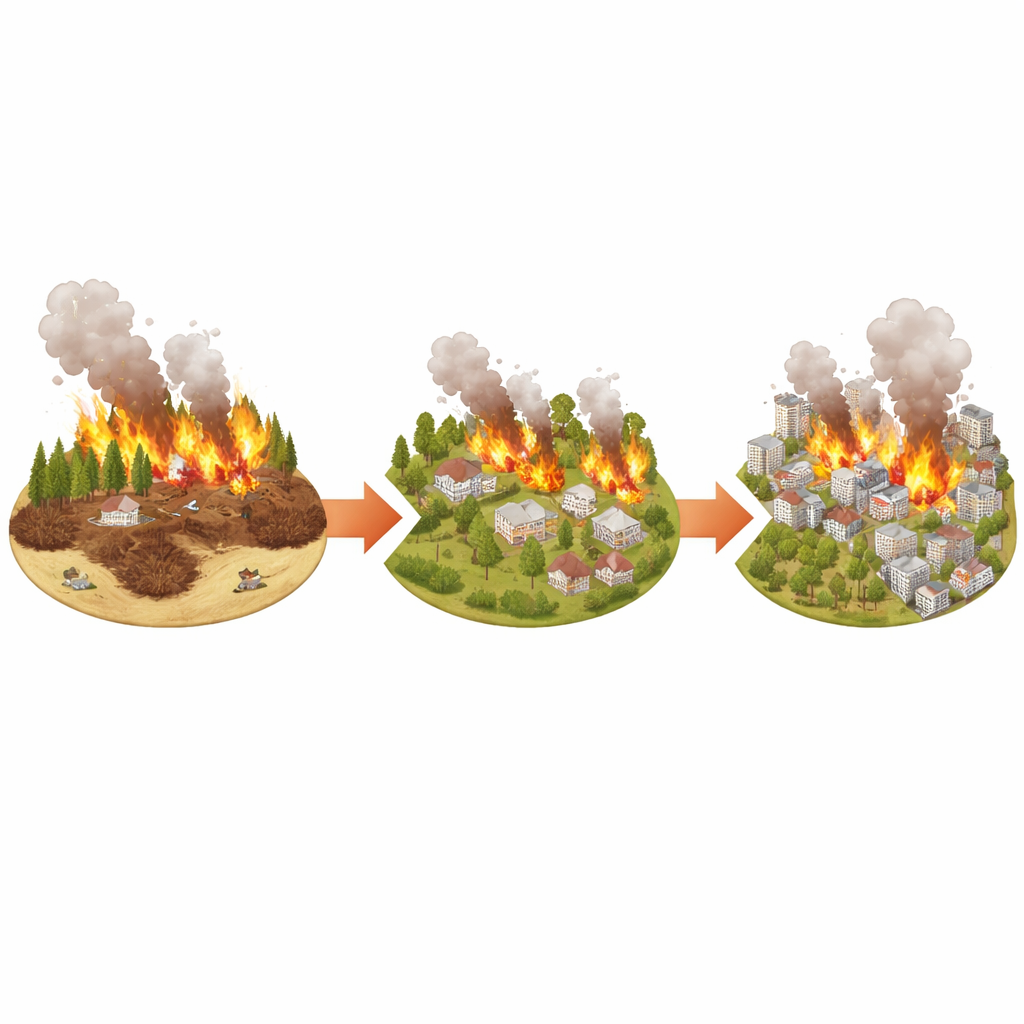
Over the two decades studied, wildfire impacts generally increased across the country, but the share of damage that falls on city and town areas has long been substantial. Urban wildfires are therefore not a brand-new phenomenon; they have been quietly shaping risks to communities for years, especially in the American West. The authors conclude that how we measure wildfire exposure—whether by land burned, fires counted, or homes and lives lost—fundamentally changes whether we see wildfire as mainly a rural or an urban issue. For planners, insurers, and residents, this means that protecting people from wildfire requires looking beyond the forest edge to the full rural-to-city continuum, and using data sources that capture the smaller, often overlooked fires that can still turn deadly when they reach where people live.
Citation: McConnell, K., Mueller, J.T., Burow, P.B. et al. Urban areas in the United States experience substantial wildfire impacts. Commun Earth Environ 7, 352 (2026). https://doi.org/10.1038/s43247-026-03336-y
Keywords: urban wildfires, wildfire risk, structure loss, rural-urban continuum, United States