Clear Sky Science · en
Regenerative agriculture improves productivity and profitability while reducing greenhouse gas emissions on Australian sheep farms
Why this matters for our food and climate
Sheep farms cover vast areas of Australia and feed millions of people, but they also release large amounts of climate‑warming gases. Many farmers are turning to “regenerative” methods that promise to heal the land while keeping animals productive and businesses afloat. This study asks a practical question: when you unbundle the buzzwords and look farm‑by‑farm, which parts of regenerative grazing actually boost pasture growth, store more carbon in soils, cut emissions and still make money?
Looking closely at real farms
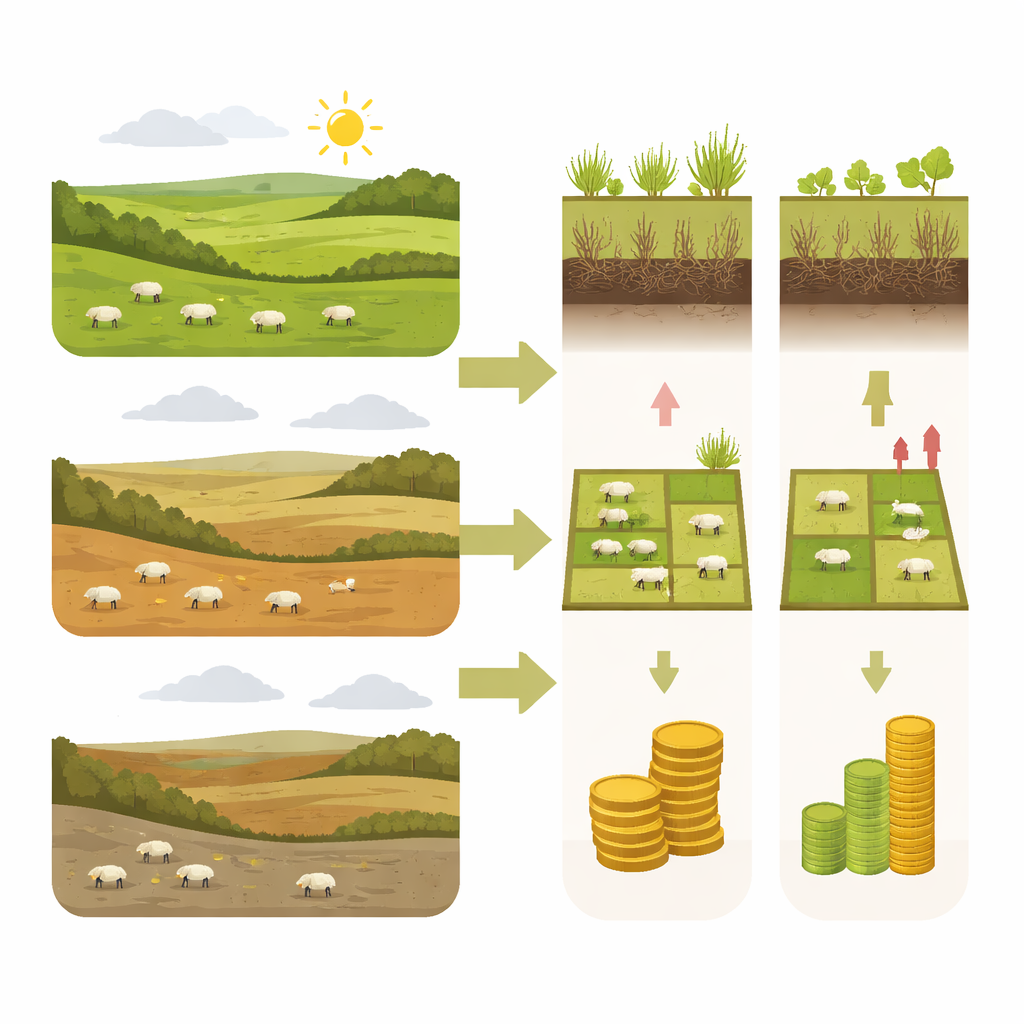
The researchers worked with four commercial sheep farms spread across a dry‑to‑wet rainfall gradient in Western Australia, South Australia and Victoria. Using detailed records of climate, soils, flocks and management, they ran a century‑long computer simulation of each farm. They compared current “Baseline” practices with alternative options that captured three core ideas from regenerative agriculture: changing which pasture plants are grown, starting from soils with low or high organic carbon, and replacing set‑stocked grazing with adaptive multi‑paddock (AMP) grazing where animals are moved more frequently. For each combination, they tracked pasture growth, soil carbon, greenhouse gas emissions and farm profits, including possible income or penalties from carbon pricing.
Plants that perform beat mixing many species
One popular belief is that simply increasing plant diversity will transform farms. Here, the story was more nuanced. Pasture productivity depended far more on the identity of key species than on how many species were present. Swards built around a few high‑yielding species increased annual pasture growth by about 7% compared with Baseline, while the poorest mixtures cut yields by nearly 40%. Because less grass meant more bought‑in feed, low‑yield pastures quickly became more expensive to run. Over 100 years, productive swards steadily built soil carbon and trimmed emissions intensity by around 6%, whereas unproductive ones lost soil carbon and raised emissions intensity by roughly 13%. In other words, choosing the right plants mattered more than chasing species counts.
Hidden history of the soil shapes carbon gains
A second focus was the starting level of soil organic carbon, which acts like a savings account built up over decades. When soils began with low carbon, they had much more room to store additional carbon under improved management. These low‑carbon soils gained stocks and lowered whole‑farm emissions intensity by about 13%. In contrast, soils that started rich in carbon tended to lose it over the century, turning into a net source of carbon dioxide and pushing emissions intensity up by about 27%. These shifts in the soil often outweighed changes caused by climate or grazing style. Yet, interestingly, whether soils began rich or poor in carbon barely altered how much pasture grew, showing that soil carbon is crucial for climate outcomes but not always for short‑term feed supply.
How grazing style trades off carbon and cash
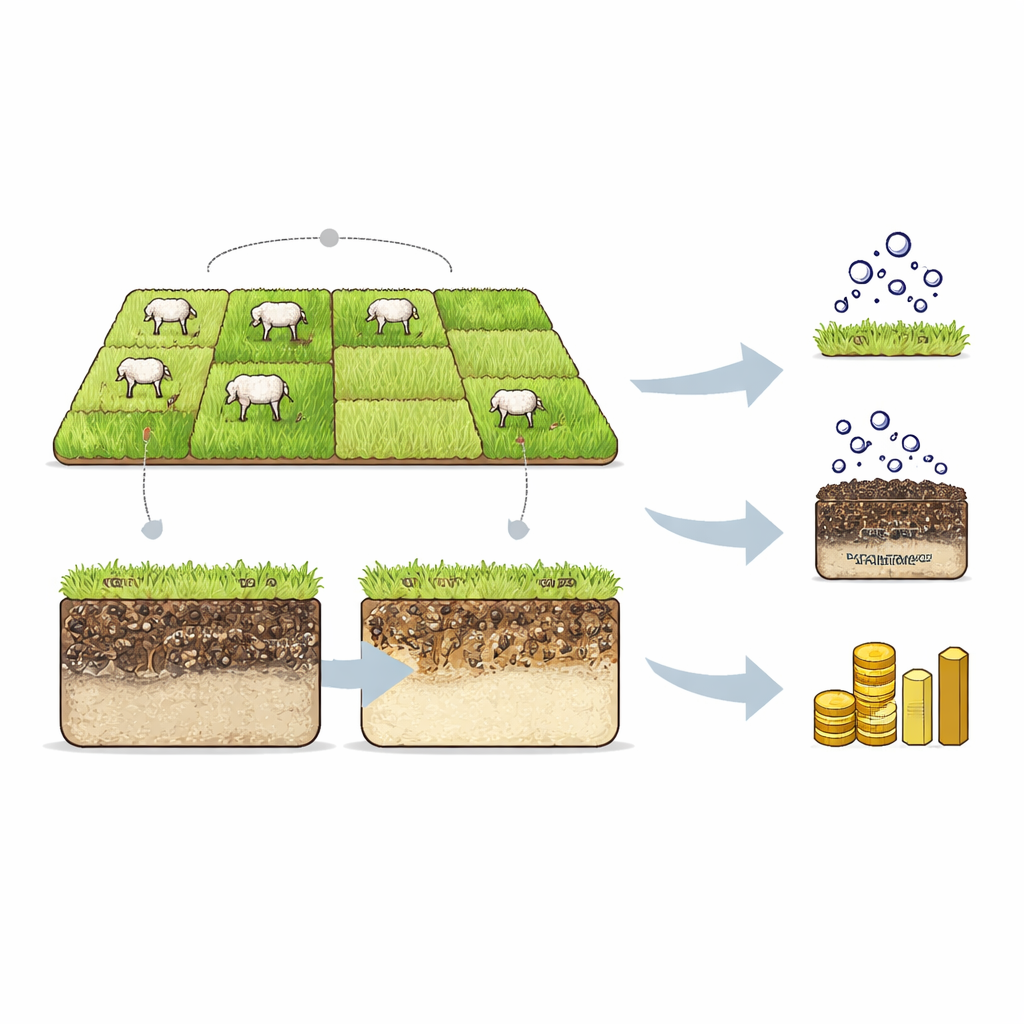
The third and perhaps most tangible lever was how sheep were moved across paddocks. Variable AMP grazing, where stock are shifted based on how much grass is on offer, consistently increased pasture growth and soil carbon compared with set stocking. This approach worked best in wetter, heavier soils, where it built substantial carbon “savings” and cut the emissions per kilogram of wool or meat—sometimes by more than half. However, because this system can also support more animals, methane from digestion remained the dominant source of farm emissions. Economically, low‑intensity grazing with short rest periods often delivered higher profits by keeping supplementary feed costs down, especially on well‑watered farms. Variable AMP grazing performed better when climate, emissions and profit were all valued together, but not when profit alone ruled.
Balancing goals for future farms
For farmers, policymakers and consumers, this work offers a grounded message. Regenerative grazing can improve soil carbon, support strong pasture growth and reduce climate impacts, but no single recipe maximizes everything. Systems that store the most carbon and deliver the largest emissions cuts are not always the most profitable in the short term. The study shows that choosing productive pasture species, recognizing the “starting balance” of soil carbon and matching stocking rates to what local rainfall can reliably support are all critical. Designing resilient, low‑emissions sheep farms will therefore mean weighing environmental gains against economic realities, rather than expecting regenerative practices to be a one‑size‑fits‑all climate fix.
Citation: Muleke, A., Christie-Whitehead, K.M., Cain, M. et al. Regenerative agriculture improves productivity and profitability while reducing greenhouse gas emissions on Australian sheep farms. Nat Food 7, 345–355 (2026). https://doi.org/10.1038/s43016-026-01331-2
Keywords: regenerative agriculture, sheep grazing, soil carbon, greenhouse gas emissions, farm profitability