Clear Sky Science · en
White eye-rings coevolved with diurnal behaviors as a trait enhancing visual appeal in rodents
Why bright eye circles on rodents matter
Many rodents have a crisp white ring of fur around each eye, while others do not. This study asks a simple question with surprisingly broad implications: why would evolution favor such eye-catching facial markings in some species, and not in others? By combining a large-scale survey of rodent species with carefully designed behavior tests, the researchers show that these white eye-rings are tied to daytime living and to how animals visually notice one another.
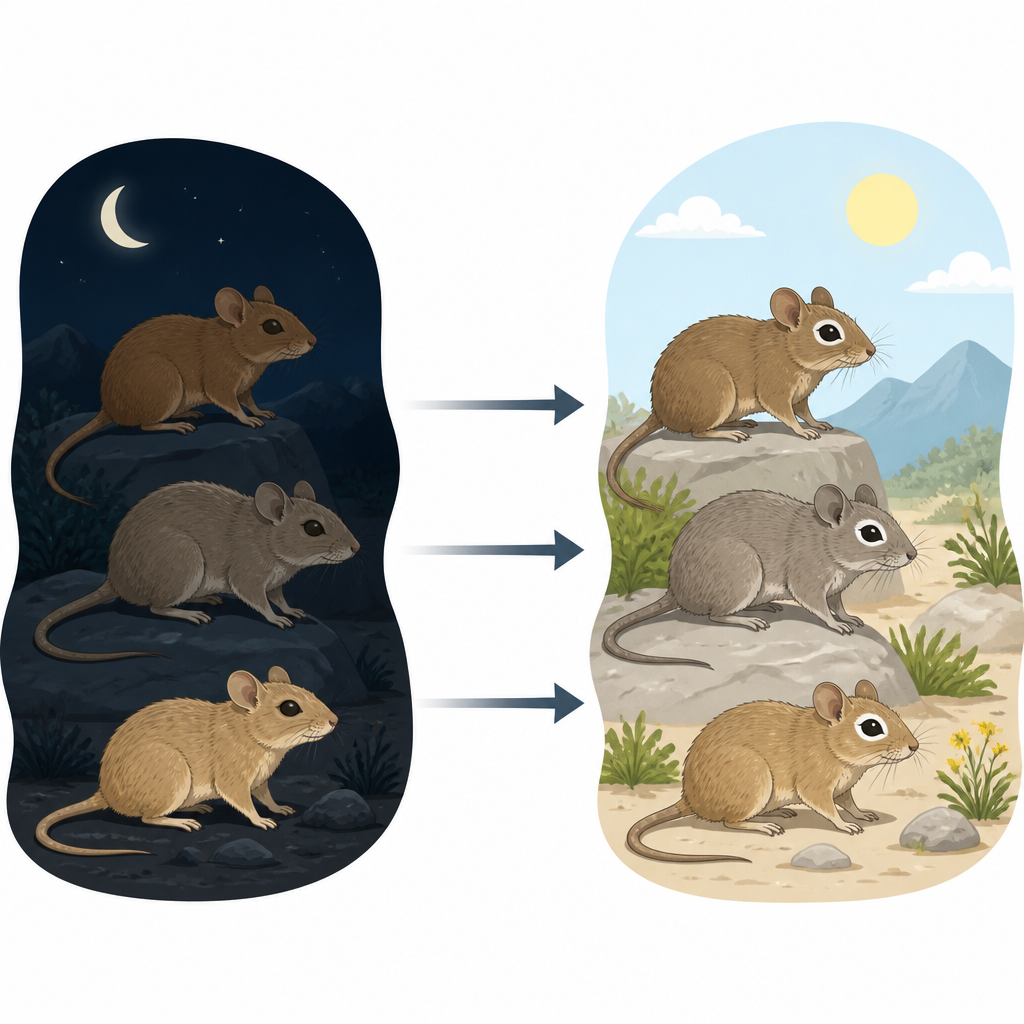
Linking bright eyes to daytime habits
The authors first mapped the presence of white eye-rings in 601 rodent species onto an evolutionary family tree. They compared this pattern with information on whether each species is active during the day or at night. Their reconstructions suggest that the earliest rodents were night active and lacked white eye-rings. Over tens of millions of years, white eye-rings appeared again and again in separate rodent lineages when those lineages shifted from night life to day life. When some groups later returned to nocturnal habits, the white rings often disappeared. Statistical tests that account for shared ancestry confirmed a strong and repeated link between daytime activity and the presence of white eye-rings.
Ruling out other possible explanations
Eye-catching coloration can serve many functions, from camouflage to social signals. The team therefore checked whether white eye-rings simply came along with other traits. They tested for links between eye-rings and other white patches on the body, preferred habitat such as forest, grassland, or desert, and whether species tend to live alone or in groups. After correcting for evolutionary relatedness, none of these factors explained the pattern. White eye-rings did not track forest living, complex social life, or other body markings. This pointed to a more specific connection between daytime activity, visual abilities, and the eye-rings themselves.

How white eye-rings change what animals look at
To see what white eye-rings actually do for an animal, the researchers turned to two closely related species with different lifestyles. The Nile rat is strictly day active and has clear white eye-rings. The common house mouse is night active and lacks them. Using a three-chamber test arena and photographs, the team asked which faces these animals preferred to approach and explore. Nile rats, both male and female, spent more time near images of Nile rats whose eye-rings were visible than near versions of the same images where the rings were digitally erased. They even preferred photos of an unfamiliar North American squirrel with its own white eye-rings over a version with the rings removed.
The special pull of a balanced face
The researchers suspected that the white rings might work by emphasizing the left-right balance of the face. To test this, they altered images so that only one ring remained or only the lower halves of both rings remained. Nile rats did not favor an image where just one ring was intact, but they did favor an image where both eyes had matching half-rings. Additional tests suggested this was not just a response to novelty. Together, the results indicate that Nile rats are especially drawn to faces with symmetrical markings around the eyes. In contrast, house mice showed no clear preference for faces with digitally added rings, suggesting that this visual bias depends on a daytime lifestyle and better reliance on vision.
What this means for animal color patterns
For a general reader, the key takeaway is that those neat white circles around some rodents’ eyes are not random decoration. They tend to evolve when rodents shift to daylight activity and can see well enough to respond to such markings. In these species, white eye-rings make faces more visually appealing, likely by sharpening a sense of balance from left to right. That extra visual pull may help animals notice one another and start social interactions, even if it is not directly tied to choosing mates or recognizing species. The work reveals how a simple facial pattern can emerge and vanish as animals move between night and day, and how shared visual preferences can leave a mark on the evolution of mammal coloration.
Citation: Le, N.H.K., Li, SH., Chiu, CC. et al. White eye-rings coevolved with diurnal behaviors as a trait enhancing visual appeal in rodents. Commun Biol 9, 677 (2026). https://doi.org/10.1038/s42003-026-09916-0
Keywords: rodent coloration, white eye-rings, diurnal behavior, facial symmetry, animal communication