Clear Sky Science · en
Exploring the impact of Cenozoic climate change on diversification of the Australian endemic Eurepini crickets (Orthoptera: Gryllidae: Eneopterinae)
Crickets as Clues to a Changing Continent
Australia today is famous for its vast deserts, but for much of the last 50 million years it was warmer, wetter, and blanketed in rainforest. This study uses an unlikely hero—the Eurepini, a tribe of small, native crickets—to trace how that long shift toward a drier climate reshaped life across the continent. By reconstructing their family tree and past ranges, the authors show how rising aridity first allowed some lineages to spread, then gradually slowed the birth of new species and likely erased many others, especially in the harsh interior. 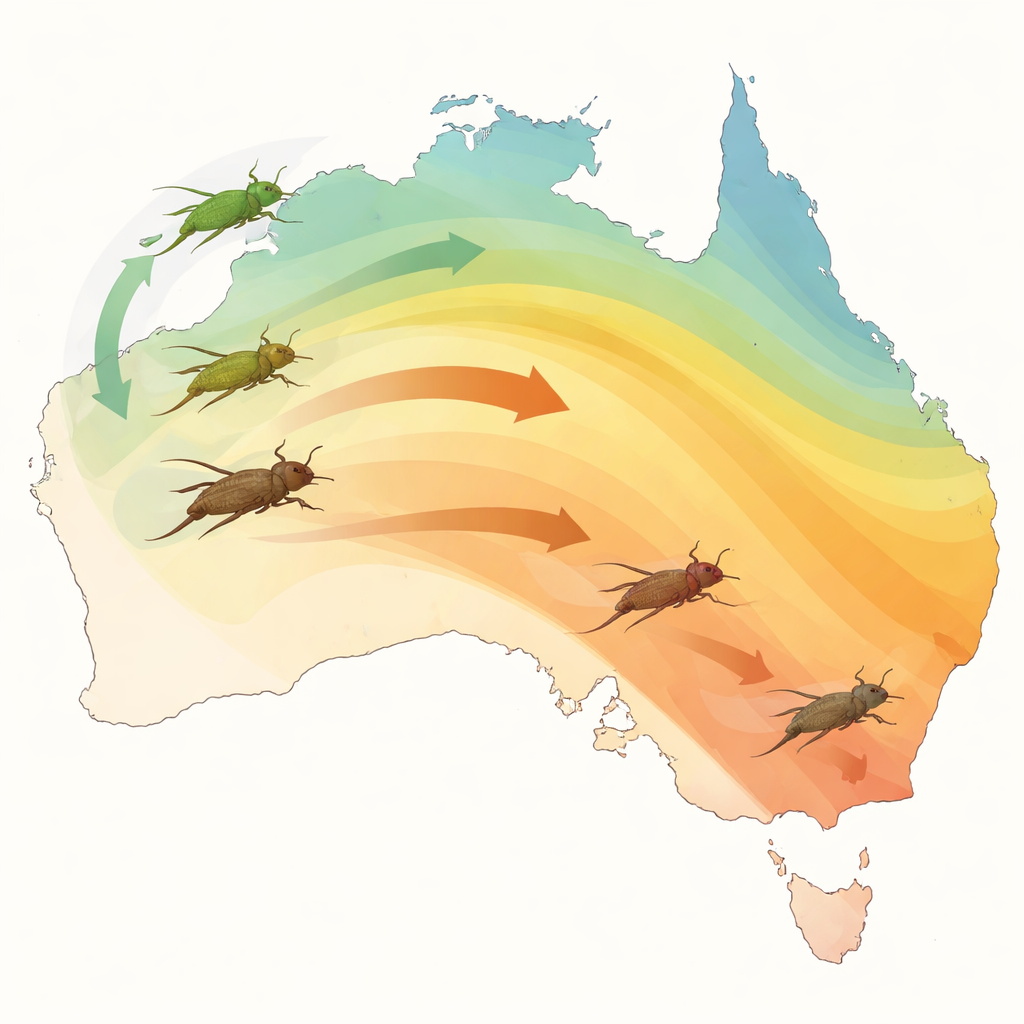
Following the Family Tree of Australian Crickets
The researchers started by assembling the most complete genetic portrait so far of Eurepini crickets, a group with 64 described species and many more still unnamed. These insects live across Australia—from leaf litter in wet forests to shrubs and grasses in open country, including the modern desert zone. Using whole mitochondrial genomes and several nuclear genes from 94 Eurepini species, the team built a detailed evolutionary tree and estimated when the major branches split, relying on fossil crickets from related groups as age anchors.
Born in the North, Spreading Across the Land
The genetic clock points to an origin for Eurepini in the Early Eocene, about 50 million years ago, in what is now northern Australia, at a time when the continent was hot, humid, and dominated by rainforests. Most of the main lineages—genera such as Miripella, Napieria, Salmanites, Eurepa, and Eurepella—began diversifying later, from the Late Oligocene and Miocene onward. Biogeographic modeling suggests that for long stretches of time these groups diversified “in place,” especially in the north and in central regions, with only gradual southward and westward expansions into what would become today’s arid heartland and southwestern corner of the continent. 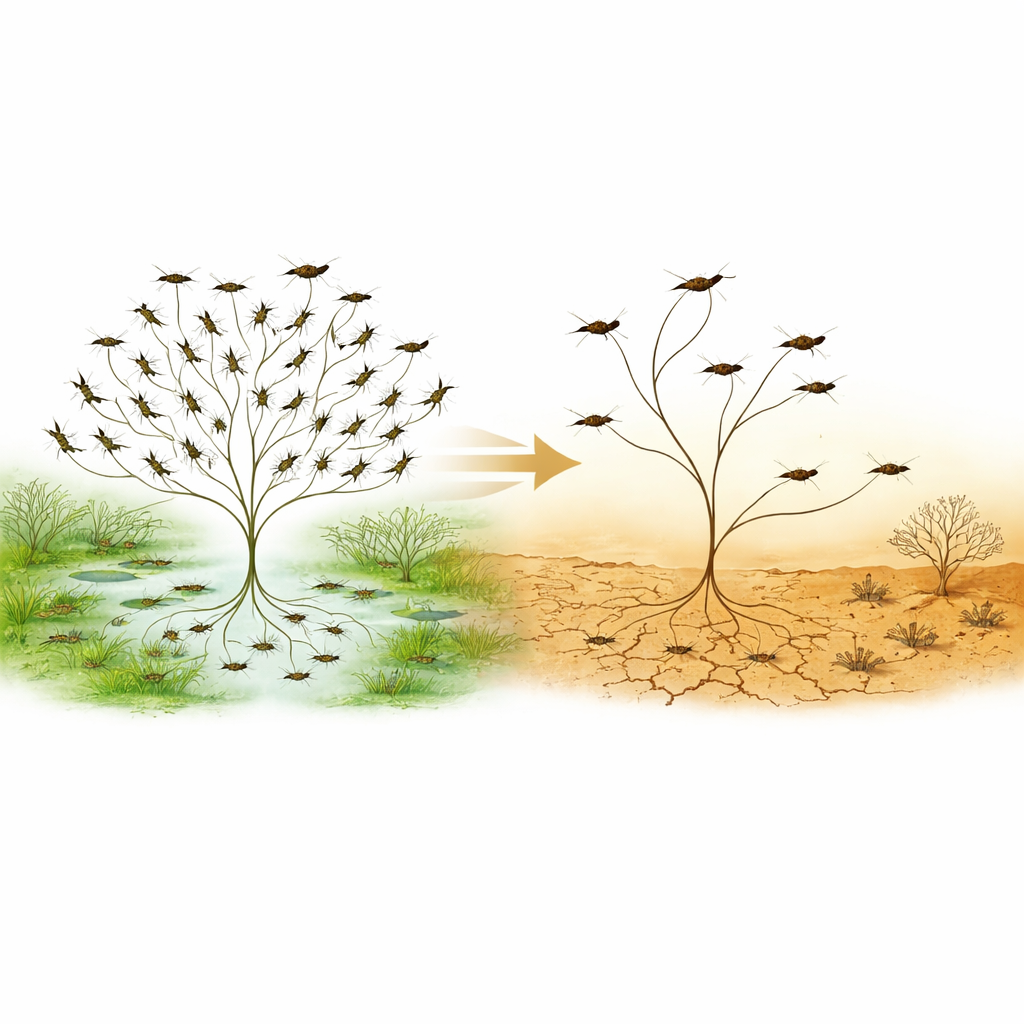
When Drying Climates Slow Life’s Branching
With this time-scaled tree in hand, the authors tested how the pace at which new cricket species appeared and disappeared changed through Earth’s recent climate history. Several independent methods agreed that Eurepini experienced relatively steady speciation for tens of millions of years, followed by a sharp drop starting around 2 million years ago, at the dawn of the Pleistocene. This downturn lines up with one of Australia’s most intense phases of cooling and drying, when sandy and stony deserts became firmly established. Statistical models that explicitly combine climate and evolution show that the best explanation is a simple one: as aridity increased, the rate at which new Eurepini species formed declined in a roughly linear fashion, while extinction stayed comparatively low but persistent.
Different Fates in Wet and Dry Regions
Not all Eurepini lineages responded to aridification in the same way. The study compared species that inhabit the arid zone with those that live in wetter, “mesic” regions. On average, lineages tied to dry areas show much lower diversification rates than their mesic counterparts, suggesting that the expansion of desert environments generally constrained their evolutionary opportunities rather than sparking a burst of adaptation. Yet there are striking exceptions: certain Eurepella crickets that moved into the arid zone about 8.5 million years ago show evidence of unusually high diversification, possibly linked to traits like elongated egg-laying structures and body forms that help them cope with harsher conditions. This mix of decline and localized success hints at a complex, region- and lineage-specific response to environmental stress.
What These Crickets Reveal About Australia’s Past
Overall, the study paints Eurepini crickets as witnesses to Australia’s transformation from a green continent to one dominated by drylands. They arose in a warm, rainforest-covered north, spread gradually across the land, and then saw their evolutionary engine slow as climates cooled and dried, culminating in a marked drop in new species around the beginning of the Ice Ages. The work suggests that many cricket lineages in the arid interior were pruned away over the last 10 million years, while only a few evolved the traits needed to survive and diversify under extreme conditions. For non-specialists, the key message is that deep-time climate change does more than rearrange habitats: it can reshape the very tree of life, favoring some branches while thinning or erasing others.
Citation: He, S., Kergoat, G.J., Su, Y.N. et al. Exploring the impact of Cenozoic climate change on diversification of the Australian endemic Eurepini crickets (Orthoptera: Gryllidae: Eneopterinae). Commun Biol 9, 548 (2026). https://doi.org/10.1038/s42003-026-09791-9
Keywords: Australia aridification, cricket evolution, Cenozoic climate change, species diversification, paleoenvironment