Clear Sky Science · en
Effect of deep marginal elevation with different intermediate materials on the fracture resistance of direct and indirect final composite restorations: an in vitro study
Why stronger fillings matter
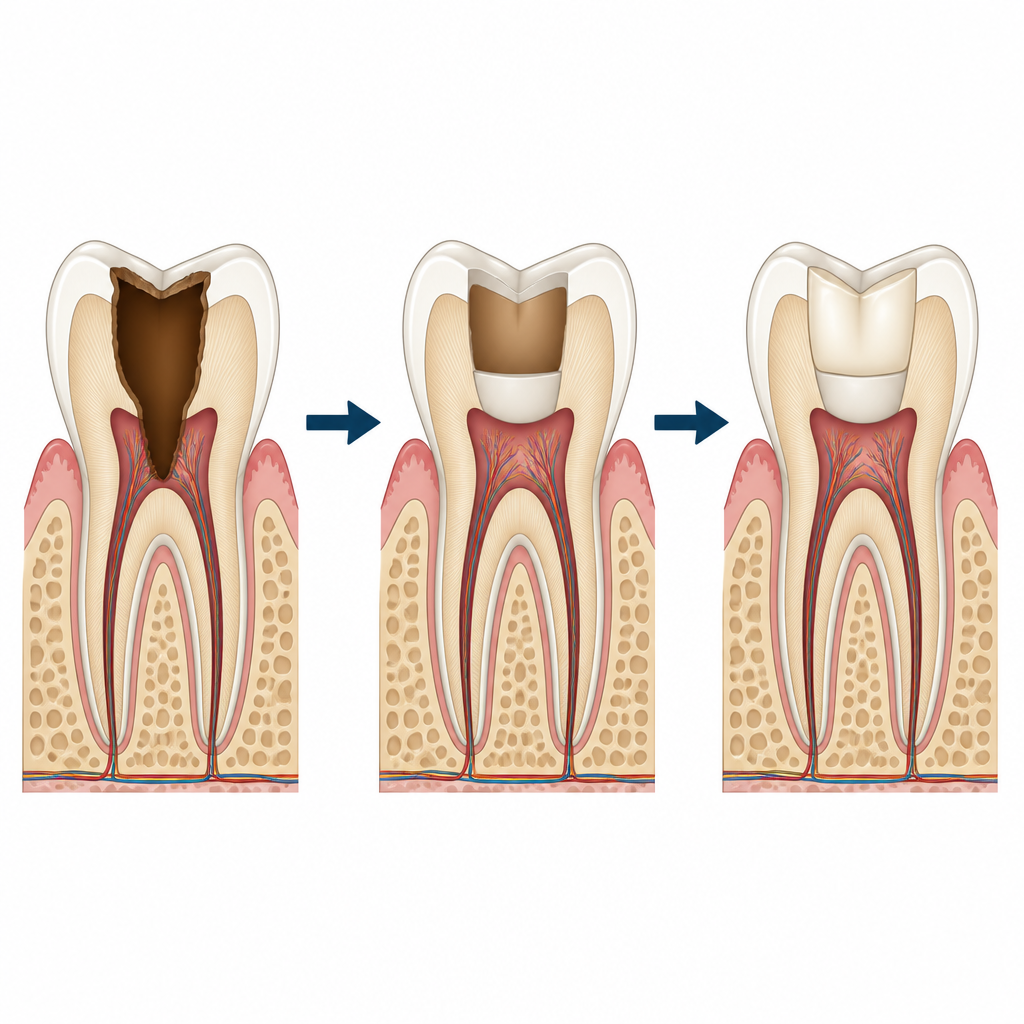
When a back tooth has a large cavity that reaches deep under the gum, fixing it is not just about plugging a hole. Dentists must rebuild the tooth in a way that lets it survive years of chewing without cracking. This study looks at a popular technique called deep marginal elevation, which raises very deep cavity edges higher up the tooth, and asks a practical question: which type of filling base makes the tooth strongest, and does it matter whether the final filling is built directly in the mouth or made as an inlay outside the mouth and then glued in?
Raising deep edges instead of cutting more tooth
Traditionally, when a cavity extends far below the gum line, dentists might cut away more gum and bone to expose the edge of the tooth. Deep marginal elevation offers a more conservative option: place a first layer of adhesive material to “lift” the deep edge closer to the visible part of the tooth, then add the main restoration on top. This helps with keeping the area dry, taking accurate impressions, and protecting the surrounding tissues. The authors wanted to see how this lifting layer affects the strength of the tooth when it is made from three different materials and placed at different depths around the natural border between enamel and root, known as the cementoenamel junction.
Testing three popular base materials
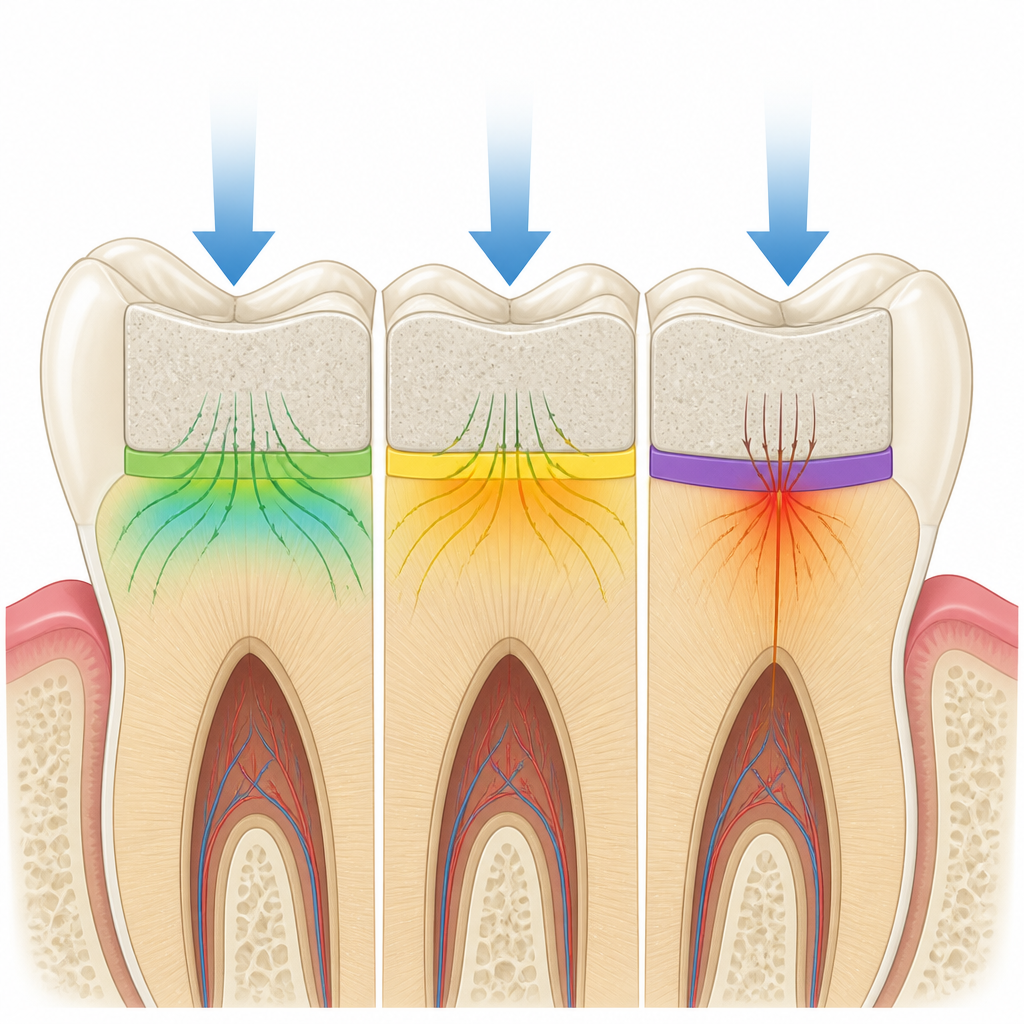
The researchers used ninety healthy upper premolars that had been removed for orthodontic reasons. They prepared each tooth with a large, standard three-sided cavity similar to what is seen in real-life dental decay. The teeth were then grouped in several ways. First, some received direct composite fillings, placed and hardened in layers inside the mouth model, while others received indirect composite inlays that were shaped and cured outside the tooth and then cemented in. Second, within each of these groups, the deep marginal elevation layer was made from one of three materials: a resin-modified glass ionomer, a flowable composite, or a newer injectable hybrid composite. Finally, each combination was tested at three depths: at the natural junction, two millimeters above it, and two millimeters below it.
Pushing teeth until they break
After the restorations were completed, each tooth was embedded in acrylic and loaded in a universal testing machine. A round metal tip pressed down on the restored chewing surface until the tooth or filling fractured, and the force at fracture was recorded. The team also examined how the teeth failed, distinguishing between cracks limited to the filling, cracks that affected the tooth above the natural junction, and deeper, more severe fractures extending below it. This allowed them to judge not only how strong the restored teeth were, but also whether failures would likely be repairable in a real patient.
Which combinations held up best
The overall type of final restoration, direct or indirect, did not by itself change strength very much. What mattered more was the combination of base material and depth. The injectable hybrid composite used as the lifting layer under indirect inlays produced the highest fracture resistance when the deep edge was at or above the natural junction. In contrast, when the edge lay below this level, the resin-modified glass ionomer performed best under indirect inlays. For some setups, especially when the cavity extended below the junction and was restored directly with certain materials, the teeth showed noticeably lower resistance. In general, the deeper the box dropped below the natural border, the more the tooth’s ability to withstand chewing forces declined.
What this means for dental care
For people needing large restorations on back teeth, this study suggests that simply choosing between a direct filling and an inlay is not enough. The material used to raise a very deep cavity edge, and how deep that edge lies relative to the natural enamel–root boundary, have a strong influence on how well the tooth will stand up to biting forces. Using an injectable hybrid composite as the base under indirect inlays appears especially helpful when the cavity edge is at or above the natural junction, while resin-modified glass ionomer is more favorable for very deep edges below it. Overall, careful selection of both material and depth allows dentists to preserve more tooth structure and still keep restored teeth strong.
Citation: Ragab, R., Saad, R. & Riad, M. Effect of deep marginal elevation with different intermediate materials on the fracture resistance of direct and indirect final composite restorations: an in vitro study. Sci Rep 16, 16011 (2026). https://doi.org/10.1038/s41598-026-51161-2
Keywords: deep marginal elevation, fracture resistance, dental composite, resin modified glass ionomer, indirect inlay