Clear Sky Science · en
Ancient DNA from the Upper Paleolithic mammoth ivory of Hohle Fels, Germany
Tracing Ice Age stories in carved ivory
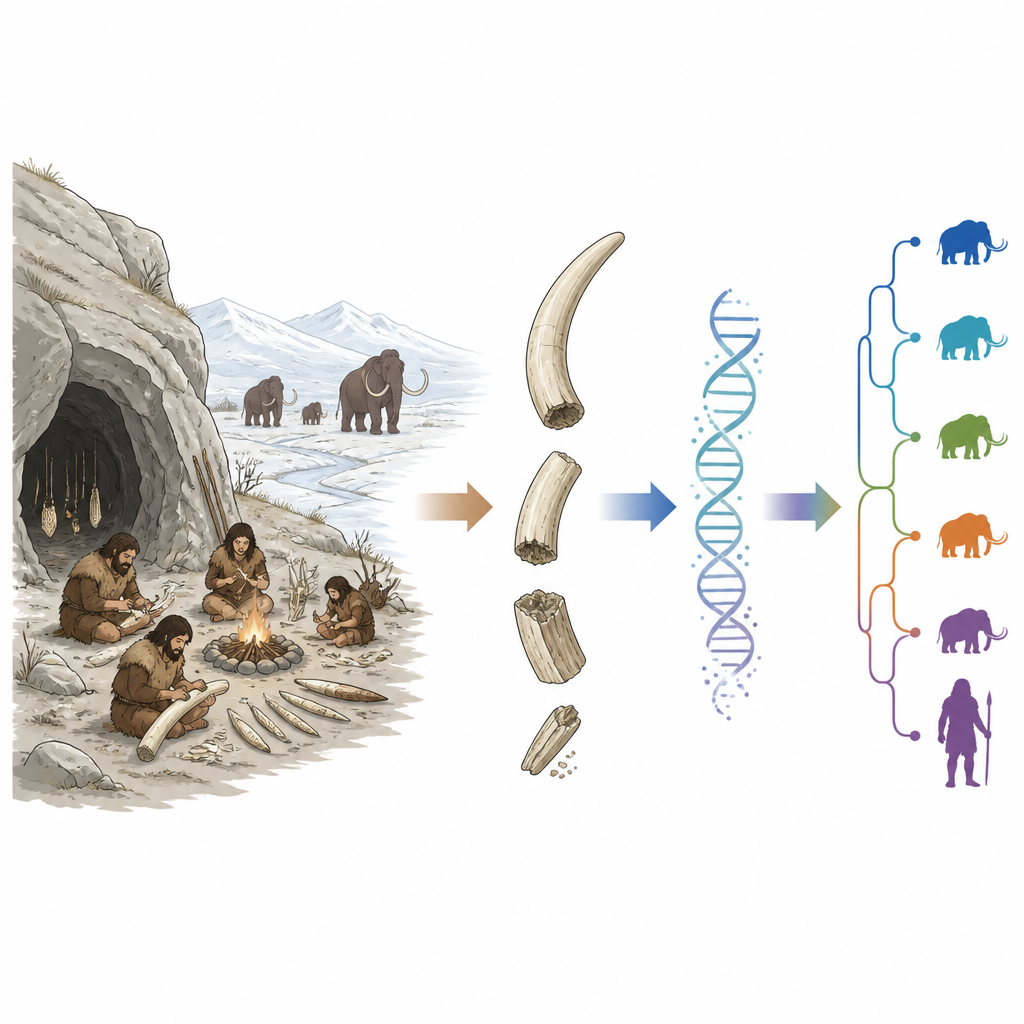
More than 35,000 years ago, people living in a cave called Hohle Fels in southern Germany carved tiny figures, musical instruments, and ornaments from mammoth tusks. This study shows that these prized ivory scraps are not just works of art or craft waste but also hidden biological records. By carefully sampling the tusks, researchers were able to read fragments of mammoth DNA and use them to explore both mammoth life and the choices humans made when hunting, crafting, and trading in the Ice Age.
Ancient tusks as time capsules
Hohle Fels holds one of the richest collections of mammoth ivory from the Upper Paleolithic, the long stretch of time when modern humans spread across Europe. The team studied 25 small pieces of worked ivory, most of them discarded chips from tool and ornament making. These fragments came from layers linked to three cultural phases known to archaeologists: the Aurignacian, Gravettian, and Magdalenian. Until now, such ivory from temperate Europe was seen as too poorly preserved for DNA work, because it does not come from permanently frozen ground. The researchers set out to test whether usable DNA survives in these tusks and, if so, what it can reveal about mammoths and the people who used them.
Finding the best spot inside a tusk
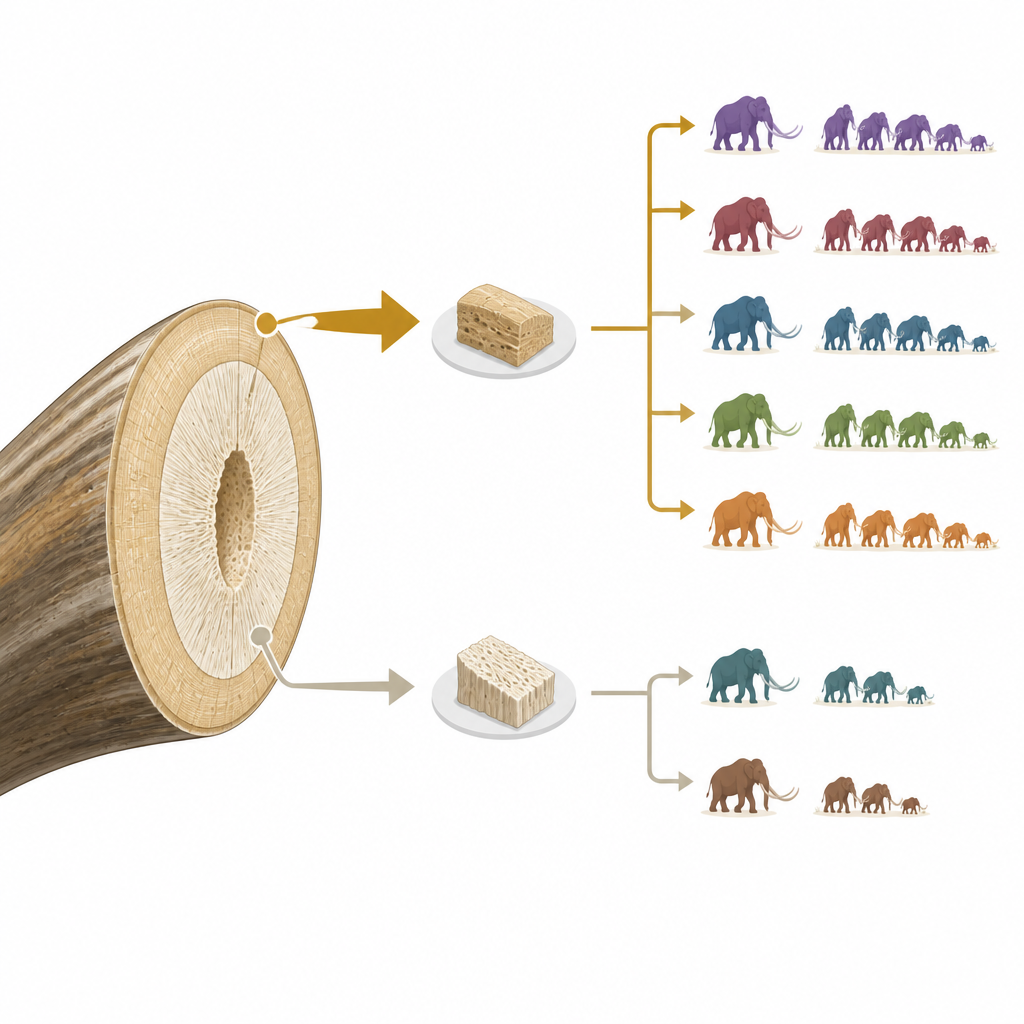
A tusk is not a solid block but is built from different tissues, mainly an inner core called dentin and a thin outer sheath called cementum. The team compared DNA recovery from both layers in the same ivory pieces. They found that the outer cementum consistently produced more mammoth DNA, longer fragments, and richer genetic information than the inner dentin, even though it makes up only a small part of each tusk. This means that future studies can target this outer layer to get better results while removing less material, an important concern when working with rare or delicate artifacts in museum collections.
Rewriting the local mammoth record
The scientists also used a form of radioactive dating on some ivory pieces to check how they fit into the cave’s timeline. Two fragments that had been thought to belong to a later Magdalenian occupation actually dated back to the earlier Gravettian period. Combined with evidence of erosion inside the cave, this suggests that some ivory was washed or moved into younger layers rather than carved there. Strikingly, no mammoth specimens in this study could be firmly tied to the Magdalenian occupation of Hohle Fels, which hints that mammoths may have been rare in the area by that time or that people had shifted to other raw materials, such as jet, for their ornaments.
Clues to herds, sexes, and movements
By examining DNA from both tusks and bones, the researchers could estimate the sex of some of the mammoths represented at Hohle Fels. Across all samples, they found a leaning toward females, unlike natural bonebeds, which tend to be dominated by males that died in accidents. This suggests that humans were often hunting or processing family herds, similar to modern elephant groups led by females, or that they favored female animals or tusks for particular uses. In addition, the team reconstructed twelve complete mitochondrial genomes, a type of DNA passed down through mothers. All belonged to a known European mammoth branch called Clade III, but they spanned several sub-groups. This rich mix of maternal lineages in a single cave implies that people drew on multiple herds over time, through hunting, scavenging, or perhaps long-range exchange of tusks.
What these findings mean for the past
Together, the results show that even tiny chips of Ice Age ivory can yield valuable genetic stories. By focusing on the cementum layer, scientists can recover higher quality DNA and link specific tusks to mammoth lineages, herd structure, and sex. At Hohle Fels, this approach reveals that people interacted with diverse mammoth groups, tended to work with ivory from female animals, and may have seen major changes in mammoth availability over time. More broadly, the study opens the door to using worked ivory across Europe as a new window into both mammoth biology and the social lives, choices, and beliefs of the humans who shaped these remarkable objects.
Citation: Moreland, K.N., Wolf, S., Drucker, D.G. et al. Ancient DNA from the Upper Paleolithic mammoth ivory of Hohle Fels, Germany. Sci Rep 16, 15181 (2026). https://doi.org/10.1038/s41598-026-46761-x
Keywords: ancient DNA, mammoth ivory, Hohle Fels, Upper Paleolithic, human–mammoth interactions