Clear Sky Science · en
Identification, characterization, and fungicide response of fungal pathogens causing postharvest diseases of watermelon (Citrullus lanatus) in Northern Thailand
Why watermelon lovers should care
Watermelon is more than a summer treat; it is a livelihood for many farmers in Thailand and around the world. Yet a hidden problem lurks between the farm and your table: fungal infections that rot the fruit during storage and transport. This study shines a light on which microscopic culprits are ruining watermelons in Northern Thailand and which common fungicides can actually stop them, providing knowledge that can help reduce waste, protect farmer incomes, and keep more fruit fresh for consumers.
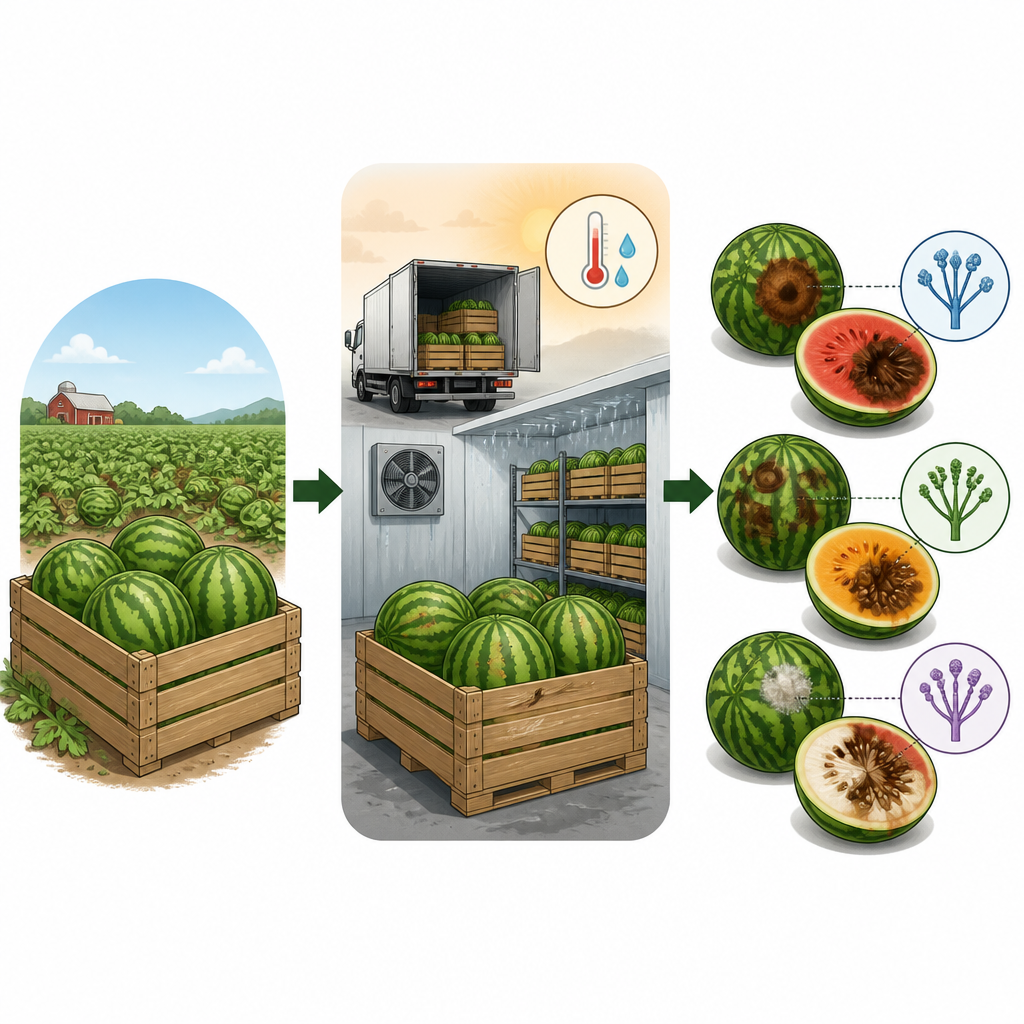
Bad actors on stored fruit
Researchers surveyed postharvest watermelon fruits from six provinces in Northern Thailand during 2024 and 2025. They focused on fruits that developed two main problems after harvest: anthracnose, which shows up as sunken dark spots on the rind, and fruit rot, where the flesh turns soft and watery. From these diseased fruits they isolated fifteen fungal strains and grouped them into three broad sets of disease-causing molds. Colletotrichum species were tied to anthracnose on the fruit surface, while Fusarium and Neocosmospora species were linked to deep internal fruit rot.
Putting names to invisible threats
To work out exactly which fungi were present, the team combined traditional microscopy with DNA-based family trees. By comparing multiple genetic markers, they could distinguish closely related species that look similar under the microscope. They identified three Colletotrichum species on anthracnose lesions and three Fusarium plus three Neocosmospora species in rotting flesh. Several of these had never before been reported on watermelon anywhere in the world, and some had not previously been linked to watermelon disease in Thailand at all. This refined picture helps explain why growers may see different symptom patterns and why some treatments seem to fail.
How strongly each fungus attacks
Finding fungi on damaged fruit does not prove they actually cause the disease, so the researchers carried out infection tests on healthy supermarket watermelons. They made small standardized wounds, applied solutions packed with fungal spores, and stored the fruits under warm, humid conditions that mimic real storage rooms. All fifteen strains caused visible lesions, while control fruits stayed healthy, confirming the pathogens’ guilt. When the team measured lesion sizes, they found that some species, such as Fusarium hainanense and certain Colletotrichum strains, produced very large spots and could rot an entire fruit within about three to four weeks, whereas others spread more slowly.
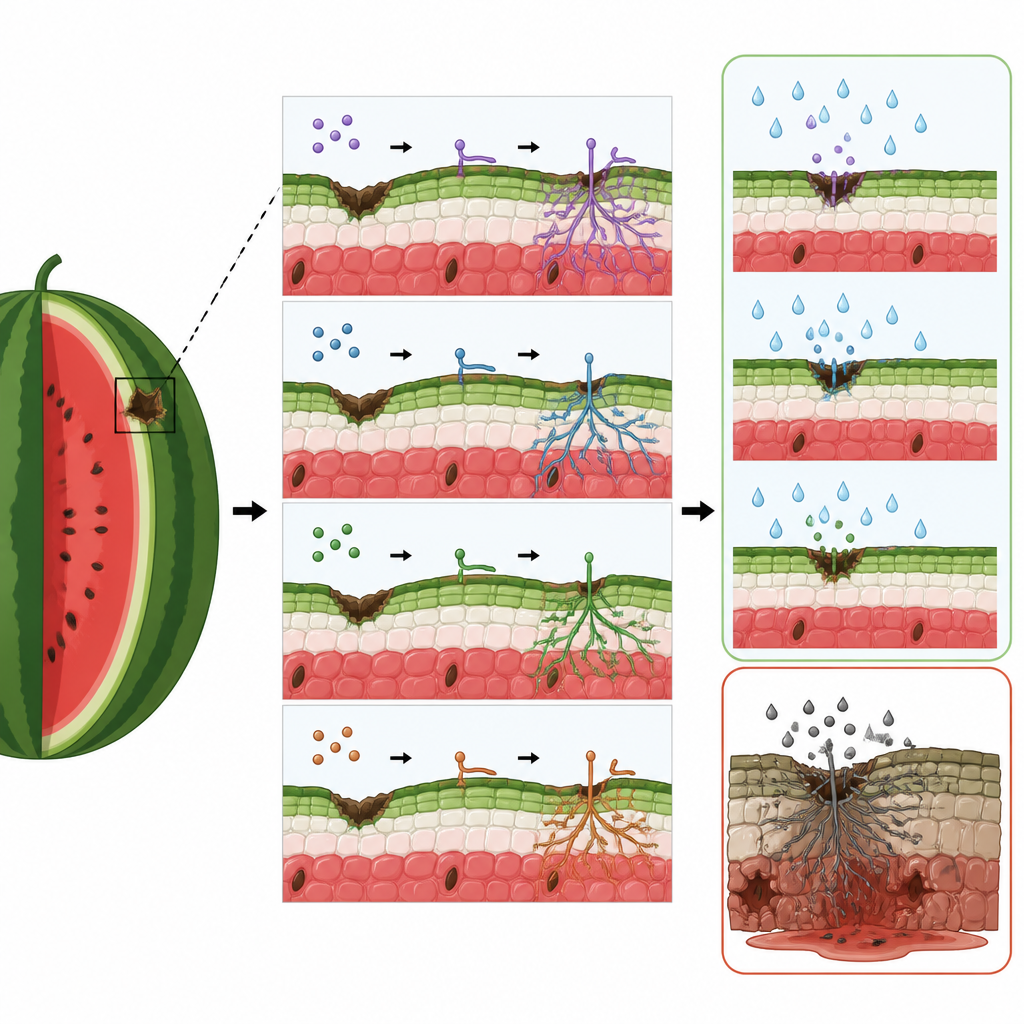
Which fungicides still work
The study also tested ten commercial fungicides already approved for use on cucurbit crops in Thailand. Each product was mixed into growth medium at its recommended field dose, and the team measured how well it slowed fungal spread. Copper-based treatments stood out: copper hydroxide completely stopped most species, while copper oxychloride fully halted Fusarium sulawesiense and several Neocosmospora species that were less affected by other chemicals. Some mixtures containing mancozeb totally inhibited particular Colletotrichum strains, and other products, such as azoxystrobin and propineb, worked poorly against many of the isolates. These varied responses show that no single fungicide is universally effective and that species-level identification matters for control.
What this means for growers and consumers
In simple terms, this work maps out which molds are actually rotting watermelons after harvest in Northern Thailand and which common fungicides can still keep them in check. By revealing several new watermelon pathogens and their differing sensitivities to chemicals, the study gives growers and advisors a clearer target for diagnosis and treatment. The authors emphasize that future work should test eco-friendly options and real fruit treatments, and should avoid overusing any one fungicide to slow resistance. For now, their findings offer a practical toolkit to cut postharvest losses, support more stable incomes for farmers, and help ensure that more watermelons reach markets in good condition.
Citation: Suwannarach, N., Kumla, J. Identification, characterization, and fungicide response of fungal pathogens causing postharvest diseases of watermelon (Citrullus lanatus) in Northern Thailand. Sci Rep 16, 15640 (2026). https://doi.org/10.1038/s41598-026-46031-w
Keywords: watermelon, postharvest disease, fungal pathogens, fungicide response, fruit rot