Clear Sky Science · en
Smart flying in challenging skies: How Red Kites adjust wind turbine micro- and meso-avoidance across weather and experience
Why this matters for birds and clean energy
Wind power is booming worldwide as we search for cleaner ways to generate electricity. But towering turbines also raise a pressing question: can we expand renewable energy without putting birds—especially large birds of prey—at serious risk? This study focuses on the Red Kite, a graceful raptor common in parts of Europe, and asks how often these birds truly dodge turbine blades, and how their behaviour changes with weather and experience. The answers help show whether wind farms and raptors can safely share the same skies.
How kites and turbines cross paths
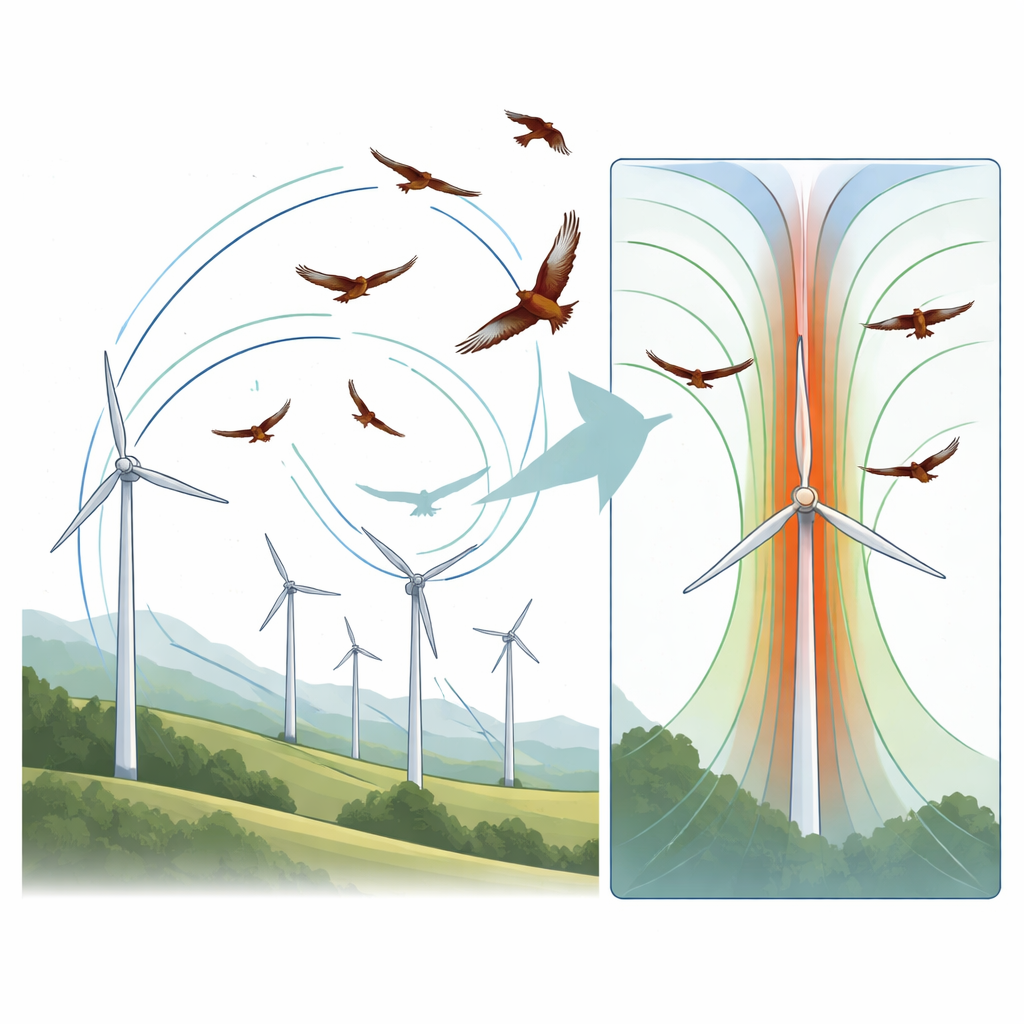
Red Kites often glide through the same windy areas that make good sites for wind farms. When they fly near a turbine, their choices can be thought of on two scales. At the “meso” scale, a bird decides whether to go near an individual turbine at all. At the “micro” scale, once it is close, it must avoid the spinning rotor zone where a collision could be fatal. Until now, researchers had only rough guesses about how reliably birds take these evasive routes, because earlier tracking devices were not precise enough to show what happens in the last few dozen metres before the blades.
Following thousands of flights in 3D
To tackle this, the researchers used high‑frequency GPS tags on nearly three thousand Red Kites across central Europe and matched more than five million bird locations with detailed information from hundreds of wind turbines in Austria and Germany. For each approach to a turbine, they reconstructed where the bird flew in relation to a carefully defined “risk area” around the rotor. They also added weather data, such as wind speed and cloud cover, and calculated how much prior exposure each individual bird had had to turbines. Because GPS positions can be off by a few metres—similar in size to the danger zone itself—they built computer simulations to see how this error would distort the apparent avoidance rate, and then corrected their estimates accordingly.
Birds that mostly steer clear
After accounting for measurement error, Red Kites were found to avoid the immediate rotor zone about 80 percent of the time when they entered the surrounding space. At the larger meso scale, they stayed away from individual turbines in roughly 87 to 94 percent of potential encounters, depending on how differences between birds were handled in the analysis. Treating these two behaviours as separate hurdles a bird must both fail to clear to be hit, the team estimated that overall avoidance reached about 98 percent. In other words, for every hundred “risky” flights near turbines, only two would be expected to carry on into a genuine collision course.
Weather and learning shape risk
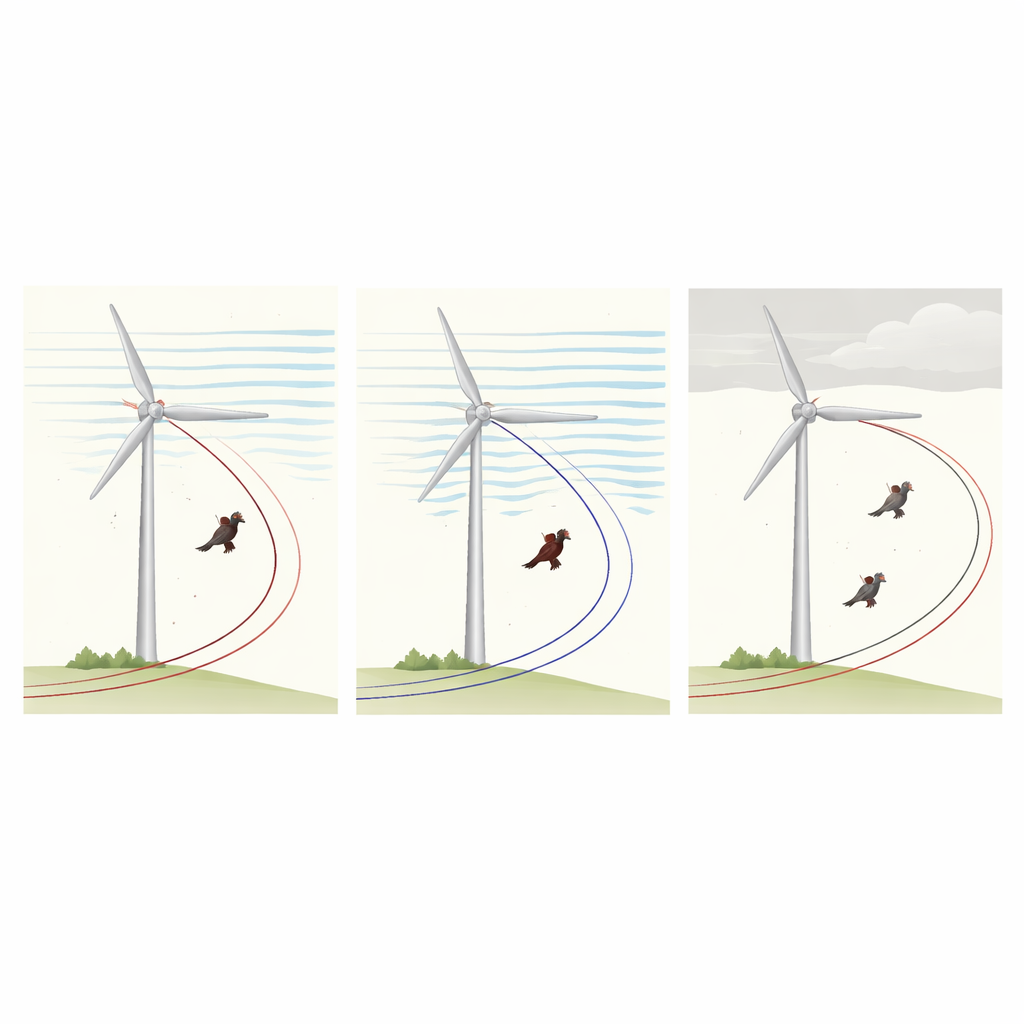
A key finding is that avoidance is not fixed; it shifts with conditions. Stronger winds and heavier cloud cover were linked to more cautious routes at both the meso and micro scales. Under these tougher conditions, birds tended to veer away earlier and keep a greater distance from the rotor zone, possibly because gusts and reduced contrast in the sky make flying more demanding. At the same time, birds with more past experience near turbines showed lower meso‑scale avoidance, meaning they flew closer to turbines overall. This could signal growing comfort that might raise risk—or better spatial awareness that lets them pass turbines safely with less dramatic manoeuvring. Importantly, the design details of turbines themselves, such as rotor size or turning speed, did not significantly change avoidance behaviour in this study.
Balancing wind power and wildlife
For non‑specialists worried about birds and wind farms, the central message is reassuring but nuanced. Red Kites in this study almost always managed to stay out of harm’s way, even in complex weather, and collisions remained rare compared with the huge number of turbine encounters. Yet this high level of safety depends on subtle, flexible behaviour that shifts with wind, clouds, and the bird’s familiarity with turbines. The authors argue that regulators should treat avoidance not as a single fixed number, but as something that can vary by context and species. Used in this way, detailed tracking data like theirs can help plan wind farms that protect both the climate and the raptors that ride its changing winds.
Citation: Mercker, M., Škrábal, J., Blew, J. et al. Smart flying in challenging skies: How Red Kites adjust wind turbine micro- and meso-avoidance across weather and experience. Sci Rep 16, 12939 (2026). https://doi.org/10.1038/s41598-026-45894-3
Keywords: Red Kite, wind turbines, bird collision risk, raptor behaviour, renewable energy