Clear Sky Science · en
Failure-avoidance bayesian optimization with failure-boundary search for automatic exploration of digging control parameters
Smarter digging on tomorrow’s construction sites
Modern construction sites rely on heavy machines that move huge amounts of soil, but getting the most out of these machines without damaging them is tricky. The best way to scoop a full bucket often sits right next to unsafe conditions such as tire slip or overloaded parts. This study presents a new way for computers to tune how a wheel loader digs so it can work hard while staying out of the danger zone.
Why digging is harder than it looks
Operating a wheel loader is not just a matter of pushing levers. As the bucket bites into a pile, the soil pushes back in complex and changing ways. Skilled human operators constantly adjust speed and bucket angle to grab more soil without making the tires spin or stressing the hydraulics. For automatic control systems, this is a difficult balancing act: they must search for settings that boost the amount of soil collected and save fuel, yet avoid combinations that cause slip, strain or unstable motion.
Teaching computers where not to go
The authors tackle this challenge by splitting the problem into two stages. First, they use a detailed computer simulator of a wheel loader digging into a pile of rock-like particles. In this safe virtual space, the system freely tries many combinations of digging speed and bucket tilt and simply logs whether each trial is a “success” or a “failure,” such as frequent tire slips. Using a statistical method, it then draws a map of the boundary that separates safe and unsafe settings, assigning a probability that each point in the control space will be safe. This map captures where the risky edge lies without needing to know all the physics of soil and machinery in detail. 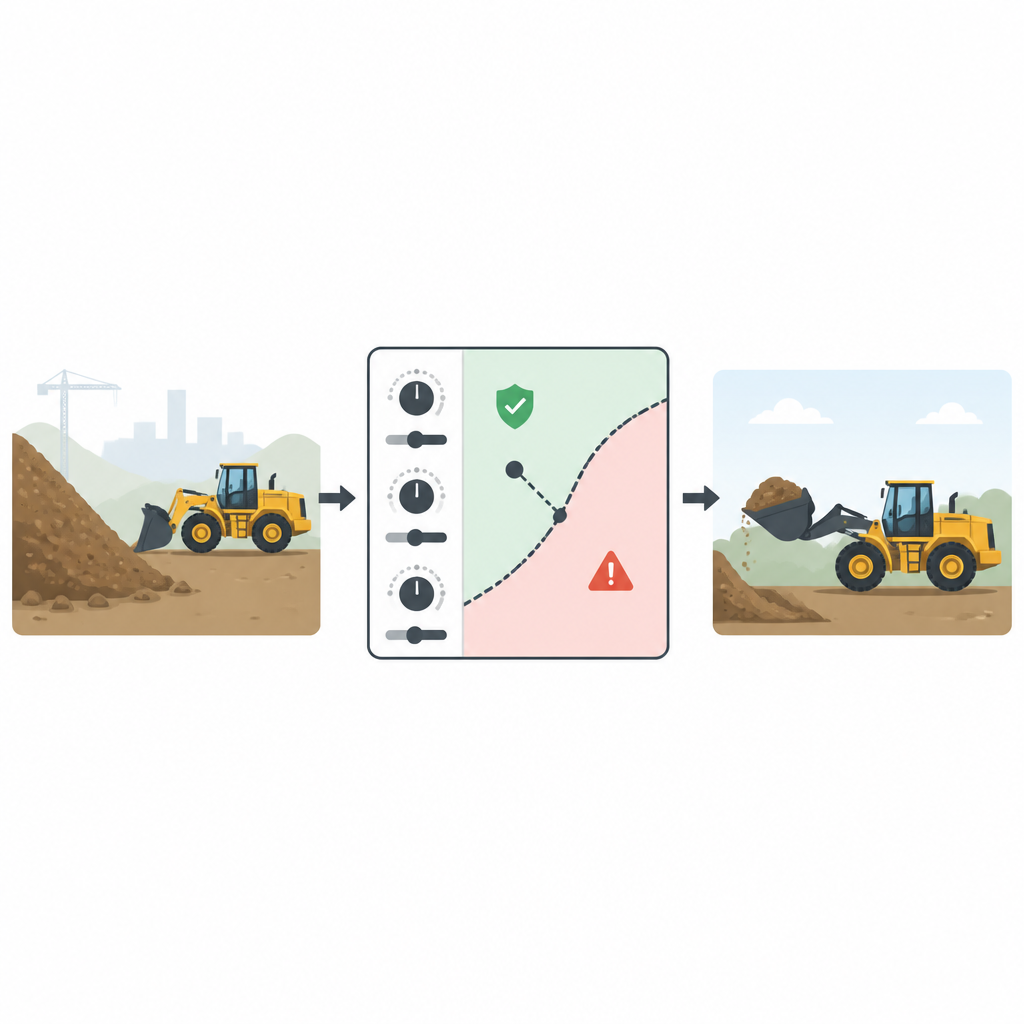
Letting the optimizer explore carefully
In the second stage, the researchers perform Bayesian optimization, a strategy for choosing new trials that balances trying promising settings and exploring uncertain ones. Here they extend a common rule for picking the next trial so that it also favors settings with higher safety probability from the first stage. A single weight controls how cautious the search is: a larger value steers the search toward safer parts of the map, while a smaller one allows bolder moves closer to the risky edge. Importantly, the earlier safety map is kept fixed during this stage to avoid bias, and only real or simulated digging performance is updated as new trials are run.
Testing the idea on simple landscapes and virtual dirt
To check whether their method behaves as intended, the authors first apply it to a toy problem where the true safe region and the quality of each setting are known. Their two-stage approach matches the speed of standard optimization methods in finding high-performing settings, but with far fewer failures than approaches that either ignore safety or try to guarantee it with heavy computation. They then move to the wheel loader simulator, where the system must choose a horizontal digging speed and a bucket tilt pattern. The results show that unsafe slip events drop to below about one in ten trials, while the amount of soil collected and the required effort remain competitive with less cautious strategies. Adjusting the safety weight lets users trade occasional risky trials for faster gains or vice versa. 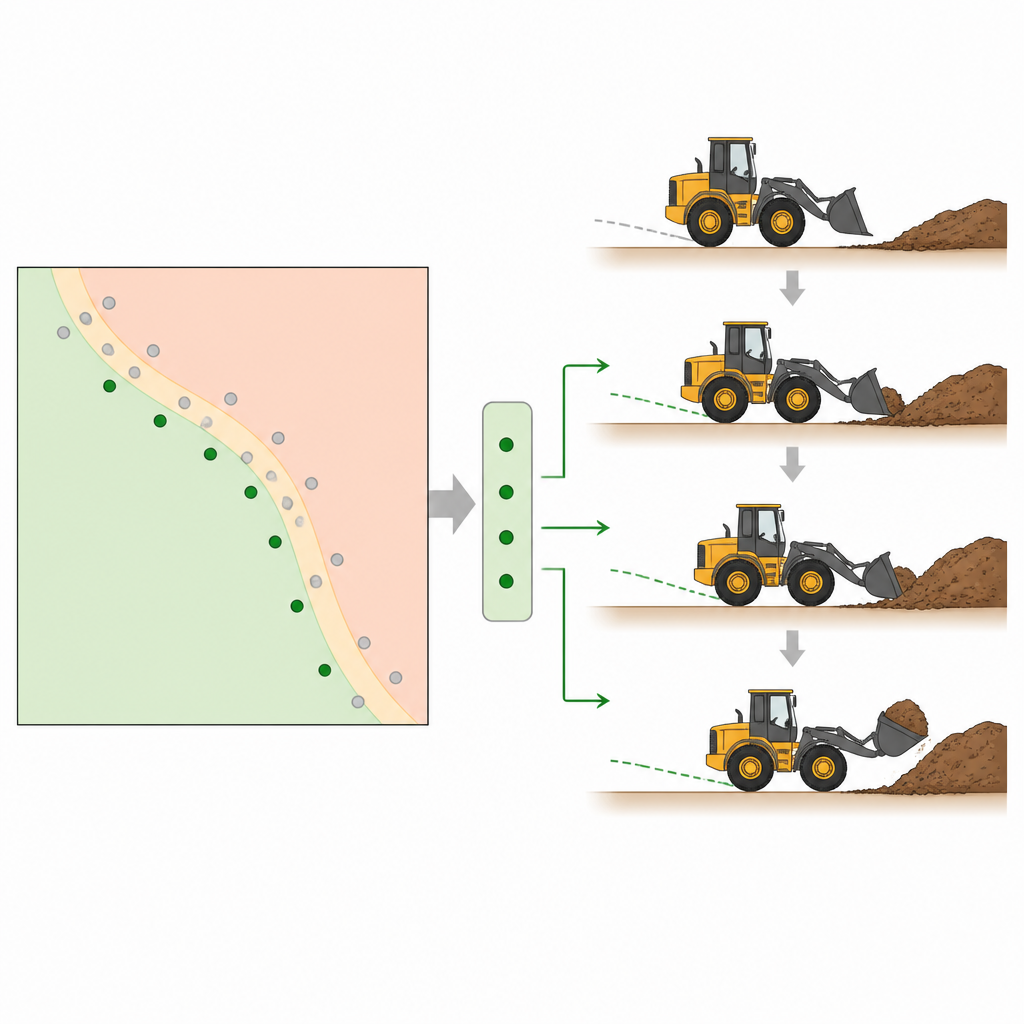
What this means for real machines
For non-specialists, the key message is that the method teaches an automatic digging system not only how to dig well, but also where the danger zone lies and how to stay just inside it. By learning a safety boundary in simulation first and then using that knowledge to guide real-world tuning, the approach can reduce the number of risky experiments needed on expensive machines. While further work is required to handle differences between simulated and real soil and to scale up to more control settings, this two-step strategy points toward construction robots that can learn efficiently while keeping both people and equipment safer.
Citation: Koyama, M., Ishikawa, M. Failure-avoidance bayesian optimization with failure-boundary search for automatic exploration of digging control parameters. Sci Rep 16, 15580 (2026). https://doi.org/10.1038/s41598-026-45046-7
Keywords: Bayesian optimization, automatic excavation, construction robotics, safe control, wheel loader