Clear Sky Science · en
Preliminary efficacy of cognitive multisensory rehabilitation for neuropathic pain in chronic spinal cord injury: a phase I randomized controlled trial
Why this matters for people living with pain
Many people with spinal cord injuries live with constant burning, shooting, or electric shock–like pain that medicines only partly ease and that can last for years. This study tests a very different approach: instead of focusing directly on the spinal cord or on drugs, it tries to retrain how the brain senses and understands the body. The findings suggest that carefully guided exercises that rebuild body awareness may sharply reduce pain and help people move and function better, even long after the original injury.
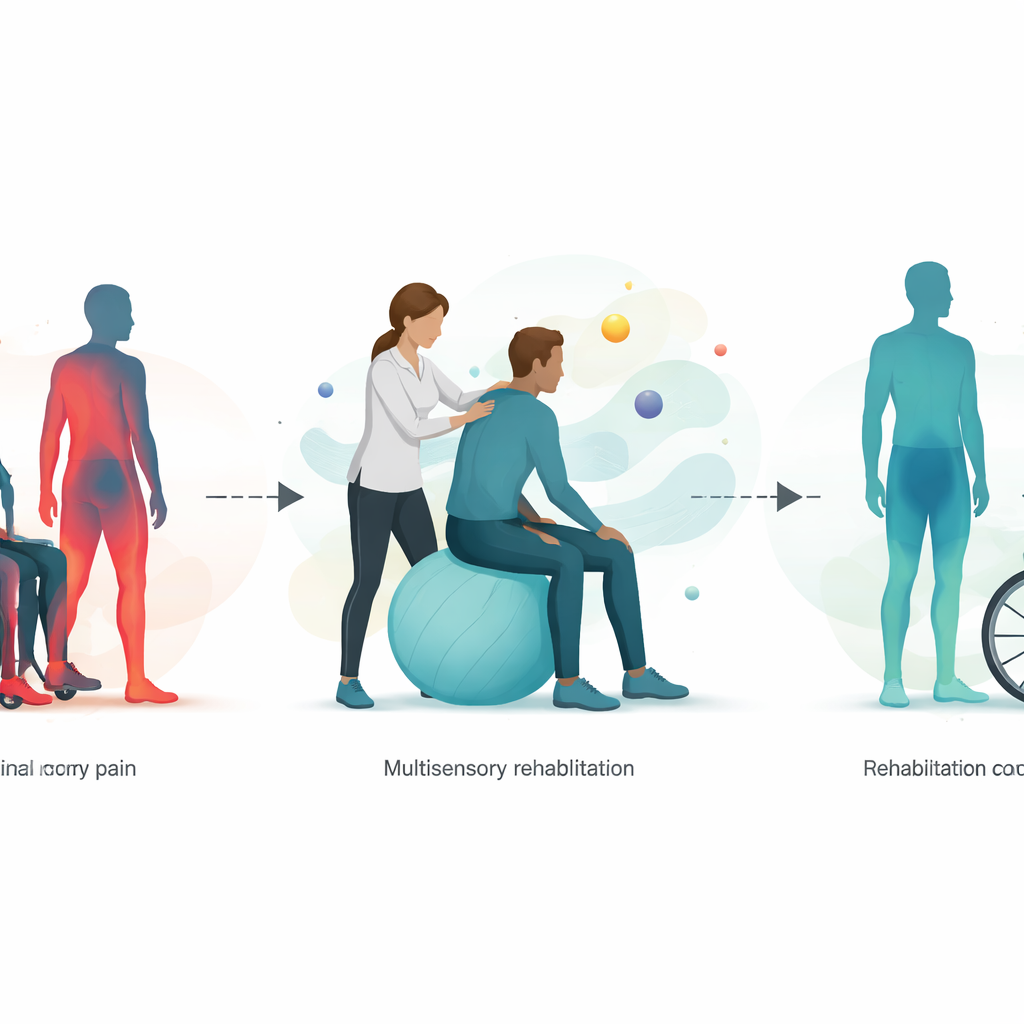
Living with a confused body map
After a spinal cord injury, the brain receives scrambled or missing nerve signals from the body. Over time, this can distort the brain’s internal “map” of where body parts are and how they feel. People may sense their legs as too big or too small, too heavy, or strangely distant, and they can feel pain in areas they cannot move or even feel to the touch. The researchers suspected that this disturbed body map does more than cause odd sensations—it may actually help drive ongoing neuropathic pain, which affects roughly two thirds of adults with spinal cord injury and often resists standard treatments.
A therapy that trains the senses and the mind
The team tested Cognitive Multisensory Rehabilitation (CMR), a form of physical therapy that blends gentle touch, movement, and guided imagination to rebuild a clear sense of the body. Rather than doing strength exercises, participants focused on feeling the position, size, and weight of their limbs, often with their eyes closed. Therapists asked them to compare what they were feeling in the moment with detailed memories from before their injury—for example, the difference between a foot pressing on a bicycle pedal and a foot resting on the ground. These sessions aimed to help the brain reconnect present sensations with older, intact body memories, gradually sharpening the body map.
How the study was carried out
Twenty-six adults with long-standing spinal cord injuries and significant neuropathic pain took part. They were randomly assigned either to begin CMR right away for six weeks or to spend six weeks in their usual care before receiving the same CMR program. Everyone eventually received 18 sessions over six weeks. The researchers measured pain levels every week, tested touch and muscle strength, and collected detailed reports about daily activities, mood, and quality of life. They also used brain scans, both at rest and during light brushing of the toes, to see how brain activity and connections changed with treatment.
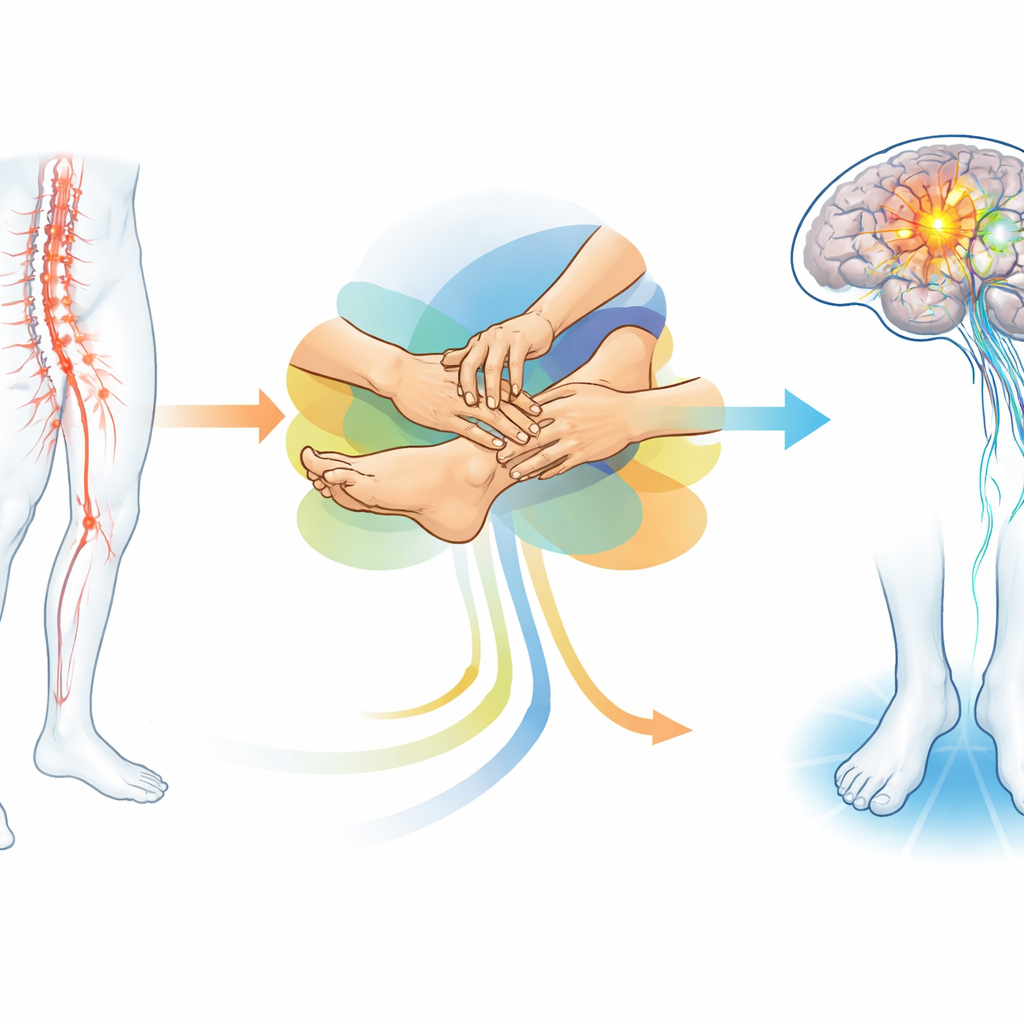
Less pain, stronger feeling, better daily life
After CMR, participants reported striking drops in pain. On a 0–10 scale, the worst neuropathic pain fell by nearly 5 points on average, and everyday pain fell by just over 4 points. About one in three people became completely free of neuropathic pain, and many were able to reduce or stop pain medications, including opioids, with their doctors’ approval. Sensation to light touch and pinprick in the legs improved, leg strength increased, and spasms became less frequent and less severe. People described being able to stand with less help, transfer more easily, feel their feet on wheelchair footplates instead of worrying they were slipping, and move with better balance and control. Anxiety and low mood eased, and ratings of physical and psychological quality of life improved.
What changed inside the brain
Brain scans offered clues to how this therapy might work. After CMR, a key region along the side of the brain that helps combine touch, movement, and pain signals showed stronger connections with nearby areas involved in body awareness and spatial mapping. During a simple toe-brushing task in the scanner, more of the brain’s sensory and body-awareness regions lit up, especially in areas tied to feeling where body parts are in space. Importantly, some people who could not feel the toe brushing at the start of the study regained some sensation afterward, and half of those who initially had no toe feeling improved. These changes suggest that the brain was not only picking up faint signals from below the injury more effectively, but also placing them into a clearer, more accurate body map.
What this could mean for the future
This early trial was small and did not compare CMR to another active therapy, so larger and more rigorous studies are needed. Still, the results challenge the idea that recovery plateaus a couple of years after spinal cord injury. Many participants were years or even decades past their injury yet experienced marked, lasting relief from pain and gains in function. By targeting how the brain represents the body, CMR may open a new path for easing stubborn neuropathic pain and improving movement—one that works with the brain’s own ability to reorganize, rather than relying solely on drugs or surgery.
Citation: Van de Winckel, A., Carpentier, S.T., Deng, W. et al. Preliminary efficacy of cognitive multisensory rehabilitation for neuropathic pain in chronic spinal cord injury: a phase I randomized controlled trial. Sci Rep 16, 14330 (2026). https://doi.org/10.1038/s41598-026-44859-w
Keywords: spinal cord injury, neuropathic pain, rehabilitation therapy, body awareness, brain imaging