Clear Sky Science · en
Identification and classification of repeated whistle types from free-ranging rough-toothed dolphins (Steno bredanensis)
Listening to Dolphins in the Open Ocean
Out in the clear blue waters off Madeira Island lives a little‑known dolphin with a big acoustic secret. Rough‑toothed dolphins are rarely seen up close, yet they rely on high‑pitched whistles to stay connected as they travel and hunt in shifting groups. This study set out to eavesdrop on these ocean wanderers and ask a deceptively simple question: do individual animals or groups have characteristic whistles they repeat, much like names or social calls, and how can scientists reliably detect such patterns in the wild?
Why Dolphin Voices Matter
For most land animals, sight and smell carry a lot of social information. In the ocean, light fades quickly and scents disperse, so sound becomes the primary long‑distance channel. Toothed whales, including dolphins, use whistles to help maintain social bonds and coordinate group movements. In bottlenose dolphins, decades of work have shown that many individuals develop distinctive “signature” whistles that function somewhat like personal IDs. But for rough‑toothed dolphins, whose lives unfold mostly far from shore, very little is known about whether they also rely on repeated call types to mark identity or keep track of companions.
Recording Wild Dolphins at Sea
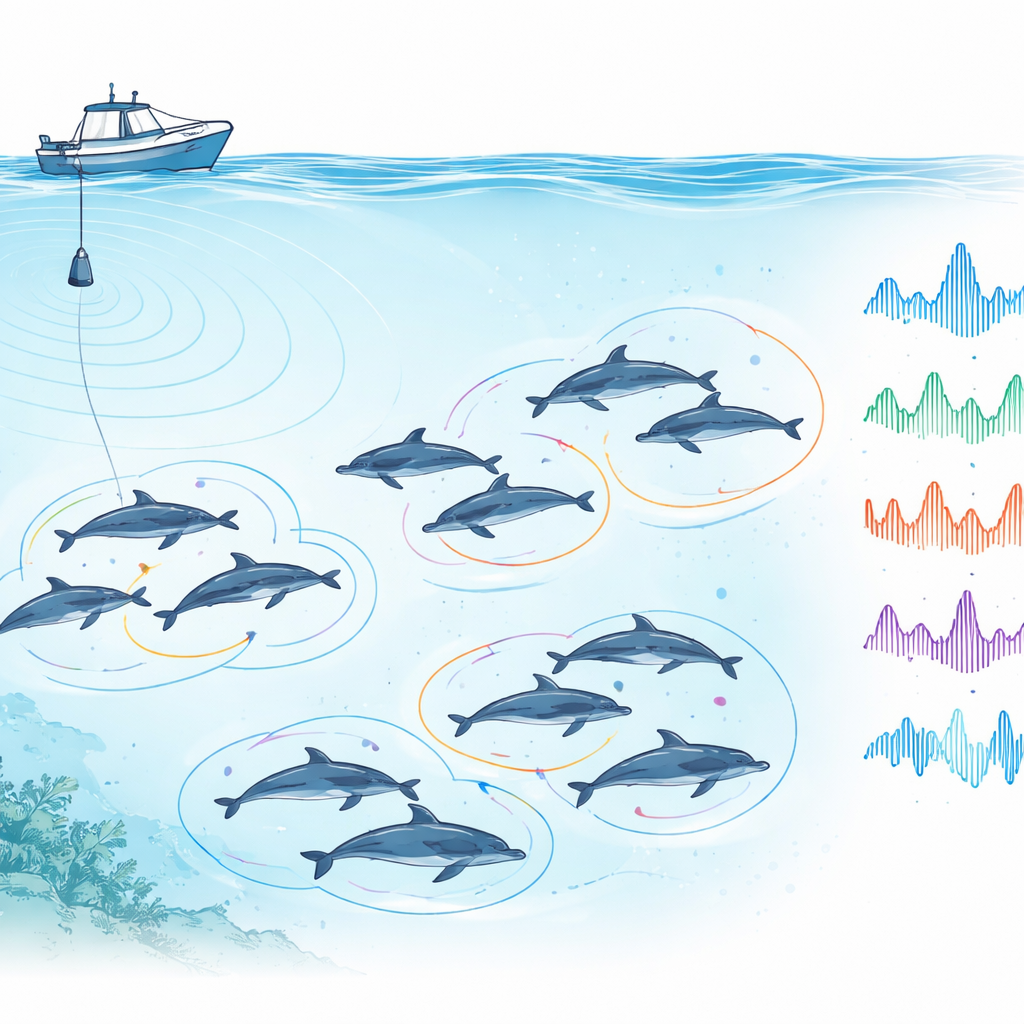
To explore this, researchers followed rough‑toothed dolphins during three encounters in the summer of 2023 off Madeira. Working from a small research boat with the engine turned off, they lowered an underwater microphone to quietly record the animals whenever at least part of the group passed within 100 meters. At the same time, they photographed dorsal fins to identify individual dolphins and see which animals reappeared on different days. Over a total of 262 minutes of recordings, they detected 4,928 whistles. From these, 1,015 whistles stood out as clearly repeated shapes in the sound patterns and were grouped into candidate types for closer analysis.
Sorting Whistles by Ear and by Algorithm
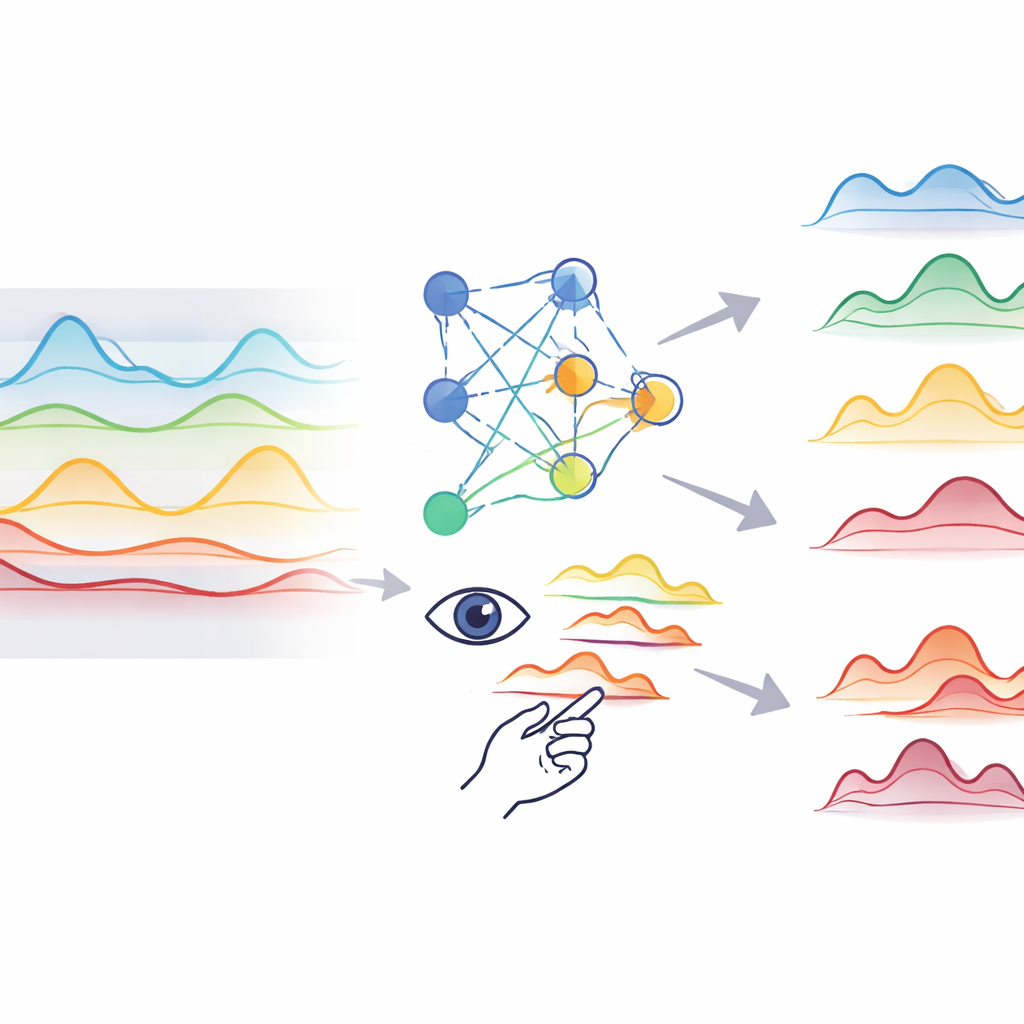
The team approached the problem of “who is whistling what” from two directions. First, an experienced analyst visually scanned spectrograms—pictures of sound that show pitch over time—and grouped similar‑looking whistle contours. Whistles with highly similar shapes that occurred at least three times within a short window were treated as repeated types. A subset of 120 whistles was then given to six additional experts, who independently sorted them into categories. Agreement among five of these judges was high enough to support the main visual groupings, yielding 25 distinct repeated whistle types, some of which appeared on multiple recording days. Next, the researchers extracted the precise contour of each whistle and fed these data into ARTwarp, an unsupervised neural‑network tool designed to automatically cluster tonal animal calls based on how closely their shapes match, even when the calls stretch or compress slightly in time.
What the Dolphins’ Patterns Reveal
Across the different methods, clear clusters of similar whistles emerged, confirming that rough‑toothed dolphins do produce repeated call types. These whistles tended to occur in bouts—short sequences where the same type was repeated several times—with most intervals between repeats falling within a few seconds. That rhythm resembles patterns seen in well‑studied bottlenose dolphins, where repetition helps maintain contact. However, the degree of stereotypy in rough‑toothed dolphins was lower: whistles in the same category often showed more variation in length or small stepped segments than is typical in classic “signature” calls. Human judges sometimes disagreed on whether two similar contours represented one type or two, and the automatic classifier often merged such debatable categories, suggesting that the animals’ own calls may be flexible within an overall template.
Clues, But Not Yet Names
These findings offer the first systematic glimpse of how wild rough‑toothed dolphins reuse particular whistles, hinting that repeated signals may help individuals or subgroups stay linked in their fission–fusion society, where small clusters constantly split and rejoin. Yet the study could not track exactly which dolphin produced each sound, nor tie whistles directly to behavior, so it cannot say for sure whether any type functions as a true personal signature or as a shared group call. Instead, it shows that this species has a set of recurring whistle patterns with moderate stereotypy, likely tuned to life in open waters and large, loosely connected groups. Future work combining multi‑hydrophone recordings, fine‑scale tracking, and behavioral observation will be needed to learn whether these repeated whistles act as names, family badges, or flexible contact calls that help rough‑toothed dolphins navigate their complex social world.
Citation: Redaelli, L., Janik, V.M., Alves, F. et al. Identification and classification of repeated whistle types from free-ranging rough-toothed dolphins (Steno bredanensis). Sci Rep 16, 14327 (2026). https://doi.org/10.1038/s41598-026-44853-2
Keywords: dolphin communication, animal vocalization, marine bioacoustics, social behavior, rough-toothed dolphin