Clear Sky Science · en
A STDFT-CEEMD approach with wavelet packet thresholding for exon prediction in eukaryotic cells
Finding the Useful Parts of Our Genetic Code
Inside every cell, long strings of DNA carry instructions for building the proteins that keep us alive. But only certain stretches of this DNA actually code for proteins, while large sections act more like punctuation or background. This paper tackles a key challenge in modern genetics: how to reliably spot the protein-coding pieces, called exons, inside huge amounts of raw DNA data using smart signal-processing tools borrowed from engineering.
Why Separating Signal from Noise Matters
Genes in humans and other complex organisms are broken into exons, which carry useful instructions, and introns, which do not. During protein production, cells copy DNA into RNA and then cut out the introns, stitching exons together into a final message that determines a protein’s makeup. Identifying where exons begin and end is crucial for understanding how genes work, how diseases arise, and how treatments might be tailored. Traditional computer methods rely heavily on large, carefully labeled training data or detailed biological models, which are not always available or may fail on poorly studied species. That is why methods that can work directly on raw DNA, treating it like a signal to be analyzed, are increasingly attractive.
Turning DNA into a Signal
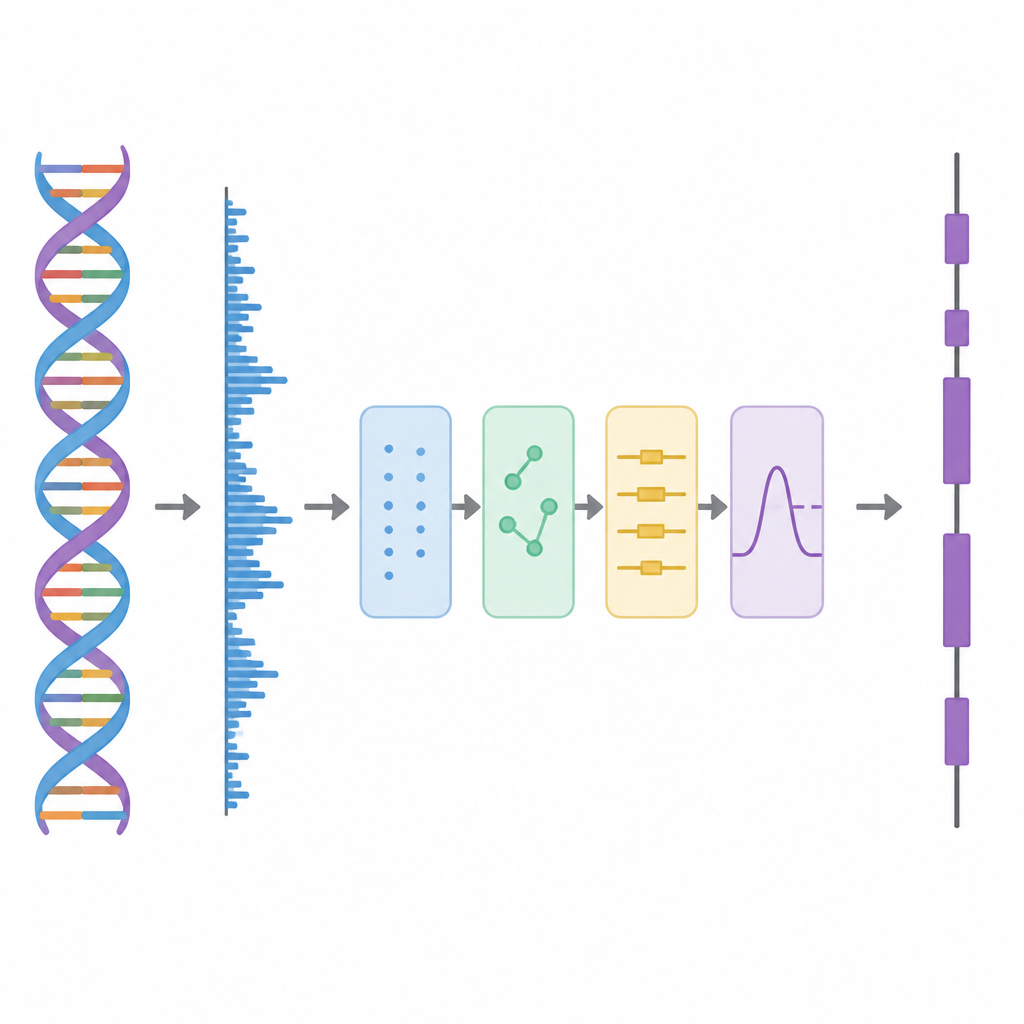
In this study, the authors treat DNA as if it were a waveform, similar to an audio track, and then apply a sequence of processing steps. First, each of the four DNA letters is turned into numbers using a special scheme based on Hadamard matrices, which are carefully chosen patterns of plus and minus ones. This step creates four clean numeric tracks that keep all the information from the original sequence but are better suited for analysis. Next, the method scans along the sequence with a sliding window and uses a time–frequency tool called Short-Time Discrete Fourier Transform to search for a repeating pattern that appears every three bases. This “period-3” rhythm is a well-known feature of protein-coding regions because proteins are built from three-letter words, or codons, in the genetic code.
Peeling Apart the Layers of the Signal
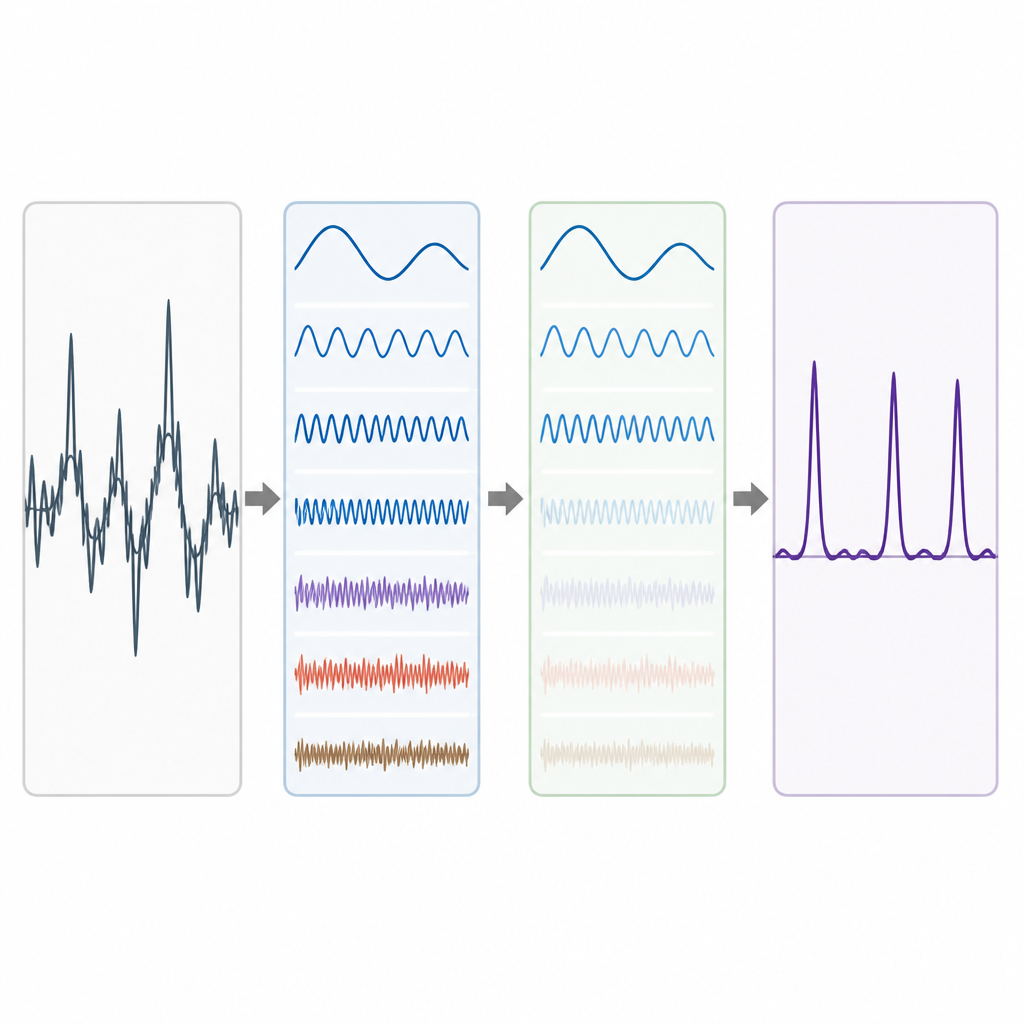
Real genomic data are messy. Long-range background trends and random fluctuations can blur the period-3 pattern, especially for short exons. To tackle this, the authors borrow an idea from advanced signal decomposition, in which a complicated waveform is split into simpler building blocks. They use a technique called Complete Ensemble Empirical Mode Decomposition, which repeatedly adds carefully balanced noise and then averages the results to produce a set of cleaner components. A self-correlation measure is then used to decide which of these components carry meaningful structure and which are dominated by noise. The noisy pieces are further cleaned using wavelet packet thresholding, a method that trims away small, jittery variations while preserving the main shape of the signal.
Testing the Method on Real Genes
To see how well their pipeline works, the authors apply it to well-studied genes from the roundworm Caenorhabditis elegans and the house mouse, as well as to a benchmark collection of 195 gene segments from human, mouse, and rat. In each case, they compare their exon predictions with expert annotations. Their approach produces clearer peaks where true exons occur and lower background in regions that do not code for proteins. When they summarize performance using common measures such as sensitivity, specificity, accuracy, and area under the ROC curve, their method consistently outperforms several earlier signal-processing approaches that rely on simpler filters or less refined decompositions. The gains are especially notable in balancing correct detection of exons with avoidance of false alarms.
What This Means for Genomic Analysis
For readers, the main takeaway is that the authors have built a more precise “listening device” for the genome. By carefully mapping DNA to numbers, tracking its rhythms over short windows, peeling apart the signal into clean components, and removing noise in a targeted way, they obtain a much sharper view of where protein-coding instructions lie. Although the current implementation can be computationally heavy and still requires tuning certain settings, the framework shows that tools from modern signal processing can meaningfully improve how we read the genome. In the long run, such methods could help scientists annotate new genomes faster and support downstream studies of gene function, disease mechanisms, and personalized medicine.
Citation: Benarjee, S., Vaegae, N.K. A STDFT-CEEMD approach with wavelet packet thresholding for exon prediction in eukaryotic cells. Sci Rep 16, 15948 (2026). https://doi.org/10.1038/s41598-026-43722-2
Keywords: exon prediction, genomic signal processing, DNA analysis, protein coding regions, noise reduction