Clear Sky Science · en
Growth, productivity and profitability of potato (Solanum tuberosum L.) as influenced by nitrogen fertilizer and intra-row spacing in Ethiopia highlands
Why potatoes and spacing matter
Potatoes are not just comfort food; they are a lifeline crop for millions of small farmers. In Ethiopia’s cool highlands, potatoes could yield much more than they do now, helping families earn better incomes and strengthen food security. But many farmers still rely on blanket advice about fertilizer and planting distances that may not suit their soils or varieties. This study asked a very practical question: for a popular Ethiopian potato called Belete, what mix of nitrogen fertilizer and plant spacing produces the most food and the best profit for farmers?
Testing smarter ways to grow potatoes
The researchers ran a field experiment on a farmer’s land in the Ethiopian highlands during the 2023 rainy season. They focused on two farming decisions: how much nitrogen fertilizer to apply, and how far apart to plant seed tubers within each row. Four nitrogen levels were tested (from none to a relatively high dose) and three within-row spacings (20, 30, and 40 cm) were combined in all possible ways. The team planted the improved Belete variety, managed the plots uniformly, and then carefully recorded how fast the plants emerged, flowered, and matured, how tall they grew, how many stems they produced, and how many tubers of different sizes formed under each treatment. 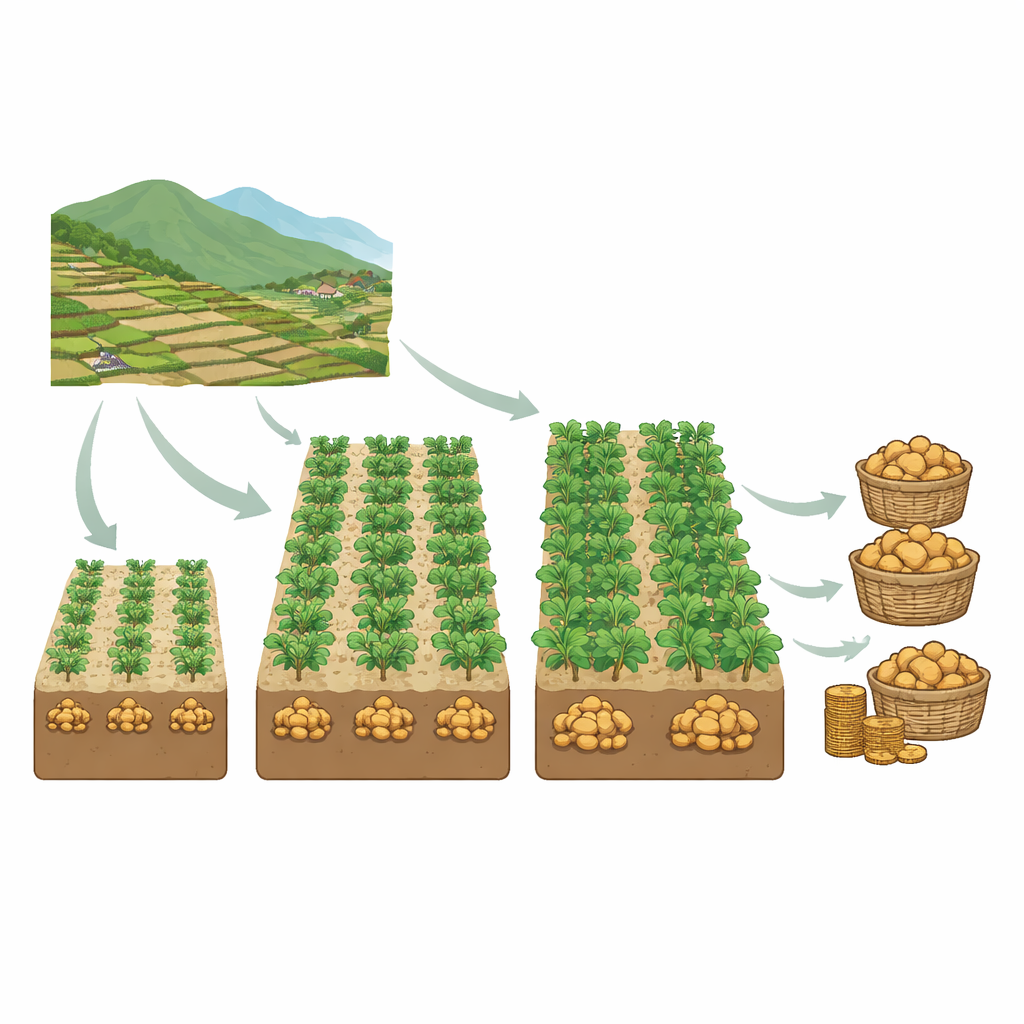
From plant growth to tuber size
Nitrogen turned out to be a powerful driver of plant growth. With more nitrogen, potato plants grew taller, produced more stems, flowered later, and took longer to reach maturity. Wider spacing between plants also encouraged taller plants and more stems per hill, because each plant had more room and access to light, water, and nutrients. These growth changes translated into big differences in what really matters to farmers: the number and size of tubers. Without nitrogen and at close spacing, plants produced many very small tubers, which have low market value. As nitrogen increased, the share of medium and large tubers rose, especially when spacing allowed enough room for each plant to develop.
How spacing reshapes the harvest
Plant spacing played a separate but equally important role. Very close spacing (20 cm) boosted the number of plants per hectare, which helped total marketable yield in some cases but also increased competition underground. This crowding favored large numbers of undersized or misshapen tubers and more unmarketable yield, especially when nitrogen was lacking. Wider spacing (40 cm) reduced competition and favored fewer but larger tubers, particularly when paired with moderate nitrogen. An intermediate spacing of 30 cm often struck the best balance, producing plenty of tubers in the medium and large size range that buyers prefer for seed and for eating. 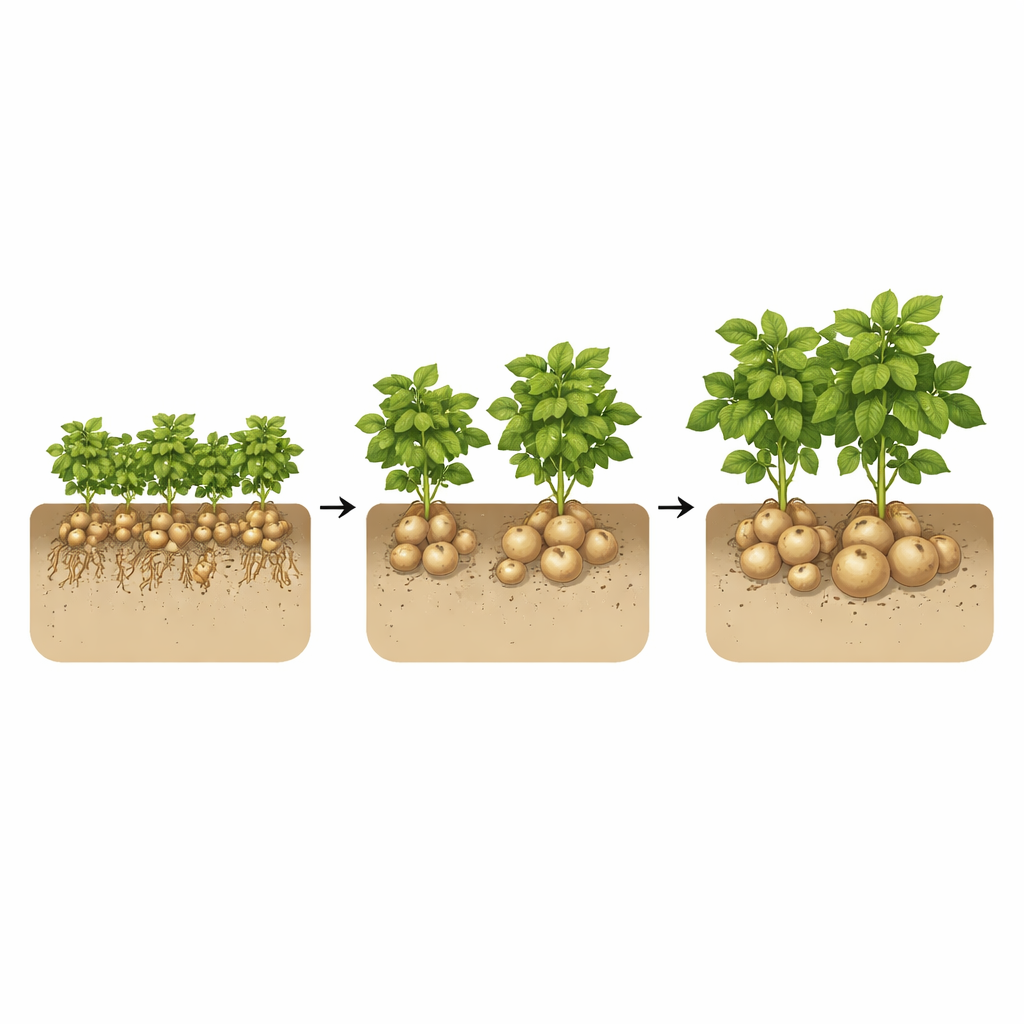
From yield in the field to money in the pocket
To see which combinations actually paid off for farmers, the team conducted an economic analysis. They accounted for costs of seed, fertilizer, and labor, and then calculated net income using local potato prices. The highest marketable yield—over 41 tons per hectare—came from 110 kg of nitrogen with the closest spacing of 20 cm. Yet after subtracting costs and comparing returns on each extra Birr invested, the winning option was 110 kg of nitrogen with 30 cm spacing. This treatment gave the highest net benefit and an exceptionally high marginal rate of return, meaning that a modest extra cost in fertilizer and seed spacing changes generated a very large income gain.
What this means for farmers and food security
For smallholder farmers growing the Belete potato in Ethiopia’s highlands, the study delivers a clear and actionable message. Instead of following a one-size-fits-all fertilizer recommendation and a fixed spacing, applying about 110 kg of nitrogen per hectare and planting seed tubers 30 cm apart within rows is likely to be both productive and profitable. This combination produced high total yields, a favorable mix of medium and large tubers, and the best financial return among all treatments tested. While the findings come from a single season and location and should be confirmed in other areas and years, they point toward simple adjustments that could help boost income and food security, while also encouraging more efficient and potentially less wasteful use of nitrogen fertilizer.
Citation: Mebrie, K., Berihun, B., Asnake, D. et al. Growth, productivity and profitability of potato (Solanum tuberosum L.) as influenced by nitrogen fertilizer and intra-row spacing in Ethiopia highlands. Sci Rep 16, 13690 (2026). https://doi.org/10.1038/s41598-026-43518-4
Keywords: potato production, nitrogen fertilizer, plant spacing, Ethiopian highlands, smallholder farming