Clear Sky Science · en
The use of virtual reality to improve quality of recovery in women undergoing gynecological surgeries: a randomized controlled trial
A New Way to Ease the Road After Surgery
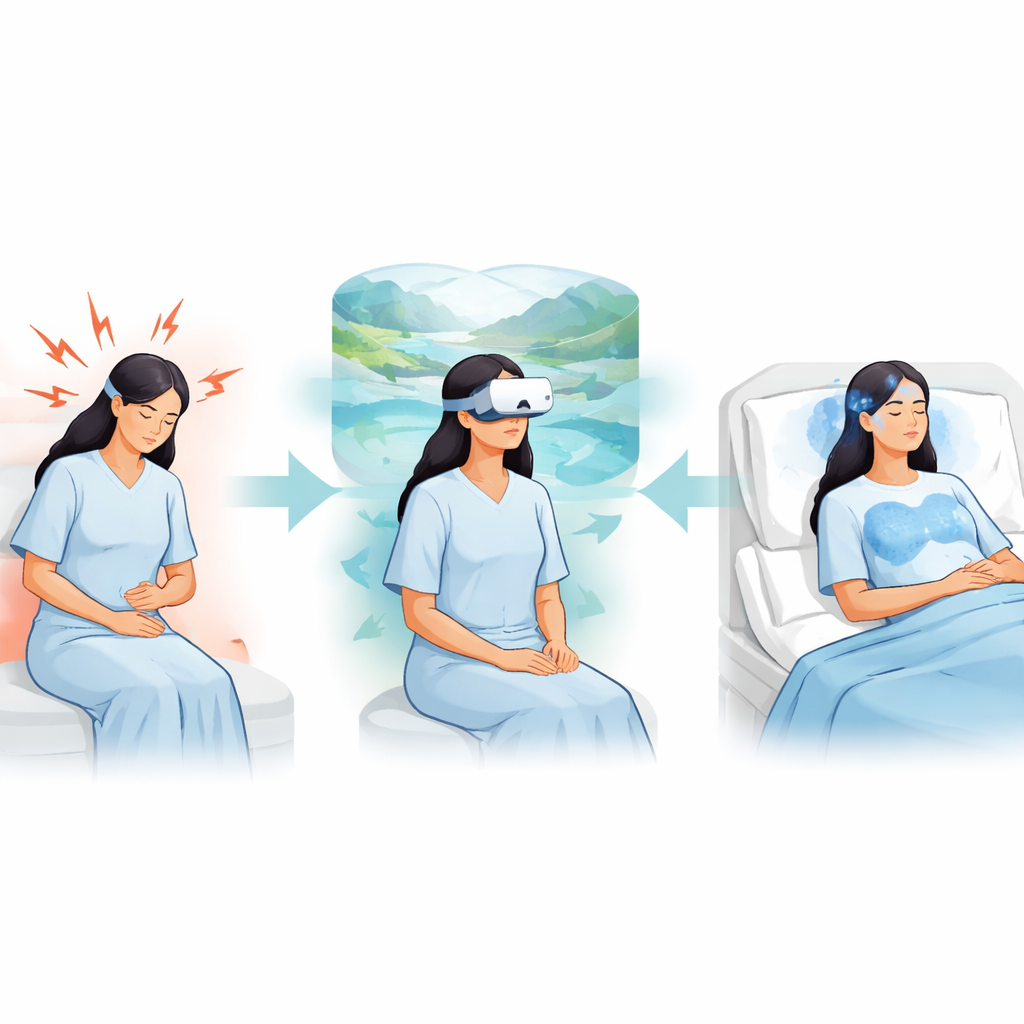
For many women, gynecological surgery does not end when they leave the operating room. The hours and days that follow can be filled with pain, nausea, and worry about how quickly they will feel like themselves again. This study asks a simple but powerful question: can slipping on a virtual reality headset—showing calming scenes and guiding slow breathing—help women recover more comfortably without adding more drugs?

Why Recovery Is About More Than the Operation
Doctors usually judge a “good” recovery by medical checklists: no major complications, stable vital signs, and a short hospital stay. Patients, however, often care most about how they feel—whether they can sleep, move around, and manage pain well enough to return to daily life. To capture this broader picture, researchers used a detailed questionnaire called the Quality of Recovery-40, which asks about physical comfort, independence, emotions, pain, and need for support. In gynecological surgery, where discomfort and anxiety are common, improving these lived experiences is just as important as the technical success of the procedure.
How the Virtual Journeys Were Used
The trial took place at a women’s hospital in Singapore and enrolled 104 women, ages 21 to 70, scheduled for various gynecological operations such as cyst removal, fibroid surgery, and hysterectomy. All patients received standard anesthesia and pain care. Half were randomly assigned to an extra intervention: several short virtual reality sessions. Using a lightweight headset, these women could choose from nine tranquil scenes—such as blue oceans, green meadows, or snowy landscapes—paired with soothing music and guided breathing. They used VR once before surgery and three times in the first 24 hours afterward, each session lasting 10 to 20 minutes. The other half of the women did not use VR; they simply completed the same questionnaires and pain ratings.
What Changed When VR Was Added
One day after surgery, women who used VR reported better overall recovery scores than those who did not. The differences were most noticeable in two areas: feeling physically comfortable and feeling less burdened by pain. Although both groups saw a dip in well-being immediately after surgery—as is expected—the VR group began to rebound more quickly. Their scores for physical comfort, independence, and pain tended to climb sooner and stay higher over the next two to three days. Interestingly, women in the VR group started off with slightly higher anxiety before surgery, yet their anxiety ratings dropped more sharply and remained lower at 48 and 72 hours after the operation.
Pain, Pills, and Peace of Mind
When researchers looked at simple numerical pain ratings at rest and with movement, the two groups were similar. However, women who used VR tended to need less paracetamol (a common pain reliever) in the first 24 hours after surgery. The pain-related part of the recovery questionnaire also improved more in the VR group, suggesting that VR may change how patients experience and cope with discomfort, even if the raw pain scores do not shift dramatically. Many women reported high satisfaction with the VR sessions; nearly all rated the experience as good or excellent, and blue and green nature scenes were especially popular, echoing broader research that such colors and environments can ease stress.
What This Means for Patients and Hospitals
The study shows that adding brief virtual reality sessions around the time of gynecological surgery can modestly improve how women feel in the first day after their operation and lower their anxiety for up to three days, without extra drugs or invasive treatments. The size of the benefit, while statistically clear, may be small from a strict clinical standpoint, and the findings come from one hospital group of mostly Asian women. Still, the work suggests that immersive, calming experiences can be woven into routine care to support both body and mind. As hospitals look for ways to promote gentler, more patient-centered recoveries, a simple headset and a virtual walk through a blue ocean or green forest may become part of the standard toolkit.
Citation: Chan, J.J.I., Sultana, R., Ho, Y.T.R. et al. The use of virtual reality to improve quality of recovery in women undergoing gynecological surgeries: a randomized controlled trial. Sci Rep 16, 12261 (2026). https://doi.org/10.1038/s41598-026-41984-4
Keywords: virtual reality, postoperative recovery, gynecologic surgery, pain and anxiety, non-drug therapies