Clear Sky Science · en
Work-related musculoskeletal risk factors in medical laboratory students: A cross-sectional insights from a RULA-based assessment with lifestyle correlates
Why Student Lab Work Can Be Hard on the Body
Hours spent hunched over microscopes or carefully pipetting samples may not look dangerous, but they can quietly strain the body. This study explores how the everyday posture of medical laboratory students—future professionals who will repeat these tasks for years—might already be putting stress on their muscles and joints. It also asks whether lifestyle habits like exercise, sleep, and overall wellbeing help protect students from this hidden wear and tear.

What the Researchers Wanted to Learn
The team focused on work-related musculoskeletal problems—aches, pains, and longer-term disorders affecting muscles and joints—that are widespread in many occupations. Laboratory professionals around the world report high rates of neck, back, and shoulder discomfort, yet students who practice similar tasks have received much less attention. The researchers set out to measure how demanding routine lab work is for students’ upper bodies, and to see whether factors such as body weight, physical activity, sleep quality, and quality of life are linked to better or worse postures during these tasks.
How the Study Was Carried Out
The study involved 31 healthy male medical laboratory students at a Saudi university. Each student performed common lab tasks—microscopy, pipetting, and seated sample handling—on standard benches and microscopes similar to those used in teaching sessions. Chair height could be adjusted, but bench and eyepiece heights stayed fixed to reflect real-world conditions. The students were filmed for five minutes per task, and three trained assessors later examined selected video frames to score posture using the Rapid Upper Limb Assessment (RULA), a widely used tool that rates how stressful neck, trunk, arm, and wrist positions are. The students also completed questionnaires about their usual physical activity, sleep quality, and quality of life, and their height and weight were measured to calculate body mass index (BMI).
What the Posture Scores Revealed
Most students did not show extremely poor postures, but their scores were far from ideal. The majority fell into RULA action levels that signal a need for investigation and possible changes, with a notable minority reaching levels where prompt ergonomic action is recommended. The greatest concern was the upper limbs—shoulders, arms, and wrists—rather than legs or lower back. When students were grouped by how active they were, those reporting higher physical activity tended to have more favorable upper-arm and overall upper-limb scores. Students with moderate activity surprisingly fared worse than both low- and high-activity groups, hinting that how activity is structured may matter as much as how much is done. Neck, trunk, and overall combined scores did not vary much with activity level.
Body Size, Sleep, and Daily Wellbeing
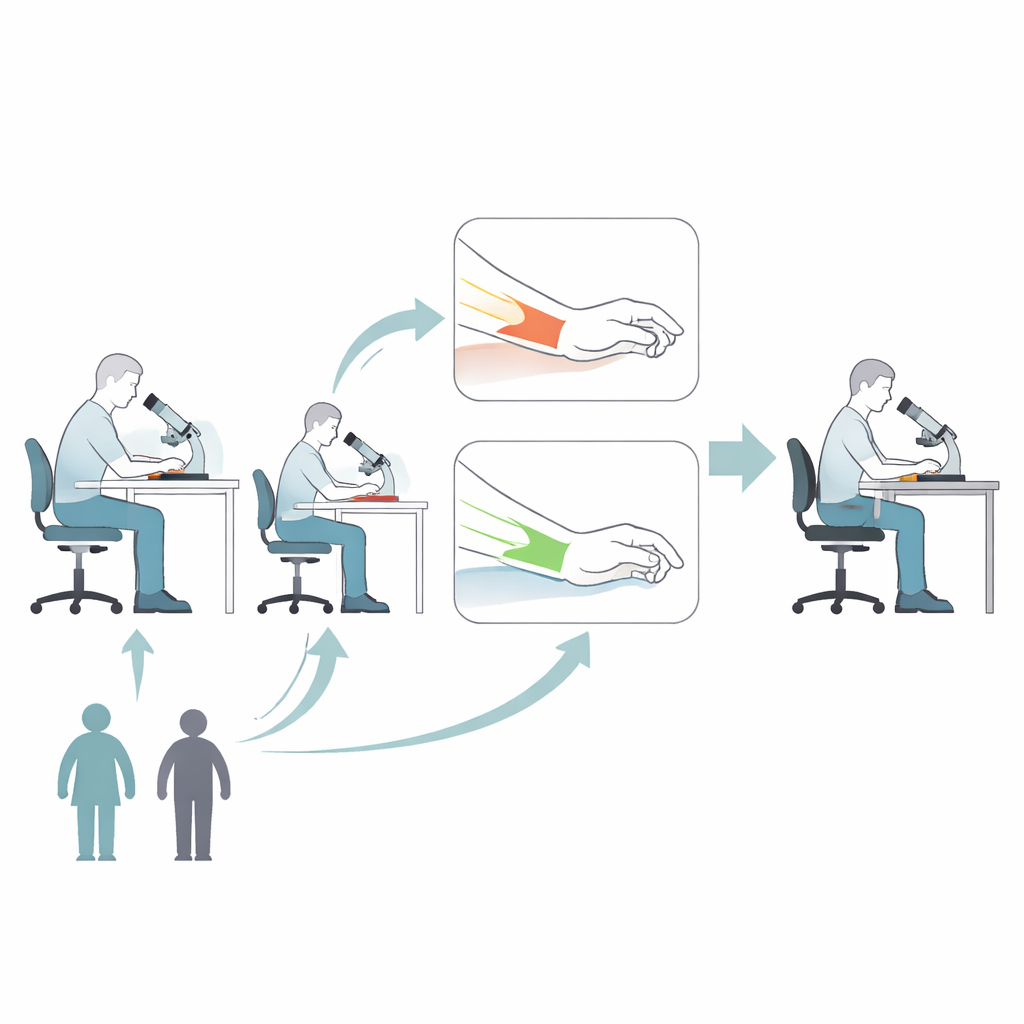
To look more closely at what might influence posture, the researchers used statistical models that considered body size, sleep quality, physical activity level, and overall quality of life at the same time. In these analyses, only BMI clearly stood out: students with higher BMI were more likely to show less favorable wrist positions, even after accounting for the other factors. In contrast, sleep quality and general quality of life were not strongly or consistently linked to posture scores in this small group. The findings suggest that how well a student’s body fits the fixed lab furniture, especially around the wrists and forearms, may be an important and modifiable source of strain. However, the authors emphasize that their sample was small, from a single site, and male only, so the results should be viewed as early signals rather than final answers.
What This Means for Safer Student Labs
From a lay perspective, the message is straightforward: even short periods of routine lab work can load the arms and wrists enough to justify ergonomic improvements. Adjusting bench and microscope heights, adding forearm supports, encouraging task rotation and brief movement breaks, and teaching students how to set up neutral sitting and arm positions could all reduce strain. Encouraging regular physical activity and addressing weight and fitness may further help students adopt healthier postures, though more research is needed to clarify these links. Overall, the study supports the idea that protecting musculoskeletal health should start during training, not just once students enter the workforce.
Citation: Alghadier, M., Alsubaie, A., Alrabie, A. et al. Work-related musculoskeletal risk factors in medical laboratory students: A cross-sectional insights from a RULA-based assessment with lifestyle correlates. Sci Rep 16, 11249 (2026). https://doi.org/10.1038/s41598-026-41498-z
Keywords: laboratory ergonomics, student musculoskeletal health, upper limb posture, physical activity and posture, body mass index and wrist strain