Clear Sky Science · en
Non-ordinary state-based peridynamics model for rock crack propagation: a combined stress-energy fracture method
Why breaking rocks matters
From tunneling beneath cities to storing carbon dioxide deep underground, many modern projects depend on how rocks crack and break. Yet watching cracks grow inside a solid block of rock in real time is extremely hard and expensive. This paper introduces a new computer-based way to simulate how cracks start, grow, bend, and link up inside rock, especially under the complicated mix of squeezing and sliding forces that occur in real engineering settings.
A new way to look at cracking
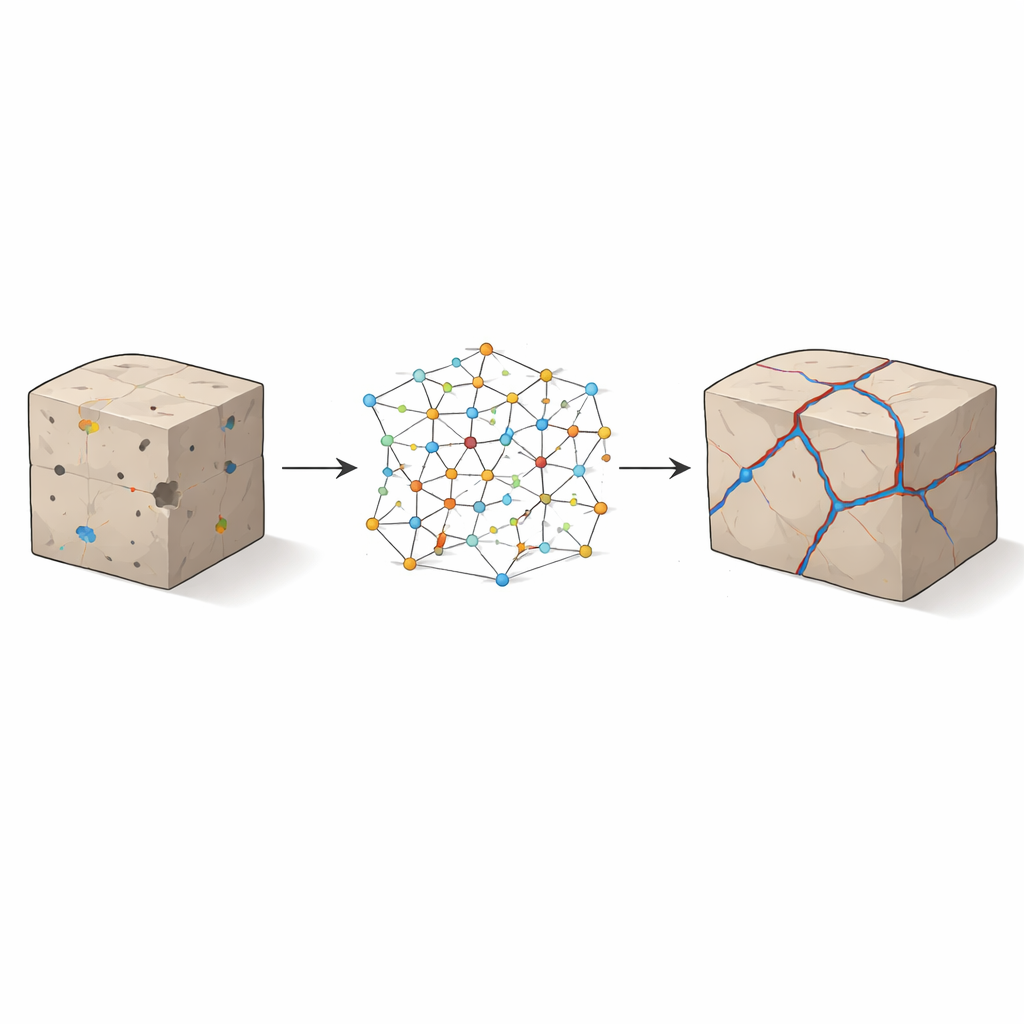
Most traditional computer models treat rock as if it were made of a continuous grid of points that only "feel" their immediate neighbors. This works well until a crack appears, because a crack is, in essence, a sudden break in continuity. The method used in this study, called peridynamics, starts from a different picture: each tiny piece of material interacts directly with many others within a certain distance, connected by invisible bonds. When the rock is loaded, these bonds stretch, compress, or slide; if they are pushed too far, they break, naturally forming cracks without extra rules or remeshing.
Fixing hidden glitches in earlier models
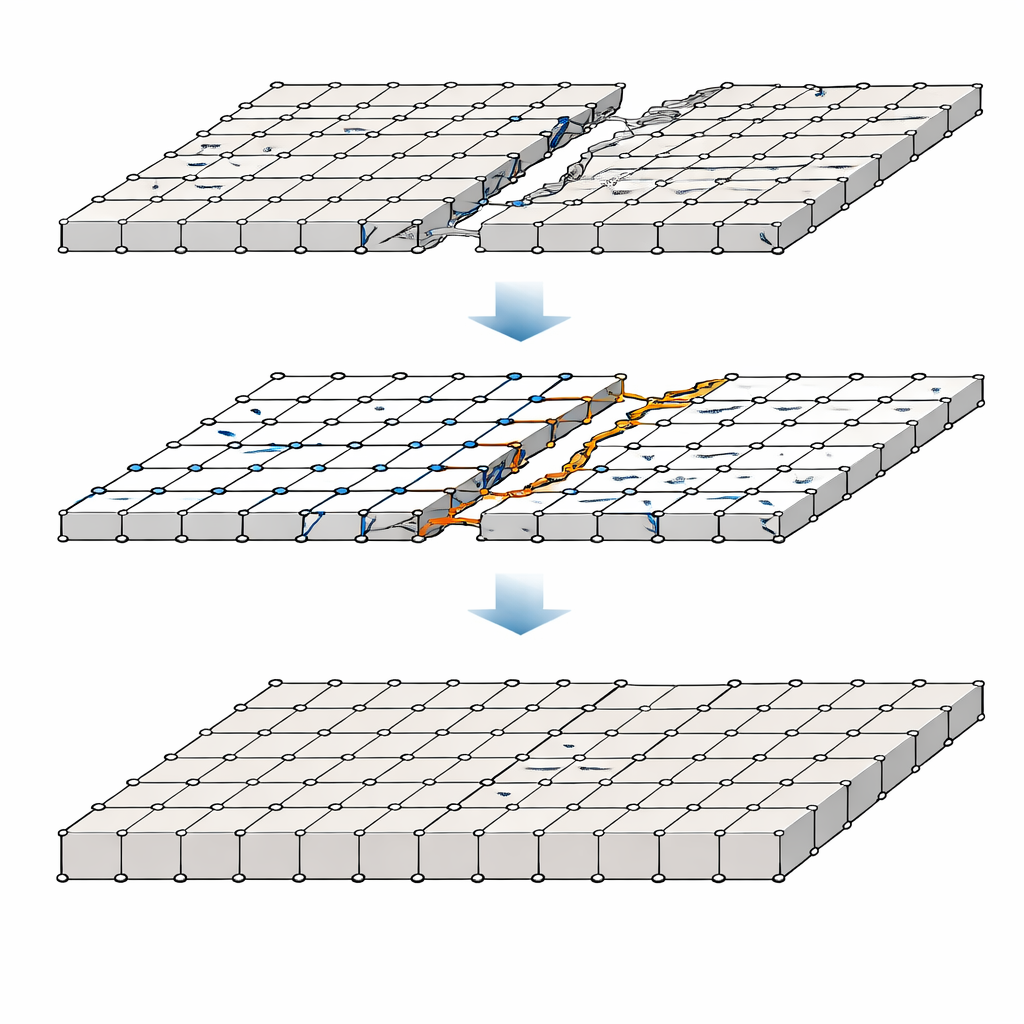
Although this bond-based view is powerful, earlier state-of-the-art versions suffered from a subtle numerical flaw. Because of how deformation was averaged, the model sometimes allowed “zero-energy modes”—wiggling motion patterns that cost almost no energy and do not make physical sense. These showed up as spurious jagged displacements and could spoil predictions of where cracks would go. The authors remove this weakness by assigning each bond its own carefully constructed measure of local deformation, built from an average of its two end points and corrected so that each bond’s initial and deformed positions are strictly compatible. This bond-level description restores a consistent local picture of stretching and shearing and sharply cuts out the nonphysical oscillations.
Teaching the model to tell shear from tension
Cracks in rock are not all alike. Under pure pulling, cracks tend to open straight up, but under compression combined with sideways sliding, they curve, branch, and form complex patterns of tensile, shear, and mixed cracks. Common engineering criteria such as the Mohr–Coulomb rule were not fully reliable when plugged directly into peridynamics, especially because they largely ignore the intermediate component of stress. In this work, the authors embed a more refined “triple shear energy” criterion at the bond level. Instead of only comparing peak and minimum stresses, this approach measures the shear energy on three possible internal sliding planes and includes the effect of the middle stress. A bond fails if either its tensile stress exceeds the rock’s tensile strength or its accumulated shear energy surpasses a threshold tied to the rock’s cohesion. This allows the simulation to distinguish between opening and sliding failures in a way that aligns more closely with laboratory observations.
Putting the method to the test
To show that the improved model is not just mathematically neat but practically useful, the authors test it against several benchmark problems. They first pull a plate with a circular hole and compare the displacements against standard finite-element results, finding nearly identical smooth fields with none of the earlier zero-energy artifacts. They then simulate a beam with two edge flaws under a four-point shear setup, a classic experiment in mixed cracking. The predicted curved crack paths, peak load, and overall load–displacement curve closely match both experiments and other high-quality numerical studies. Next, semi-circular bend specimens with inclined notches are loaded so that fracture mode gradually shifts from pure opening to mixed opening–shear. The model reproduces the observed crack initiation angles and final paths across a range of notch angles. Finally, it tackles more realistic rock blocks with one or two pre-existing flaws under compression and shear. The simulations capture well-known patterns such as wing cracks shooting away from flaw tips, conjugate shear bands, and complex linkages across rock bridges, again aligning with laboratory photos from earlier work.
What this means for rock engineering
Overall, the study shows that carefully describing deformation and failure at the scale of individual bonds makes a big difference for predicting how real rocks break. By eliminating spurious numerical modes and using a shear-energy-based failure rule that respects the full three-dimensional stress state, the model can track where and how cracks start, how they curve under changing stresses, and how separate cracks eventually connect. While still computationally demanding and based on idealized rock properties, this improved peridynamic framework offers a more reliable numerical “laboratory” for exploring crack evolution in brittle materials, with clear potential benefits for safer design in mining, underground construction, and geotechnical energy systems.
Citation: Gong, B., Song, Y., Zhang, L. et al. Non-ordinary state-based peridynamics model for rock crack propagation: a combined stress-energy fracture method. Sci Rep 16, 11386 (2026). https://doi.org/10.1038/s41598-026-40833-8
Keywords: rock fracture modeling, peridynamics, shear crack propagation, numerical simulation, brittle materials