Clear Sky Science · en
Oxytocin-induced modulation of explicit and implicit visual perspective taking
Seeing the World Through Other Eyes
Imagine walking into a room and instantly, almost effortlessly, sensing what others can see and how they see it. This everyday skill, called perspective taking, underpins everything from reading emotions to navigating crowded streets. The hormone oxytocin is often hailed as the brain’s “bonding” signal, thought to make us more social and empathetic. This study asks a deceptively simple question: does oxytocin actually help us see the world from someone else’s point of view, or can it sometimes get in the way?
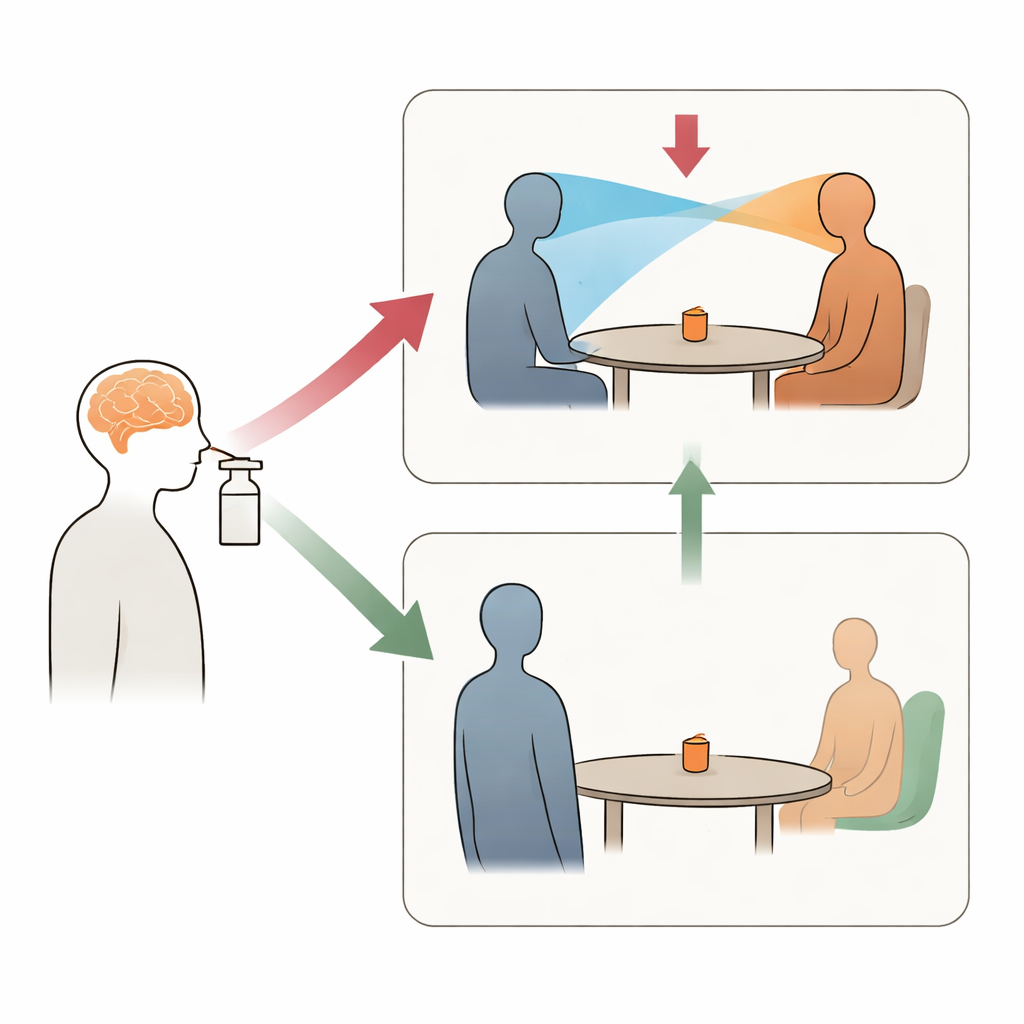
Two Ways of Taking Another’s View
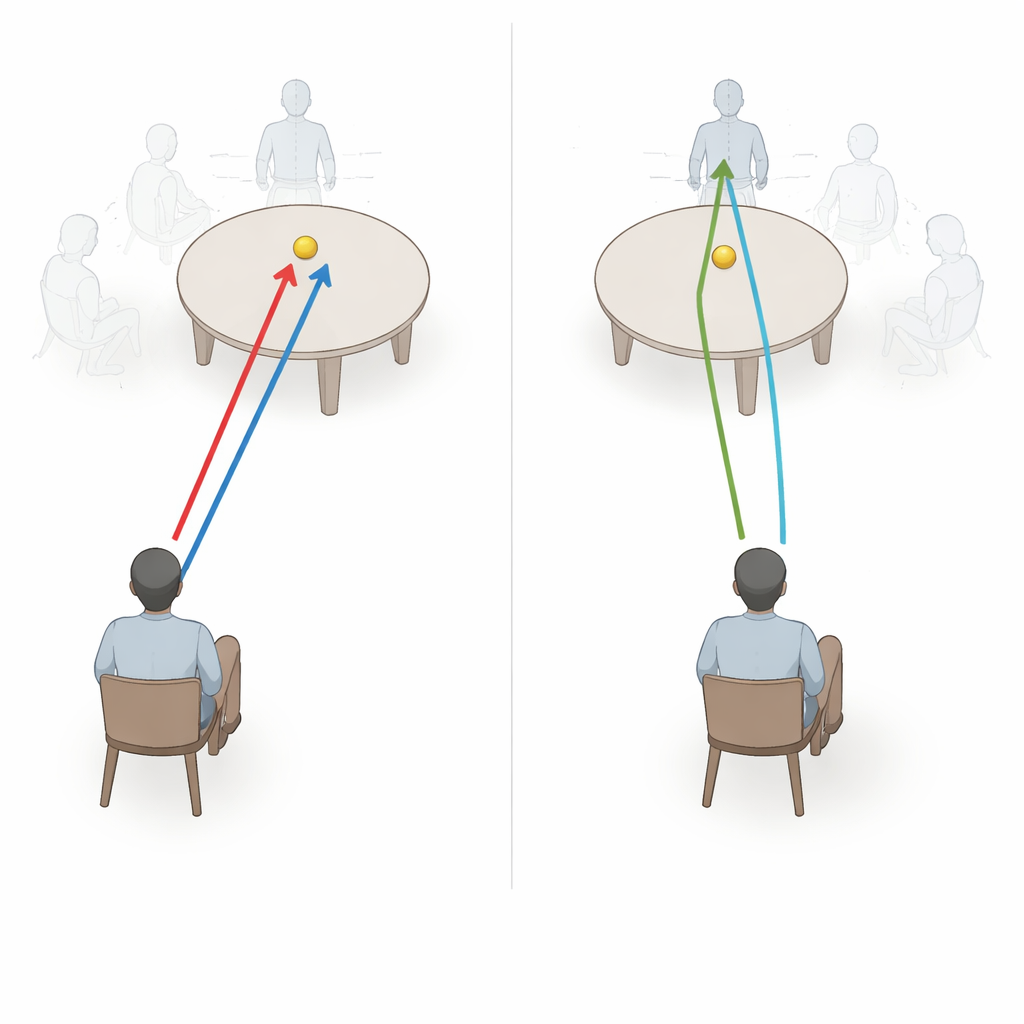
The researchers focused on visual perspective taking, the ability to judge where objects are in space from different viewpoints. They distinguished between two forms. In explicit perspective taking, people intentionally put themselves “in another’s shoes” and answer from that person’s viewpoint. In implicit perspective taking, people answer from their own viewpoint, but another person’s presence can subtly pull their attention and influence their responses even when they are not asked to think about that other person. Understanding how oxytocin affects these two modes offers a window into how the hormone shapes the boundary between self and other.
Testing Oxytocin in a Controlled Setting
Seventy-nine healthy young men took part in a double-blind, placebo-controlled experiment. Each participant self-administered a nasal spray containing either oxytocin or an inactive solution and then waited 40 minutes before performing two computerized tasks. In the explicit task, volunteers looked at a scene with a human figure (an avatar) standing beside a round table with a red ball on it. They had to decide whether the ball was to the left or right from the avatar’s viewpoint, not their own. Sometimes the avatar’s view matched their own (congruent trials), and sometimes it conflicted (incongruent trials), especially when the avatar stood at a large angle or the ball was far away.
When Others’ Views Are Background Noise
In the implicit task, the display looked similar but the instructions changed: participants now answered from their own viewpoint while the avatar, or a simple object used as a control, sat in the scene but was irrelevant to the task. The ball always appeared straight ahead from the participant’s position, so their answer was, in principle, easy. Yet the other figure’s viewpoint could still be congruent or incongruent with theirs and might tug at their attention. By comparing trials with a human avatar against trials with a non-social object, the team could test whether any effects were truly social rather than just visual distractions.
Oxytocin Blurs Boundaries Rather Than Simply Helping or Hurting
The results painted a nuanced picture. In the explicit task, oxytocin made performance slightly worse when demands were highest: participants given the hormone were less accurate when judging far-away targets from an avatar whose view conflicted with their own. Reaction times did not slow, suggesting that oxytocin did not make them generally sluggish but instead made it harder to suppress their own viewpoint. In the implicit task, the pattern flipped in socially aligned situations. With oxytocin, participants responded faster and more accurately in trials where their own view matched that of a nearby human avatar, and they were quicker when a distant human avatar was present compared with a non-social object. These effects were subtle and sometimes statistically fragile, but they consistently pointed to oxytocin changing how self and other are blended rather than uniformly sharpening that distinction.
Why This Matters for Social Minds
For a layperson, the key takeaway is that oxytocin is not a simple “social booster.” Instead, it seems to soften the border between one’s own perspective and that of others. When a situation calls for keeping perspectives separate—such as deliberately reasoning from someone else’s vantage point under high conflict—this blurring can hurt performance. When perspectives line up and another person’s view supports one’s own, the same blurring can make responses smoother and quicker. These context-dependent effects help explain why past oxytocin studies have yielded mixed findings and suggest that future uses of oxytocin, for example in conditions like autism that involve difficulties with perspective taking, will need to carefully match the social demands of the situation to the hormone’s nuanced influence on how we see ourselves and others.
Citation: Huang, Y., Qu, C., Wei, C. et al. Oxytocin-induced modulation of explicit and implicit visual perspective taking. Sci Rep 16, 9835 (2026). https://doi.org/10.1038/s41598-026-40445-2
Keywords: oxytocin, social cognition, perspective taking, self–other processing, visual attention