Clear Sky Science · en
Climate impacts from North American boreal forest fires
Why Northern Forest Fires Matter to Everyone
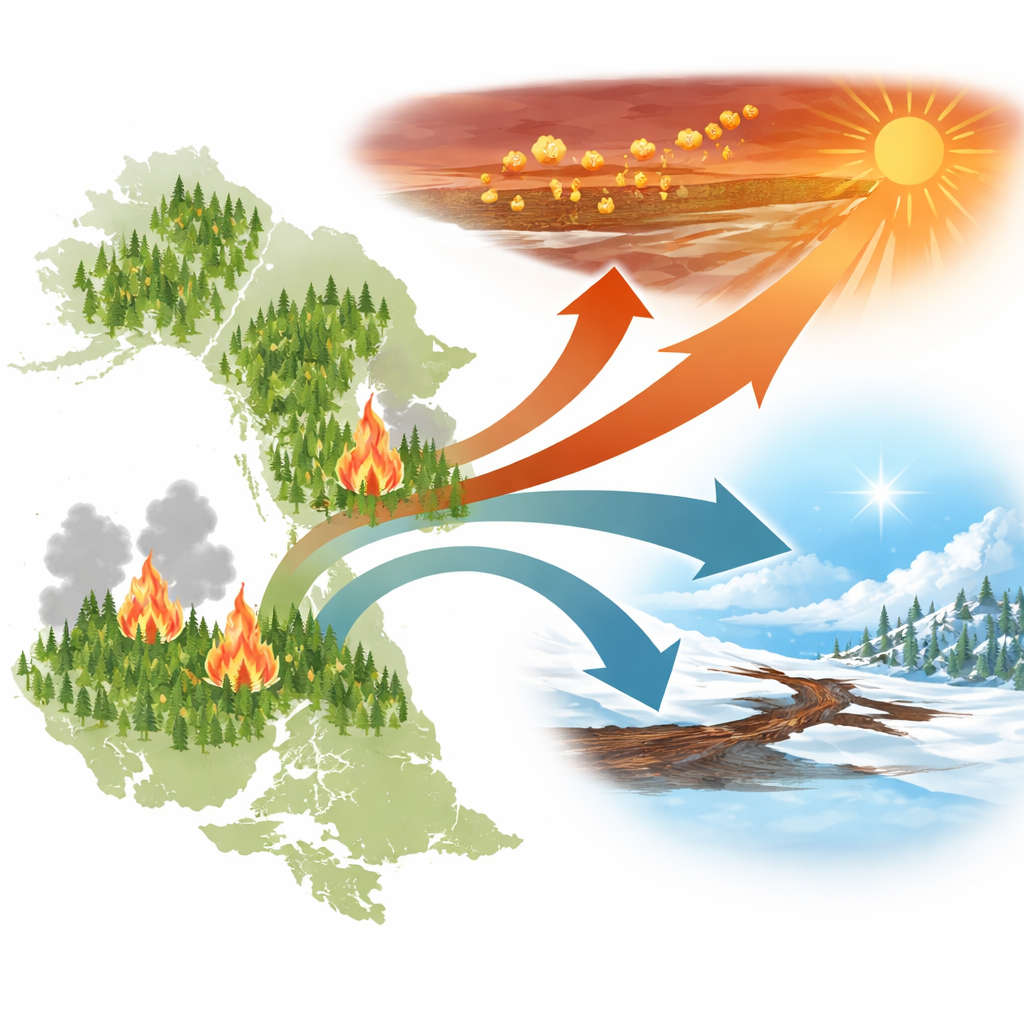
Vast forests ring the high latitudes of Alaska and Canada. When these boreal forests burn, the impact reaches far beyond smoky skies and dramatic news footage. These fires can either heat the planet by releasing greenhouse gases and thawing frozen soils, or cool it by exposing bright, reflective snow that bounces sunlight back to space. This study asks a simple but crucial question: when you add up all these effects over decades, do northern forest fires mostly warm or cool our climate—and where should we focus efforts to reduce their long‑term damage?
Balancing Acts in a Changing Northern World
The researchers examined nearly two decades of fires, from 2001 to 2019, across Alaska and western Canada. They treated each burned patch of ground as part of a grand climate experiment and followed its influence for 70 years into the future. Instead of looking only at the immediate smoke and carbon released during a fire, they tallied five major pathways: greenhouse gases from burning trees and soil, short‑lived particles in the smoke, how dark or bright the land surface becomes after the fire, how quickly vegetation grows back and pulls in carbon, and extra greenhouse gases released when fires trigger the thawing of long‑frozen ground known as permafrost. All of these were translated into a common yardstick: how much they change the balance of solar energy at the top of Earth’s atmosphere.
Two Neighbors, Opposite Climate Outcomes
Surprisingly, the overall effect of these fires was not the same on both sides of the border. On average, fires in Alaska ended up warming the climate, while fires in western Canada tended to cool it. In Canada’s Boreal Shield region, which has little permafrost and long, snowy springs, burned areas became significantly brighter for decades. That extra springtime reflection outweighed the warming from greenhouse gases released during the fire and from the soil, tipping the balance toward net cooling. In contrast, Interior Alaska sits in a zone where permafrost is widespread and the soils are packed with carbon. There, deep‑burning fires not only released more carbon immediately but also helped thaw the frozen ground below, unlocking additional greenhouse gases over time. The cooling from brighter, snow‑covered burns and smoke particles simply could not fully offset this hidden, slow‑motion warming.
Where and How Fires Burn Makes All the Difference
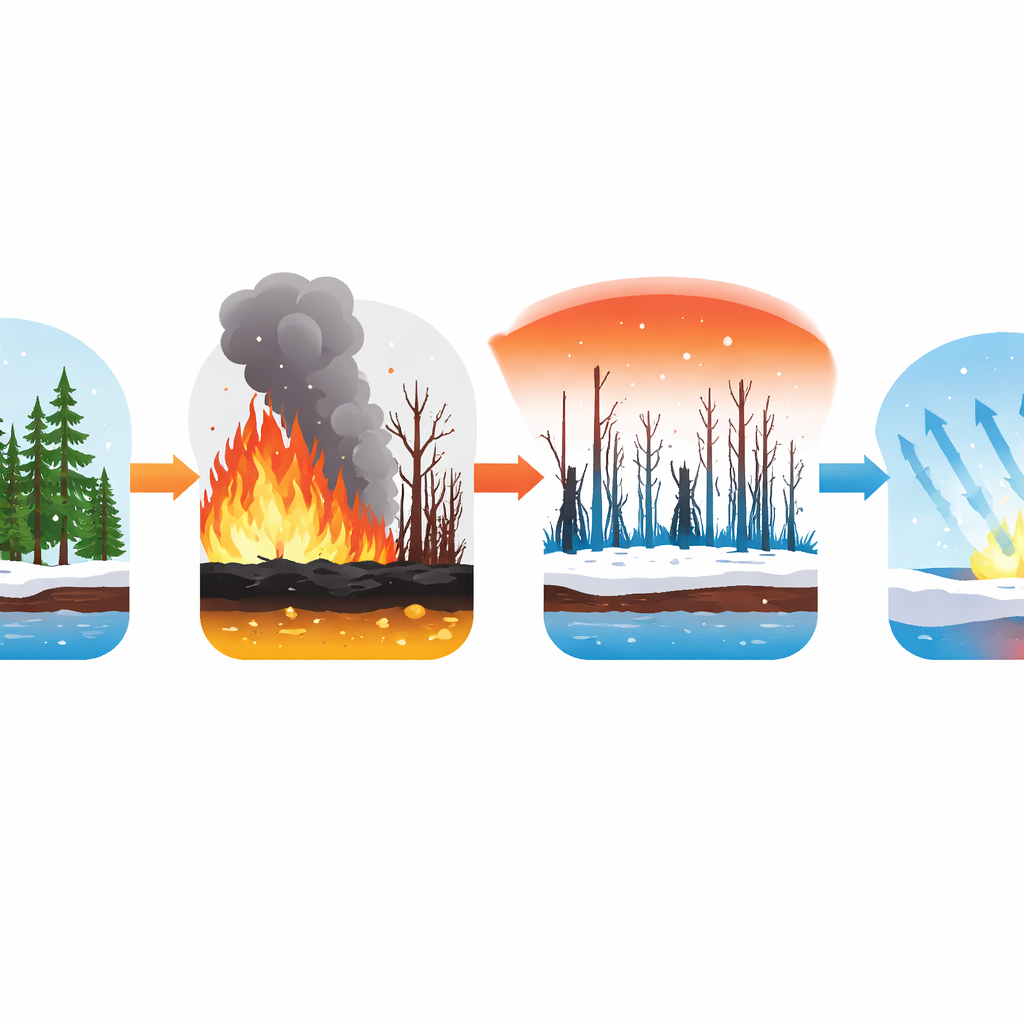
The study found that not all fires are created equal. Climate‑warming fires tended to occur in drier areas, on steeper slopes and at higher elevations, often in forests dominated by black spruce, a tree that builds up thick, carbon‑rich layers of organic matter on the forest floor. These fires burned deeper into the soil and released more carbon per square meter than cooling fires, even though they were not necessarily larger. Fires near the northern tree line, where snowy ground stays exposed longer in spring, generally cooled the climate because of the strong brightening of the surface after burning. Further south, where snow melts earlier, that cooling effect weakened. The presence and continuity of permafrost also mattered: landscapes with more extensive frozen ground saw greater extra warming from thaw‑related emissions after fire.
What This Means for Forests and Climate Choices
Looking ahead, the authors point out that the cooling benefit from brighter, snow‑covered burn scars is likely to shrink as the climate warms, snow seasons shorten and snow cover becomes less reliable. Meanwhile, more frequent and intense fires are expected to threaten the large carbon stores locked in northern soils. The results suggest that smarter fire management—such as targeted suppression, prescribed burns and forest practices that steer vulnerable areas away from the most carbon‑rich, permafrost‑laden fuels—could help reduce the most climate‑damaging fires without trying to stop fire everywhere. For a layperson, the key takeaway is that northern wildfires are not just a temporary air‑quality problem: in some places they act like a brake on warming, but in others they kick a powerful, long‑lasting accelerator. Knowing where each of these outcomes is most likely helps guide decisions that can keep more of the Arctic’s ancient carbon safely in the ground.
Citation: van Gerrevink, M.J., Veraverbeke, S., Cooperdock, S. et al. Climate impacts from North American boreal forest fires. Nat. Geosci. 19, 455–461 (2026). https://doi.org/10.1038/s41561-026-01940-3
Keywords: boreal forest fires, permafrost thaw, climate feedbacks, radiative forcing, Arctic carbon