Clear Sky Science · en
Progressive release of long-stored carbon from tropical peatland disturbances
Hidden bogs with a big climate role
Tropical peatlands may look like ordinary wetlands, but under their muddy surfaces lie vast stores of carbon built up over thousands of years. This study reveals how human activities such as draining and burning these peatlands in Indonesia are turning them from quiet carbon keepers into powerful carbon sources that affect the global climate.
Ancient carbon beneath the forest floor
Peatlands form where waterlogged conditions slow the breakdown of dead plants, allowing layer upon layer of partly decayed material to accumulate. In the tropics, these peat domes have been storing carbon since long before modern civilization. The authors focused on three neighboring peatland sites in Central Kalimantan, Indonesia: one still waterlogged and forested, one drained by canals but retaining trees, and one both drained and repeatedly burned. Because the sites share similar geology and history, any differences in their peat reveal how disturbance changes the fate of stored carbon. 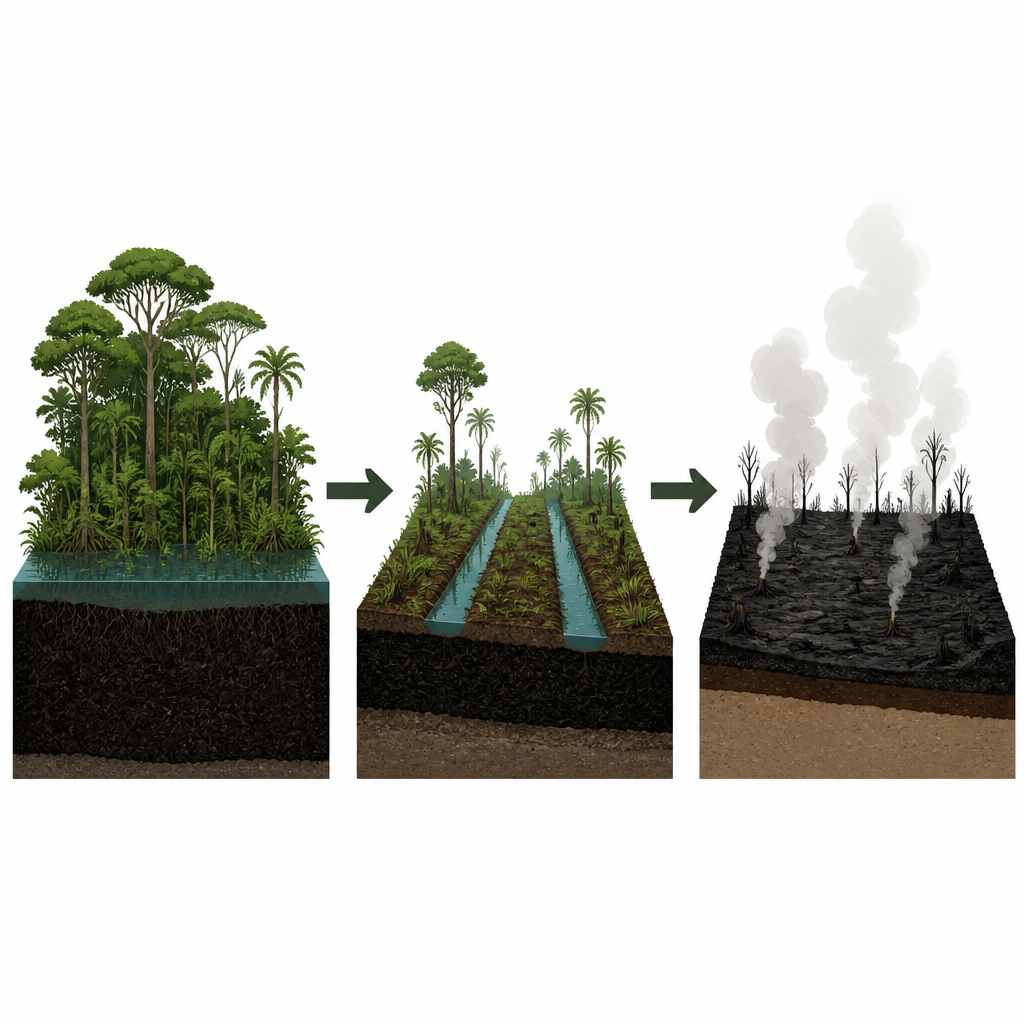
Following carbon through time
To trace when the released carbon was first locked away, the team dated peat samples and dissolved organic carbon in groundwater using radiocarbon, a form of carbon that naturally decays with time. Rather than just measuring by depth, they expressed peat stocks as a function of age. This allowed them to see how much carbon from specific time slices had been lost. In the undisturbed forest, peat layers remained thick and rich in carbon from the surface down. In the drained forest, however, the upper 45 centimeters, which held peat roughly a thousand years old, had already lost a substantial share of its carbon.
Drainage and fire as a one-two punch
Lowering the groundwater level exposes peat to air, feeding microbes that convert long-stored carbon into carbon dioxide. Over the 18 years following canal construction, drainage alone released about 5 to 11 kilograms of carbon per square meter, much of it centuries to millennia old. Peat subsided by nearly 10 to 20 centimeters, and measurements of soil breathing and river exports suggest that early years of drainage likely saw even faster loss than recent fluxes capture. Fires added a dramatic extra blow. At the burned site, repeated fires between 1997 and 2014 removed roughly 23 to 32 kilograms of carbon per square meter from the upper half meter of peat, equivalent to burning material that had accumulated over about 3,000 years.
Slow-burning legacy after the flames
Fire does not simply remove the top layer and end the story. By stripping away surface peat, fire exposes deeper, older material that had long been protected under water. The study’s thermal tests show that this exposed ancient peat still contains a surprising amount of easily decomposed organic matter, making it vulnerable to continued breakdown. Groundwater sampled at the burned site carries dissolved carbon up to 4,000 years old, clear evidence that not only smoke but also dark, carbon-rich water is exporting ancient carbon. Even years after the last fire, the burned peatland continues to emit carbon dioxide at rates similar to other disturbed sites, indicating an ongoing, slow-motion release from its deep reserves. 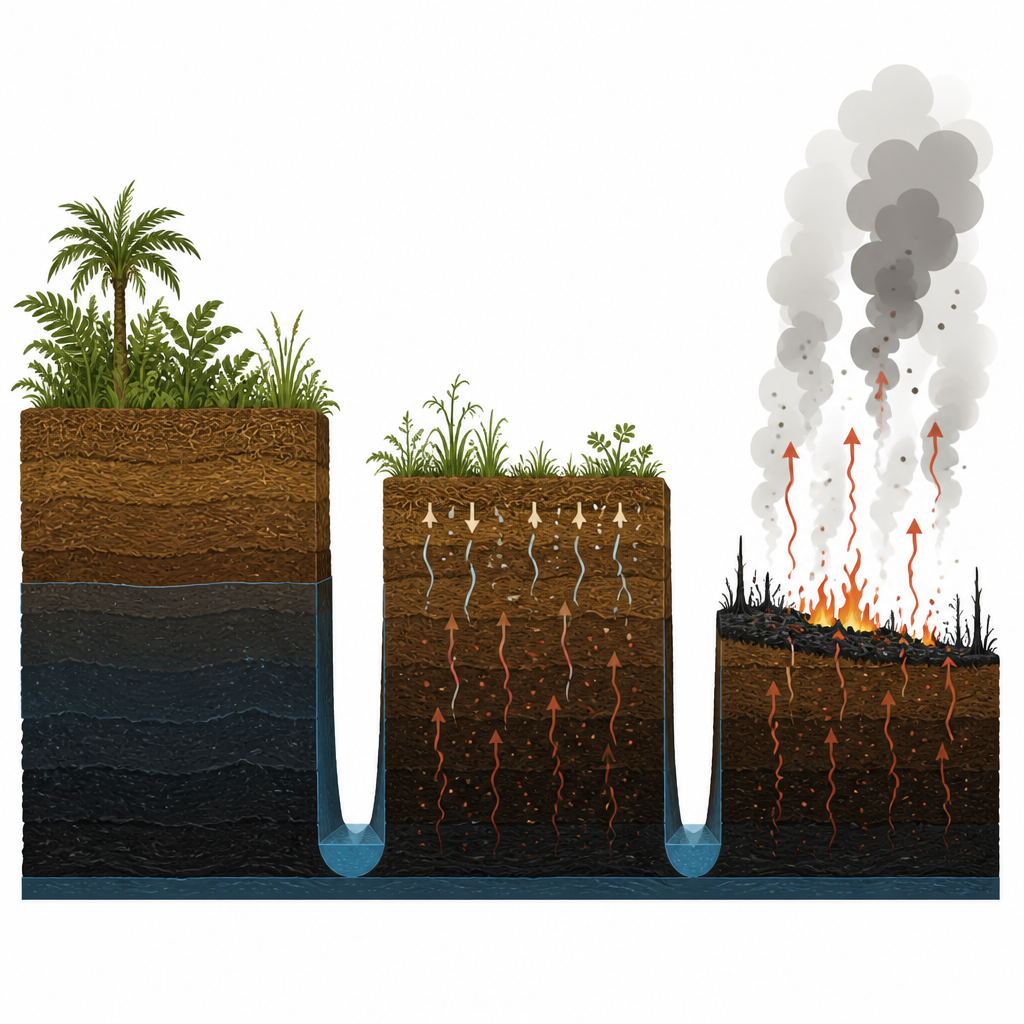
Consequences that reach far beyond one swamp
By combining age profiles with known areas of drained and fire-damaged peatland across Indonesia, the authors estimate that 0.81 to 3.70 billion tons of peat carbon were released between 1996 and 2014. Drainage accounts for roughly half of this loss, fires for the rest. On top of past emissions, the continued decomposition of old peat in disturbed areas likely adds another 0.03 to 0.08 billion tons of carbon to the atmosphere each year, equivalent to a noticeable fraction of the current global land carbon sink. For a lay reader, the takeaway is stark: when tropical peatlands are drained or burned, they do not quickly bounce back. Instead, carbon that took thousands of years to store can be lost in decades, making the protection and careful restoration of these quiet wetlands an important part of managing Earth’s climate.
Citation: Koarashi, J., Itoh, M., Atarashi-Andoh, M. et al. Progressive release of long-stored carbon from tropical peatland disturbances. Nat Commun 17, 4369 (2026). https://doi.org/10.1038/s41467-026-72890-y
Keywords: tropical peatlands, carbon emissions, peat fires, land use change, climate impact