Clear Sky Science · en
A shared speed encoding model for running and backing away behaviours in segregated neural circuits
How the Brain Sets the Pace for Escape
When an animal decides whether to bolt forward, freeze, or cautiously back away, its brain must not only choose an action but also set how fast that action unfolds. This study in mice uncovers how a tiny region deep in the brain computes movement speed and routes that shared speed signal into very different defensive responses. The work offers a window into how the brain turns vague feelings of threat into precisely tuned motion, and why the same danger can sometimes make us rush forward and other times retreat or stop.
A Central Hub for Survival Choices
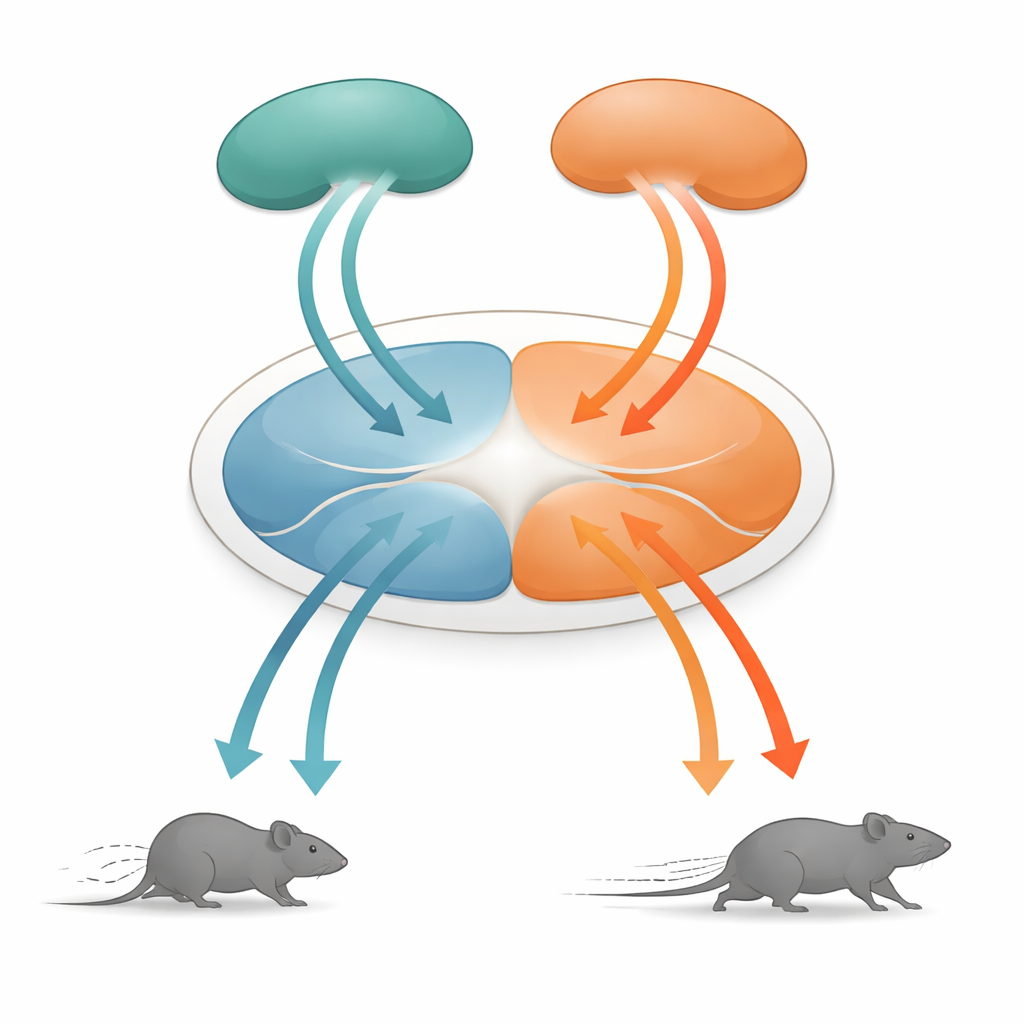
At the heart of this story is the dorsal periaqueductal gray, or dPAG, a small structure in the midbrain long known to be crucial for defensive behaviors. It receives information from many higher brain areas and turns those signals into concrete movements. The researchers focused on two major input sources: the temporal association cortex (TeA), which helps link sensory events into context, and the superior colliculus (SC), a structure that rapidly detects looming visual threats. Both regions send projections into the dPAG, but until now it was unclear how their activity is turned into detailed motor commands such as running speed.
Neurons That Predict How Fast You Will Run
Using delicate recordings from individual neurons in awake, head-fixed mice running on a turntable, the team first tracked cells in the TeA whose firing rates rose and fell with the animal’s running speed. These "running-related" neurons did not respond directly to flashes, sounds, or air puffs; instead, their firing ramped up one to three seconds before the animal began to run, and continued to mirror its speed during the run. When the scientists plotted firing rate against running speed, they found that the relationship followed a saturating curve: as firing increased, speed rose quickly at first and then leveled off at a maximum, matching the biological limit that animals cannot accelerate indefinitely.
A Shared Speed Code in a Deeper Brain Layer
The same style of experiment in the dPAG revealed a parallel pattern. Neurons there also increased their firing before and during running, and their firing-to-speed relationship followed the same mathematical curve as in the TeA. However, dPAG neurons were more "efficient": for a given change in firing, they produced larger changes in running speed, and their influence kicked in closer in time to movement onset. By stimulating specific sets of TeA and dPAG neurons with light at different frequencies, the researchers could causally dial running speed up and down in line with that same curve. This showed that the relationship is not just a correlation but a genuine speed-encoding rule shared across levels of the movement hierarchy.
Two Movement Units: Running Forward and Backing Away
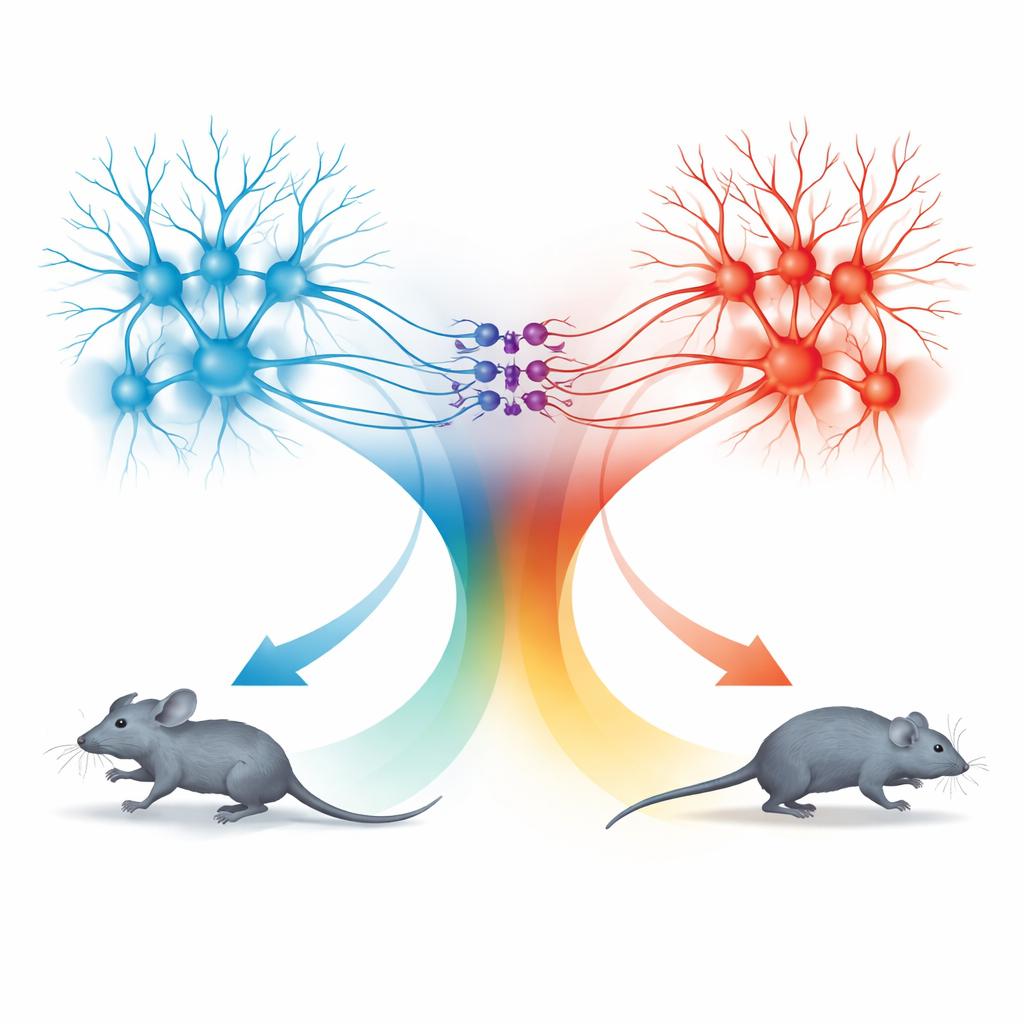
The surprise came from examining the pathway from the superior colliculus into the dPAG. Neurons in this route also followed the same speed rule, but the behaviors they drove were different. When these SC-connected cells were activated at low light frequencies, mice stopped moving; at higher frequencies they backed away; and when the stimulation ended, they often burst into a brief period of fast forward running, called rebound running. Detailed tracing showed that TeA and SC signals entered largely separate populations of dPAG neurons. TeA-linked excitatory cells formed a "running unit" that drove straightforward escape running, while SC-linked excitatory cells formed a "backing-away unit". A small set of inhibitory somatostatin (SOM) neurons in the dPAG connected these units in one direction: they were activated by the backing-away unit and in turn suppressed the running unit.
A Simple Circuit for Many Defensive States
By combining selective activation and silencing, the team mapped how these three cell types combine to yield four distinct behaviors: running, backing away, stopping, and rebound running. Activating TeA-linked cells alone produced forward running whose speed followed the shared encoding curve. Activating SC-linked cells switched on the backing-away unit and SOM neurons, shutting down the running unit and causing either stopping or backward motion depending on stimulation strength. When the stimulation ceased, the sudden lift of SOM-driven inhibition let the running unit briefly rebound, producing a burst of forward escape. In this way, the dPAG uses a single quantitative speed code but routes it through different microcircuits to generate different defensive choices.
What This Means for Understanding Action Choices
For a non-specialist, the key message is that the brain separates two problems: how strong a movement should be, and which movement to perform. In this mouse model, a shared mathematical rule transforms neural firing into movement speed, while specialized "behavior units" in the dPAG decide whether that speed becomes running forward or backing away. A small inhibitory bridge then allows the system to switch quickly between these states, even producing a rebound dash after a period of enforced stillness. This work offers a concrete example of how compact neural circuits can flexibly orchestrate complex survival behaviors using simple, reusable coding rules.
Citation: Chen, J., Li, H., Lian, N. et al. A shared speed encoding model for running and backing away behaviours in segregated neural circuits. Nat Commun 17, 4119 (2026). https://doi.org/10.1038/s41467-026-70755-y
Keywords: defensive behavior, movement speed, midbrain circuits, escape responses, mouse neuroscience