Clear Sky Science · en
Millennial land carbon emissions in China offset by carbon sinks of the past four decades
Why the story of China’s carbon matters
When we talk about climate change, we usually focus on smokestacks and tailpipes. But the way we use land—cutting forests, plowing fields, and planting new trees—can release or absorb just as much carbon dioxide. This study looks at China’s landscapes over more than 1,000 years to ask a surprisingly hopeful question: after centuries of clearing forests and expanding farms, can recent efforts to regrow trees and restore land really erase that long history of carbon losses?
A thousand years of changing landscapes
The researchers used a sophisticated computer model to replay China’s environmental history from the year 851 to 2022. They combined reconstructions of past climate, historical records of cropland and forest area, and modern satellite data. Over this long span, China went through major climate swings—such as the relatively warm Medieval Climate Anomaly and the cooler Little Ice Age—as well as dramatic changes in land use, especially during dynasties marked by rapid population growth, urbanization, and agricultural expansion. By feeding all of this information into the model, the team could estimate how much carbon was stored in plants and soils, and how that changed through time.
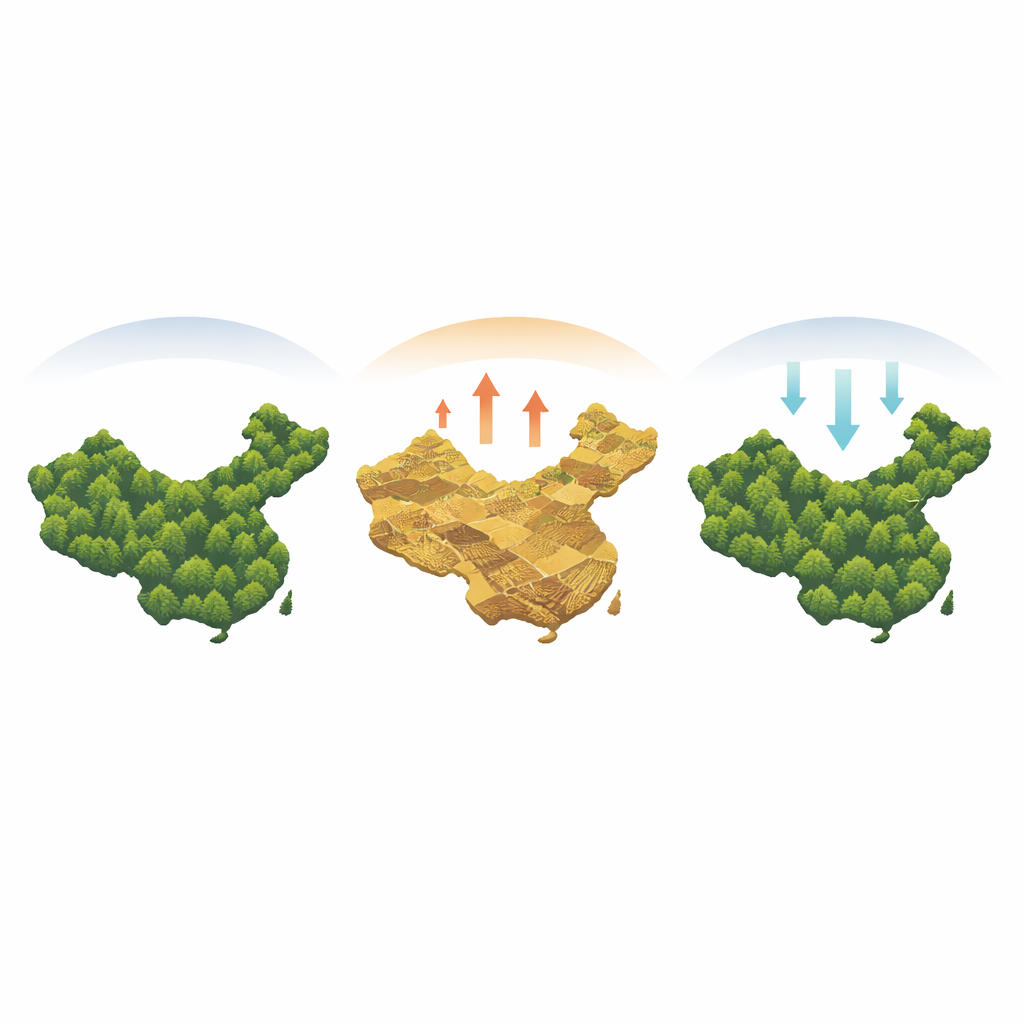
How clearing forests reshaped China’s carbon
The model shows that for most of the millennium before the 1980s, China’s land was a net source of carbon to the atmosphere. Large areas of forest were cut down to make way for farms, especially in Northeast and Southwest China, where deforestation was most intense between 1700 and 1980. The study estimates that from 851 to 1980, China’s ecosystems lost about 17 billion metric tons of carbon—largely from vegetation, but also from soils disturbed by farming and forest clearing. During the 1700–1900 period alone, emissions from China’s land accounted for roughly one-fifth to one-quarter of all global land-use-related carbon losses, highlighting how regional land decisions can influence the global carbon cycle.
Climate swings, carbon lags, and the hidden role of soils
Climate changes also left their mark on the land’s carbon stores, but in subtle ways. Cooler and drier conditions during the Little Ice Age tended to slow plant growth while also slowing the breakdown of dead organic matter in soils. As a result, soil carbon in many places actually increased even as vegetation carbon fell slightly. The study finds that soil responds slowly to changes in temperature, rainfall, and forest cover, with delays of a decade or more. Forests can lose soil carbon quickly when they are cleared, but soils regain carbon only gradually after new trees are planted. This slow, asymmetric response means that even if forest area returns to earlier levels, the underground carbon “bank” can still be in deficit for many years.
Recent decades: a powerful carbon comeback
Since around 1980, China has launched some of the world’s largest tree-planting and reforestation programs, while atmospheric CO2 levels have continued to rise, effectively fertilizing plant growth. The model suggests that these two forces together have turned China’s land into a strong carbon sink. Over just four decades, vegetation and soils have taken up about 16–18 billion metric tons of carbon—roughly matching the total amount released from 851 to 1980. Forest cover has roughly doubled, and many of the regions that once lost the most carbon, such as Northeast and Southwest China, are now major carbon absorbers. However, despite this impressive rebound, soil carbon in some areas has not fully recovered to pre-deforestation levels, reflecting the long timescales of underground restoration.
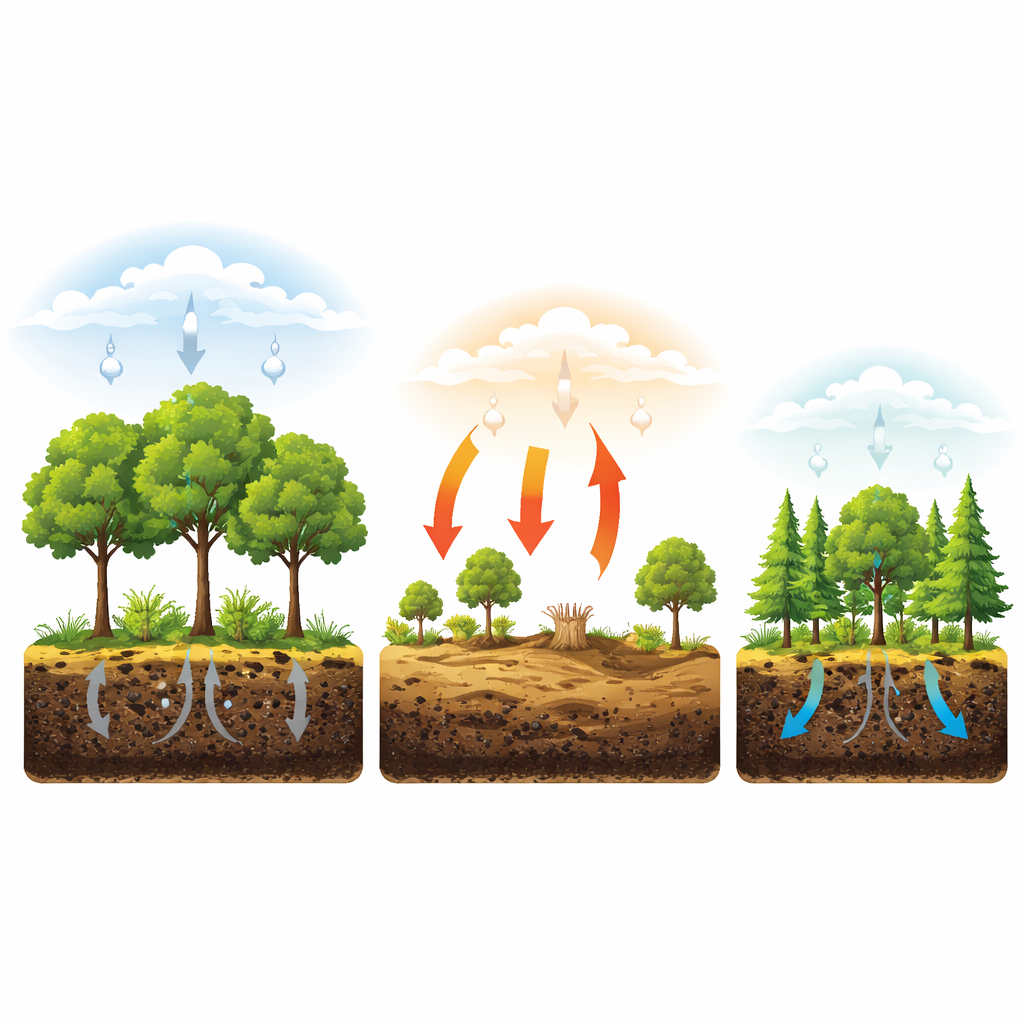
What this means for our climate future
For a non-specialist, the key takeaway is striking: a thousand years of net carbon losses from China’s land have been effectively canceled out in just forty years by a combination of tree planting and the boost plants receive from higher CO2. That does not erase the damage done by fossil fuels, nor does it mean land can absorb carbon forever without limits. But it does show that large, sustained efforts in land stewardship—protecting forests, restoring degraded areas, and managing farms wisely—can make a real difference to the climate. The study also warns that because soils respond slowly and can be sensitive to warming and drying, today’s gains are not guaranteed. Long-term planning that respects these time lags will be essential if China’s land is to remain a reliable ally in stabilizing the planet’s climate.
Citation: Chen, W., Ciais, P., Yu, K. et al. Millennial land carbon emissions in China offset by carbon sinks of the past four decades. Nat Commun 17, 3234 (2026). https://doi.org/10.1038/s41467-026-70049-3
Keywords: land carbon, reforestation, China climate, carbon sink, deforestation history