Clear Sky Science · en
Does dispositional awe foster young adults’ international altruism? The roles of self-transcendence and identity with all humanity
Feeling Small, Thinking Big
From climate disasters to pandemics, our lives are increasingly shaped by global crises. Yet when we give to charity or lend a hand, we often focus on those closest to us. This study asks a timely question: what makes some young adults care just as deeply about strangers in faraway countries? The authors investigate whether a particular emotion—everyday feelings of awe—can nudge people toward a wider sense of “us” and, in turn, more willingness to help people across national borders.
Why Awe Matters for Helping Strangers
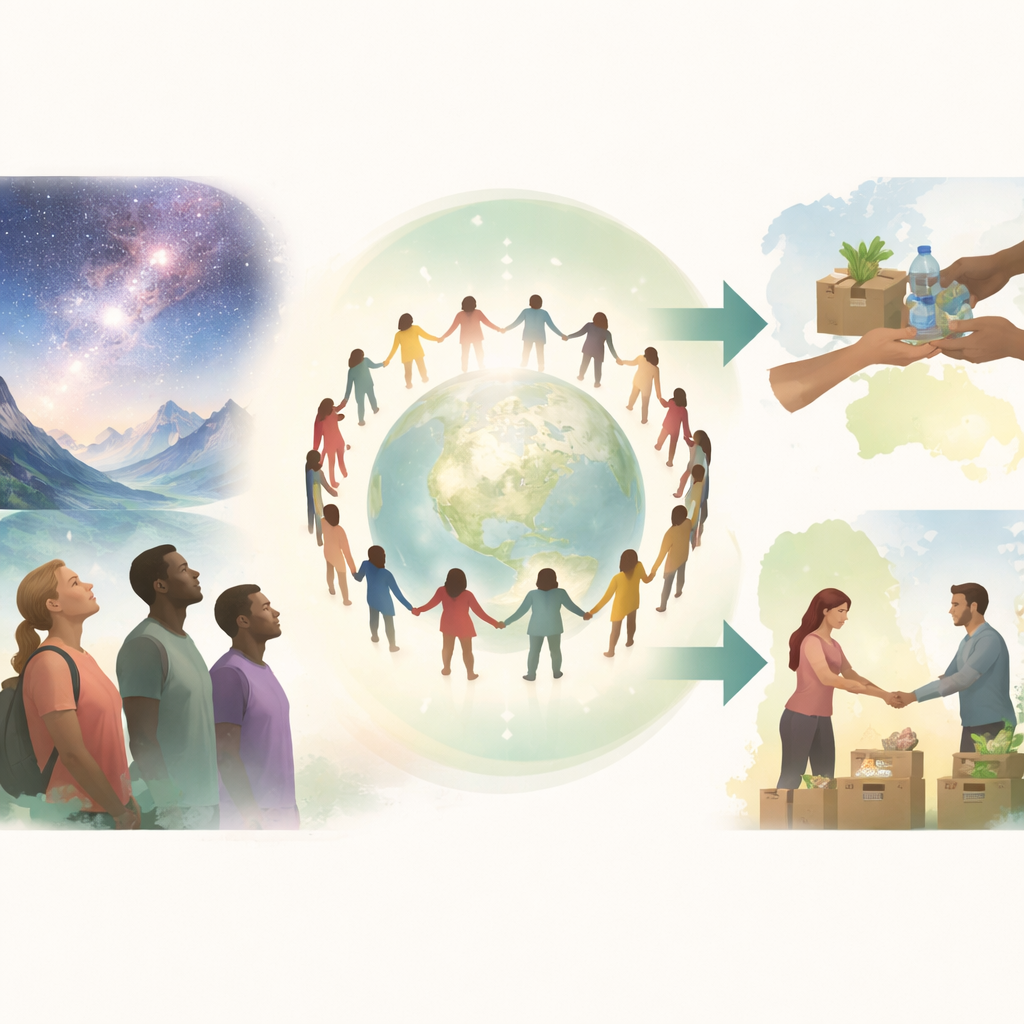
Awe is the feeling we experience when we stand before something vast and mind‑stretching: a star‑filled sky, a powerful storm, or a breathtaking act of kindness. Some people are especially prone to feeling this emotion in daily life—a trait the researchers call dispositional awe. Drawing on modern psychology, they propose that awe can do more than make us say “wow.” It can shift our focus away from our narrow self‑interest, encourage inner growth, and help us see all humans as part of a shared story. This widened viewpoint, they argue, may be a key ingredient in international altruism—willingness to donate or otherwise help people in other countries with no expectation of reward.
Two Inner Shifts: Growing Beyond the Self
The team focused on two subtle inner shifts that might link awe to cross‑border helping. The first is self‑transcendence, a value orientation in which people care less about advancing their own interests and more about the well‑being of others and of nature. The second is identity with all humanity, the sense of feeling close to people worldwide and seeing humanity as one broad in‑group rather than a patchwork of competing “us versus them.” According to recent theories, repeated experiences of awe can foster self‑transcendence—people reflect more deeply, question old assumptions, and come to value fairness and care for all. Those self‑transcendent values, in turn, make it easier to adopt a global identity that blurs the boundaries between nations and groups.
Testing the Links in China and the United States
To see how these ideas play out in real life, the researchers surveyed 780 young adults: 497 university students in China and 283 college‑educated participants in the United States. Participants reported how often they feel awe, how strongly they endorse self‑transcending values such as harmony and universal concern, how close they feel to all humans, and how willing they would be to donate to charities helping people abroad in crises like droughts, forest fires, pandemics, and hunger. Using advanced statistical models, the team examined whether dispositional awe predicted international helping intentions and whether this link ran through self‑transcendence and identification with all humanity.
How Awe Works Differently Across Cultures
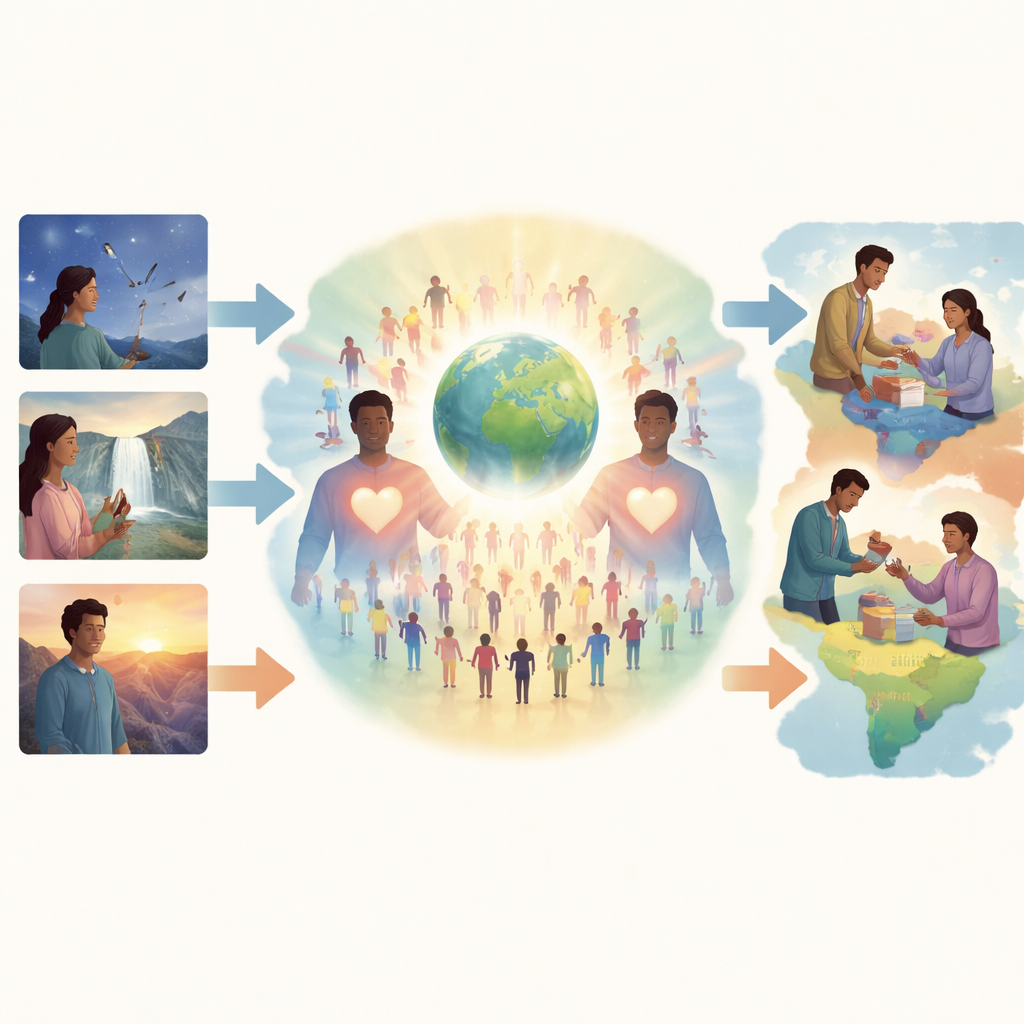
In both countries, young adults who were more easily awed also reported stronger intentions to help people in other nations. But the inner pathways showed intriguing cultural nuances. Among Chinese participants, awe boosted international altruism partly by nurturing self‑transcendence and partly by strengthening identity with all humanity. These two factors worked both side‑by‑side and in sequence: awe supported self‑transcendent values, which fed into a global identity, which then encouraged helping abroad. Among U.S. participants, identity with all humanity played the starring role. Awe strongly predicted self‑transcendence, but self‑transcendence by itself did not reliably translate into helping. Instead, awe led to broader values, those values deepened a sense of belonging to all humanity, and this global identity then powerfully predicted willingness to aid people in other countries.
From Awe to Action in a Shared World
Overall, the study suggests that feeling awe on a regular basis may gently push young adults toward seeing themselves as part of a single human family and acting accordingly. While the exact psychological routes differ somewhat between China and the United States, the broad story is similar: awe encourages people to grow beyond narrow self‑concerns, embrace more universal values, and feel connected to distant others. That inner transformation makes them more ready to share resources and support across borders. The findings hint that carefully designed experiences that evoke awe—whether through nature, art, science, or human achievement—could help cultivate a generation more inclined to respond to global challenges with generosity rather than indifference.
Citation: Wang, M., Xu, Q. Does dispositional awe foster young adults’ international altruism? The roles of self-transcendence and identity with all humanity. Humanit Soc Sci Commun 13, 563 (2026). https://doi.org/10.1057/s41599-026-06926-5
Keywords: awe, international altruism, global identity, self-transcendence, cross-cultural psychology