Clear Sky Science · en
A multi-dimensional study of primary school children’s drawings of God
How Kids Picture the Divine
Ask a child to “draw God,” and you will get far more than a simple sketch. These images quietly reveal how young people think about invisible realities, how they use symbols, and how their families, schools, and churches shape their inner worlds. This study looks closely at hundreds of such drawings from Hungarian Catholic schoolchildren to see what their pictures can tell us about growing up, believing, and learning to think in more abstract ways.
What the Researchers Wanted to Know
The study focused on 753 students aged 12 to 14 in Catholic primary schools, some with extra art programs and some without. Each student was given a blank sheet of paper and asked to draw God “as you imagine Him,” then answer a short questionnaire about school performance and religious beliefs. Instead of judging artistic talent, the researcher measured patterns: Was God shown as a human-like figure or something less human? Did the drawing use bright colors or mostly grey and black? Were familiar religious symbols, like a cross or halo, present? How much of the page did God fill, and where was the figure placed? Computer vision tools helped quantify color use, while trained coders examined themes, symbols, and how human-like the divine figure appeared.

How God Appears in Children’s Drawings
Most students—about three quarters—still pictured God as some kind of “being,” often male and clothed in white, with halos, clouds, or a throne. Yet there was also variety: some drew God as part of nature or the cosmos, as an object, or in a more abstract way, such as light or symbolic shapes. A rich “cosmic background” with stars or space was especially common. Despite their religious schooling, the children used only a limited set of classic Christian symbols: the cross and simple images of Jesus appeared regularly, but more complex church symbols and Bible scenes were rare. The result is a portrait of a God who is clearly personal—often a face surrounded by light—rather than a dense theological scene.
Age, School Success, and Faith in the Picture
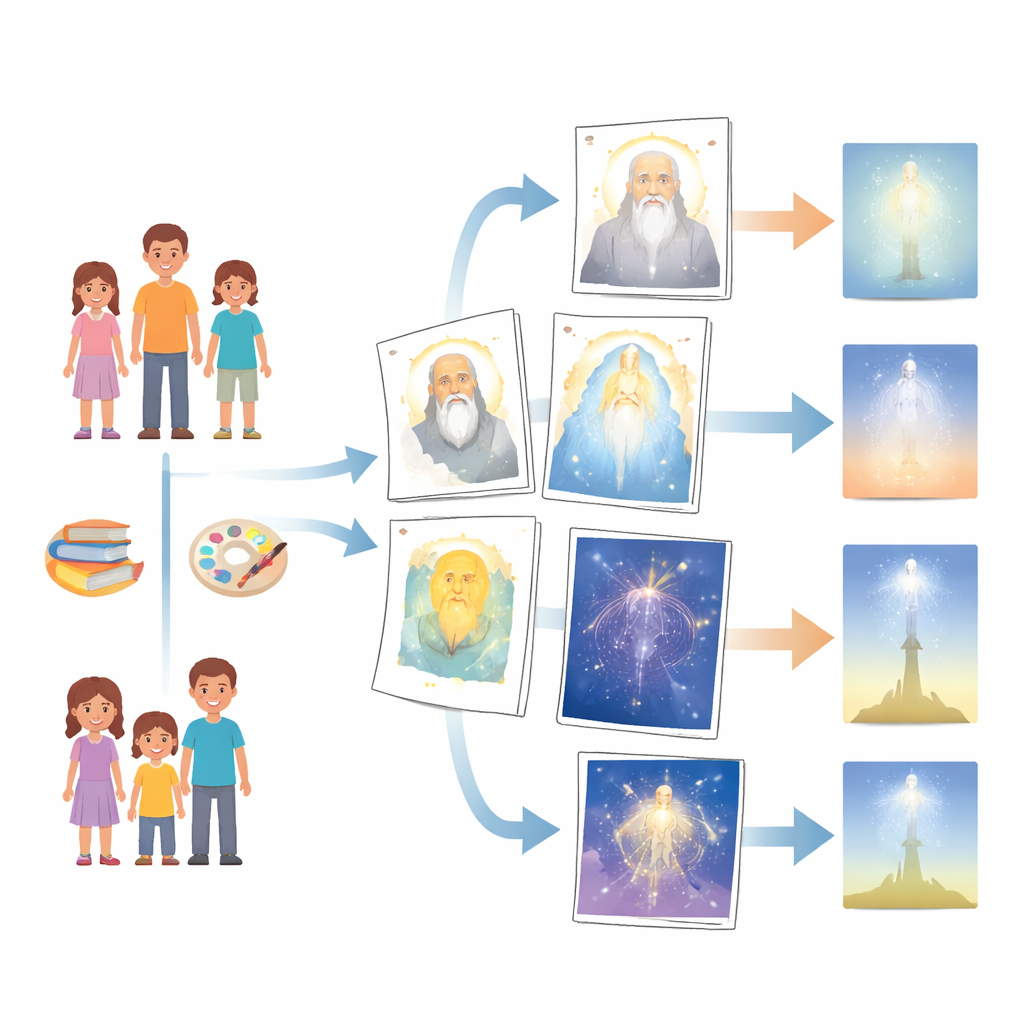
As children got older within this age band, their drawings became a little less human and a bit more abstract. Older students were less likely to show God as a straightforward person and more likely to hint at a bodiless presence or a figure high above the earth. They tended to place God higher on the page and used more achromatic colors like black, white, and grey, while using the color blue slightly less. Students with better grades leaned toward more complex, less human-like depictions, used more blue and orange, and relied less on colorless drawings. The study interprets school performance as a rough sign of underlying thinking skills, suggesting that more advanced cognitive abilities may support more abstract ways of imagining the divine.
Gender, Art Classes, and Color Choices
Gender did not strongly alter whether God was shown as male, but it did shape style. Girls’ drawings more often featured glowing white clothing and a halo or crown of light—classic, gentle images of a holy person. Art education had subtle effects: students in schools with formal art programs were less likely to present God as a simple human figure and more likely to favor less literal, more symbolic depictions. Religiosity also mattered, but in a nuanced way. More religious students were more inclined to draw God as a being at all, yet their images did not become more or less human in detail. Interestingly, stronger faith slightly reduced the use of blue and nudged color choices toward orange tones, hinting at a more deliberate, symbol-rich use of color among the most devout.
What These Images Tell Us About Growing Minds
For a lay reader, the takeaway is that these children’s drawings act like small windows into the development of both belief and abstract thinking. Even in early adolescence, most young people still “ground” the divine in a human or living form, perhaps because it is easier to relate to a person than to an invisible force. At the same time, as children grow older, do better in school, and receive more arts training, their pictures edge toward more symbolic and less literal portrayals of God. The study suggests that drawing is not just decoration on top of faith and schooling; it is a sensitive tool for seeing how children weave together imagination, religious teaching, and their emerging ability to think in symbols.
Citation: Turós, M. A multi-dimensional study of primary school children’s drawings of God. Humanit Soc Sci Commun 13, 569 (2026). https://doi.org/10.1057/s41599-026-06915-8
Keywords: children’s drawings of God, religious development, symbolic thinking, art education, child psychology