Clear Sky Science · en
A changing climate change climate? A meta-analysis of climate change attitudes and polarization in the Netherlands spanning four decades
Why this story about climate opinions matters
Climate change is often portrayed as a topic that splits societies into warring camps. This study asks whether that picture is actually true for the Netherlands, a low-lying country on the front line of rising seas. By pulling together nearly four decades of national surveys, the researchers show how Dutch views on climate have shifted since the 1980s—and whether people have really grown further apart in their opinions.
Looking back over four decades
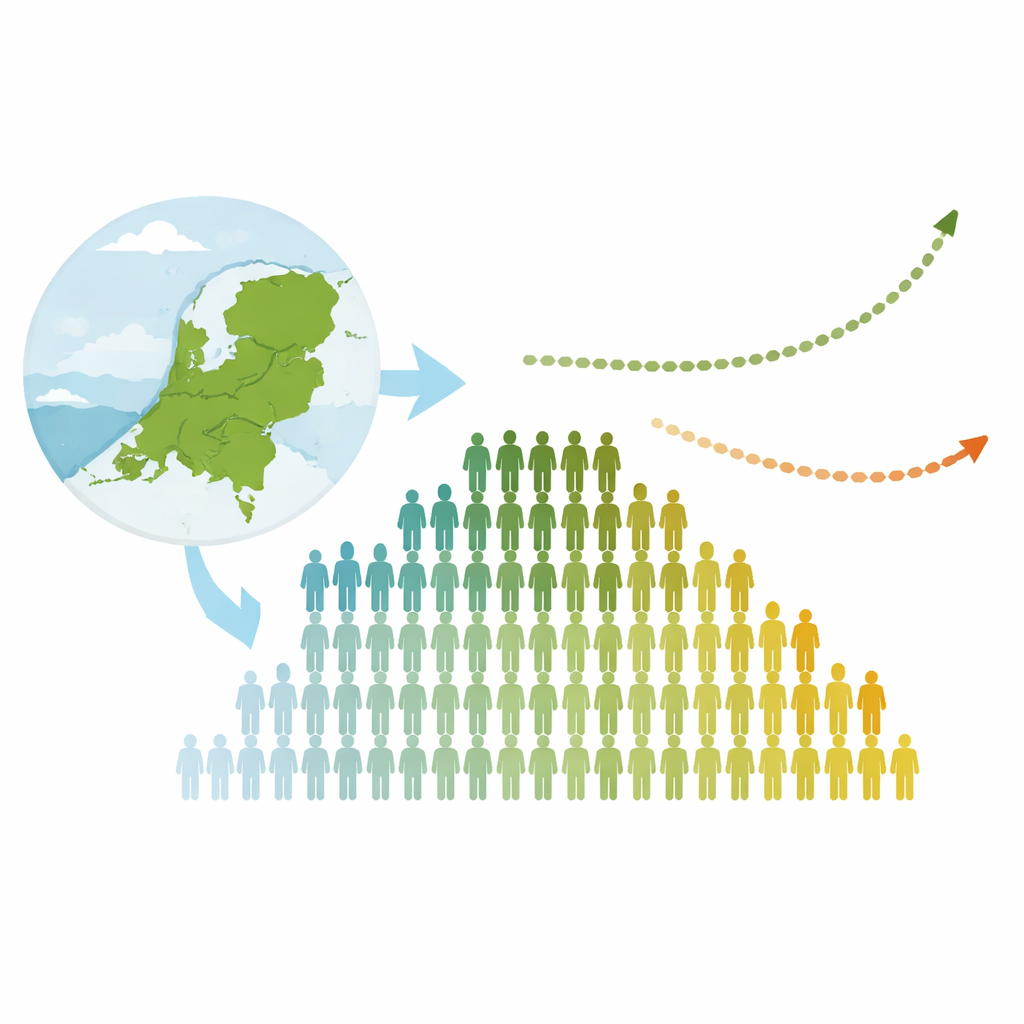
Instead of relying on a single poll, the authors combined every accessible, nationally representative Dutch survey that asked about climate or the environment more than once between 1986 and 2023. This produced eight major data sources, 38 survey waves, and 71 separate questions about climate change. Some questions tested what people believe—for example, whether climate change is happening and caused by humans. Others probed how worried they are, or whether they are willing to change their behavior or support climate policies. For each question, the researchers measured both the average response and how widely answers were spread out, treating greater spread as a sign of stronger polarization.
More agreement on the reality of climate change
Across all these surveys, the overall trend points toward more climate-friendly attitudes. On average, Dutch people have become more convinced that climate change is real and serious, and more supportive of action than they were in the late 1980s. This is especially true for the emotional side of attitudes: worry about climate change has increased. At the same time, the study finds that people’s views have moved closer together rather than further apart. Statistical measures of dispersion show a small but significant decline in polarization over time, especially for belief-related questions about whether climate change is happening and what causes it.
Beliefs converge, behavior lags behind
The study highlights an important nuance: not all parts of climate attitudes move in lockstep. When it comes to beliefs and concern, Dutch people are increasingly on the same page. But questions about personal behavior—such as willingness to make sacrifices or change lifestyle—show less convergence. In other words, people may largely agree that climate change is a problem, while disagreeing more about how far they themselves, or society, should go to address it. This gap between shared understanding and contested action helps explain why climate politics can still feel tense even when basic facts are widely accepted.
How age and education shape the trend
The authors also ask why averages and polarization have changed. They look at three key social divides: age, education, and gender. Women, on the whole, hold more climate-friendly attitudes than men and are also less polarized among themselves. Surprisingly, older people in the Netherlands now express somewhat more climate-friendly views than younger people, running against the common idea that climate concern is mainly a youth phenomenon. Education matters too: people with intermediate and higher education tend to be more climate-friendly than those with only basic schooling. Over time, Dutch society has both aged and become more highly educated, and the differences between educational groups’ climate views have shifted. The study shows that this changing mix of people—and the way attitudes within those groups have grown more similar—helps explain why average support for climate action has risen while overall polarization has fallen.

What this means for climate debates
Put together, the findings challenge the image of a country drifting into climate culture wars. In the Netherlands, most people are moving toward stronger recognition of climate risks and greater support for action, and they are not splitting into ever more hostile camps over the basic facts. The sharpest disagreements now lie less in whether climate change is real and more in what everyday changes and policies are acceptable and fair. For policymakers, this is cautiously good news: there is a broad, and increasingly shared, understanding of the problem. The task ahead is to design climate measures that take social and economic differences seriously, so that more people feel able and willing to act on the concern they already share.
Citation: Peelen, A., Tolsma, J. A changing climate change climate? A meta-analysis of climate change attitudes and polarization in the Netherlands spanning four decades. Humanit Soc Sci Commun 13, 445 (2026). https://doi.org/10.1057/s41599-026-06638-w
Keywords: climate change attitudes, public opinion, polarization, Netherlands, environmental behavior