Clear Sky Science · en
Environmental impacts of intensive beef fattening: a case study in the Veneto region, Italy
Why This Matters for Your Dinner Plate
Beef often sits at the center of our plates—and at the center of debates about climate change and animal welfare. This study looks closely at a major beef-fattening region in northeast Italy to ask a simple but crucial question: how much does the way we house cattle indoors change both their impact on the planet and their quality of life? By following two common indoor systems in real farms over time, the researchers show that small choices about floors, space, and animal health can ripple out into big differences in emissions, resource use, and animal suffering.
Two Ways to Keep Cattle Indoors
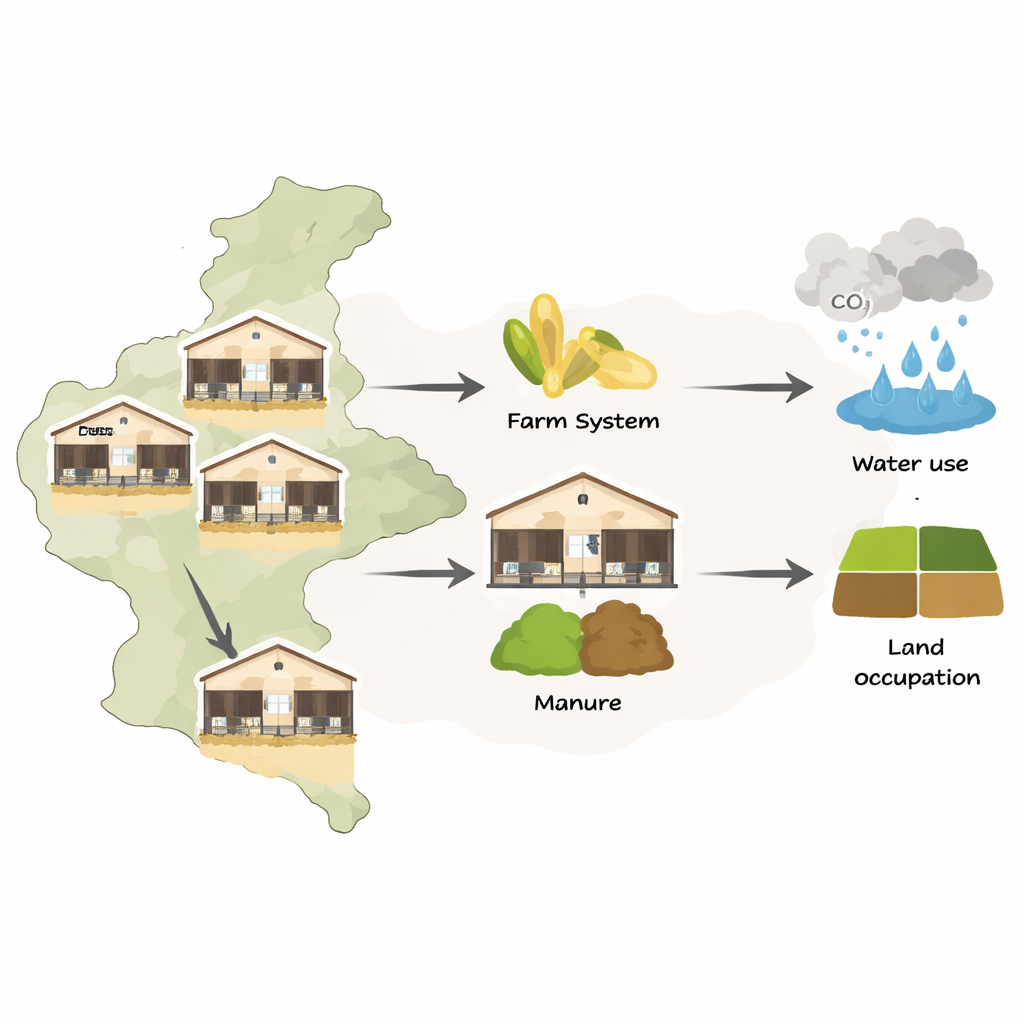
In the Veneto region, young beef cattle imported from France are finished indoors for more than six months before slaughter. The study focuses on two common housing systems. In one, animals stand and rest on deep straw bedding that is regularly replenished. In the other, they live on fully slatted concrete floors, where manure drops through gaps into pits below. Both systems are intensive and rely heavily on human-edible crops such as maize, rather than pasture. Using a detailed life-cycle assessment, the authors counted greenhouse gas emissions, water use, land occupation, and pollution from feed production, the animals’ digestion, and manure handling in each system.
How Farm Design Shapes Environmental Footprints
The analysis of representative farms revealed that most climate-warming emissions come from the animals themselves (through digestion) and the crops grown to feed them. But the type of floor changes the pollution profile. Slatted floors lead to higher methane emissions from manure pits, while deep bedding produces more direct nitrous oxide from decomposing straw and manure. When all impacts per kilogram of weight gain are added up, deep-bedding farms generally perform better for climate, air pollution, water use, and animal welfare, although they can show higher eutrophication, a form of water pollution driven by nutrient runoff. Freshwater withdrawals and land occupation are substantial in both systems, reflecting the feed-intensive nature of this style of beef production.
A Region in Transition
The authors scaled their farm-level results up to the entire Veneto region between 2020 and 2029, using official data on how many young bulls and heifers are imported each year. They found that the overall number of animals in these intensive fattening systems is declining sharply. As the larger share of animals is kept on deep bedding, this decline alone is projected to cut climate-warming emissions from the sector by nearly 60 percent under a business-as-usual path. The team also explored an alternative future where, after 2024, animal numbers stay constant but 80 percent of cattle move to deep-bedding housing. In this scenario, regional emissions still fall—especially for climate change—though some impacts, such as acidification and water use, tick slightly upward because of the increased use of straw and space per animal.
When Animal Losses Waste the Planet
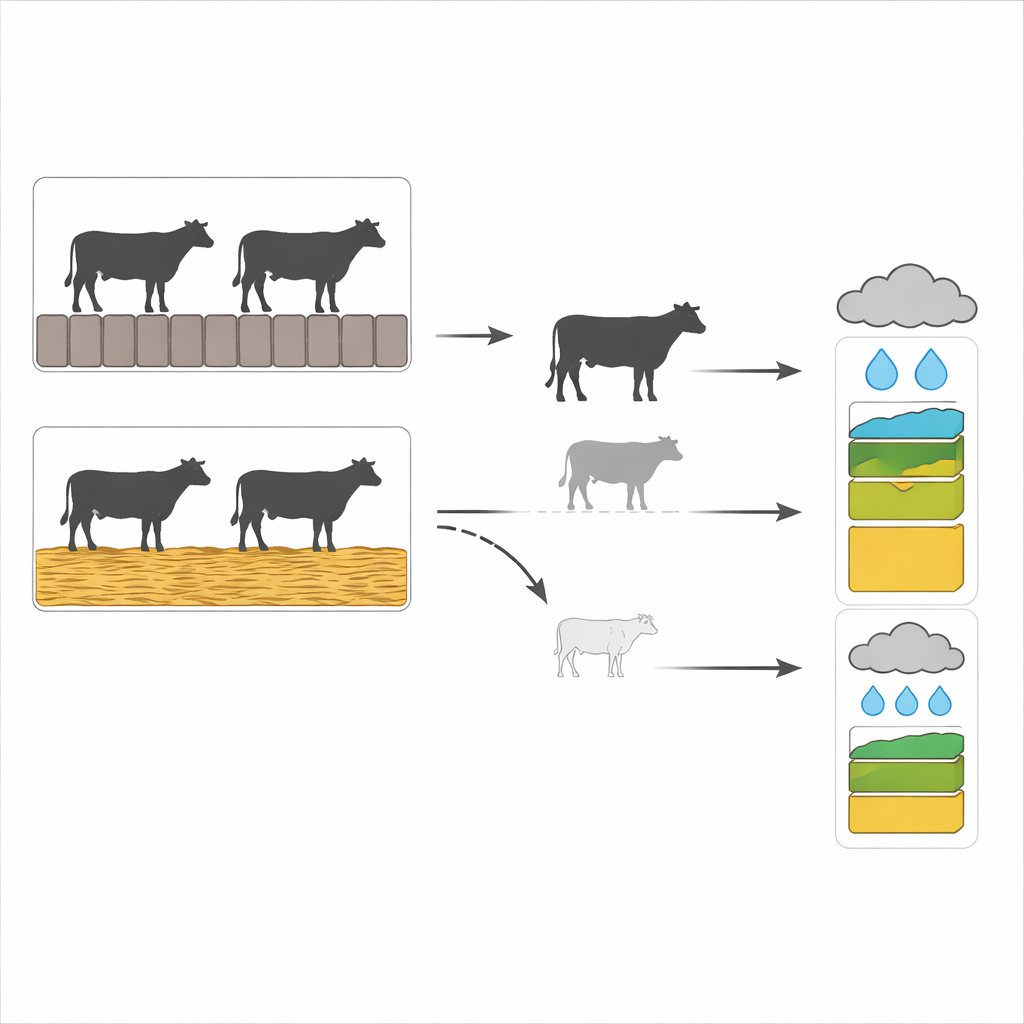
Beyond housing design, the study zeroes in on a less visible driver of environmental harm: animals that die or are slaughtered early due to illness or injury. These cattle consume feed, water, and space but never turn into saleable beef, meaning all the resources invested in them are effectively wasted. The researchers show that mortality tends to occur early in the fattening period, while early culling usually happens late, after animals have already consumed large amounts of feed. When they calculate the emissions tied to replacing dead animals and to animals culled near the end of fattening, these losses amount to the climate impact of tens of thousands of fully finished cattle over a decade. Systems with higher early culling rates, such as those using slatted floors, therefore carry a hidden environmental surcharge linked directly to poor welfare outcomes.
What This Means for Future Beef
For people who care about both the planet and animals, this case study offers a hopeful but nuanced message. It shows that indoor beef systems are not all alike: designs that provide deeper bedding and better conditions can cut climate impacts and improve welfare at the same time, especially when they also reduce animal deaths and emergency slaughter. At the regional scale, shrinking cattle numbers and shifting away from harsher flooring could together deliver large emission cuts. The authors argue that policies and farm investments should treat animal welfare not as a luxury add-on but as a core part of environmental strategy—because every animal that thrives to slaughter weight, rather than dying or being culled early, represents resources used more wisely and a smaller burden on land, water, and air.
Citation: Martinić, O., Magrin, L., Poore, J. et al. Environmental impacts of intensive beef fattening: a case study in the Veneto region, Italy. npj Sustain. Agric. 4, 35 (2026). https://doi.org/10.1038/s44264-026-00151-y
Keywords: beef production, animal welfare, greenhouse gas emissions, intensive livestock systems, life cycle assessment