Clear Sky Science · en
Growing inequality of ecosystem service distribution in China’s urban–rural transition zones: implications for SDG 11.3
Cities Growing at the Edges
Across China, the blurry border where city streets give way to farm fields is changing fast. This in-between belt, known as the urban–rural transition zone, is where millions of people live, commute, and rely on nearby nature for cooler air, cleaner water, and daily green relief. The study behind this article asks a basic but often overlooked question: as cities spread, who still enjoys these benefits from nature, and who is being left with heat, concrete, and pollution instead?
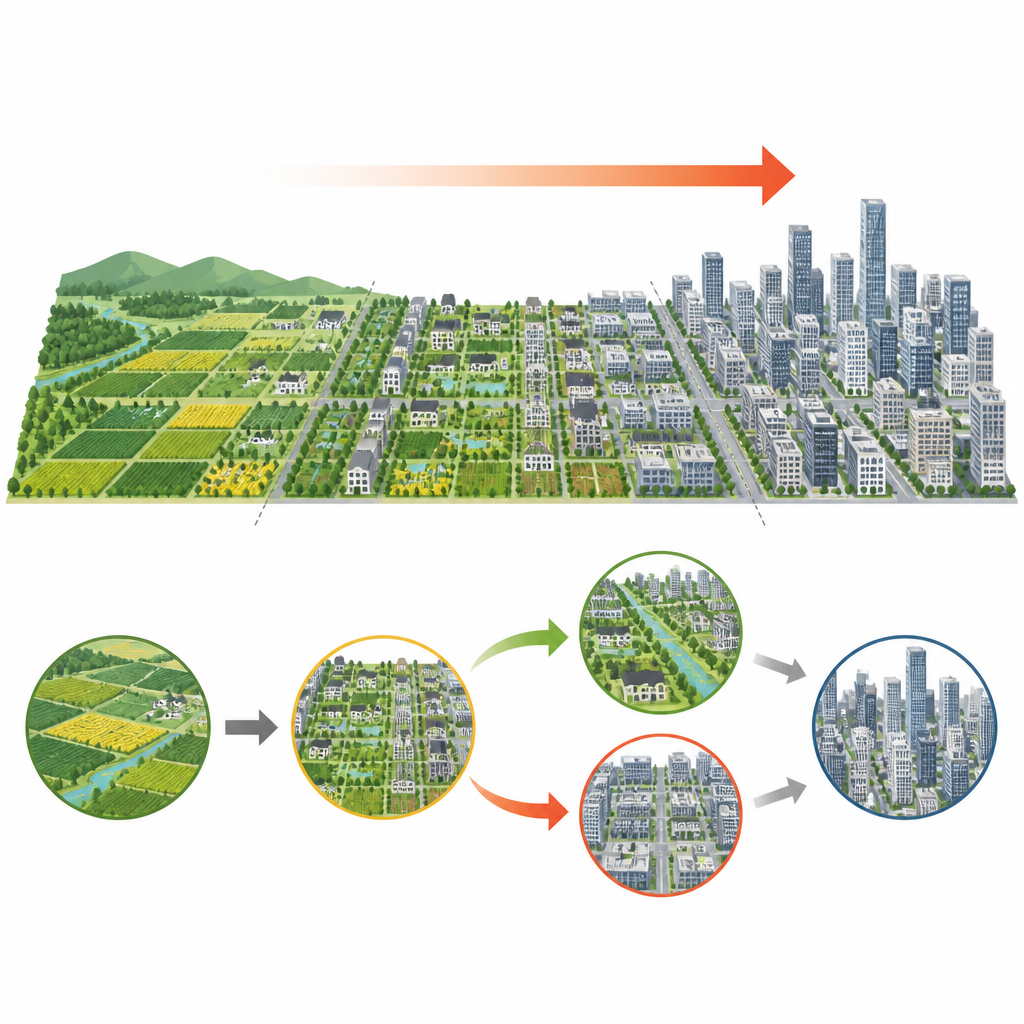
Where Town Meets Countryside
The researchers focused on the “just beyond the ring road” areas that sit between dense city cores and open countryside. Using satellite images of night lights and land cover from 2000 to 2020, they traced how these zones expanded across China. Over two decades, the size of these transition belts grew more than fourfold, especially around large cities in central and eastern China. Some cities, such as Beijing, Shanghai, and Guangzhou, saw early and rapid outward growth, while others in colder or drier regions began expanding later. This uneven timing created a patchwork of different development paths, but most shared a common pattern: more pavement and new buildings reaching steadily into former farmland and semi-natural land.
More Nature Overall, Less Fairness
To see how fairly nature’s benefits are shared, the team built a measure called the ecosystem services Gini coefficient, adapted from the well-known income inequality index. They combined four key services that support daily life and comfort: water supply, soil protection, carbon storage, and habitat quality. Then they compared how much of these services different parts of each transition zone receive relative to how many people live there. Despite an overall rise in the total “ecological budget” of these areas over the 20 years, their analysis shows that access to these benefits has become less even. The Gini values rose from 0.245 to 0.370, and more than 90 percent of urban–rural transition zones passed the usual inequality threshold. In plain terms, more nature is available on paper, but it is increasingly concentrated in places where fewer people live.
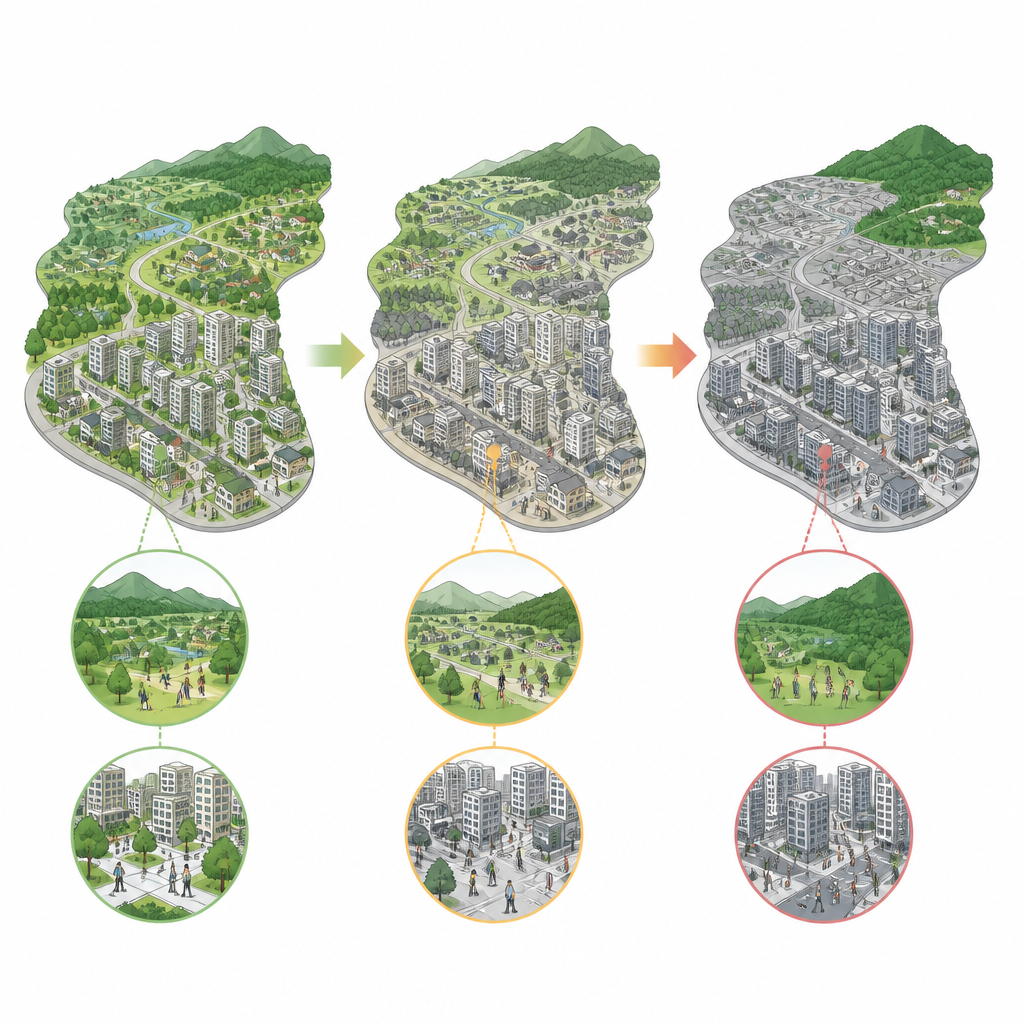
Green for a Few, Grey for Many
Why is this happening? The study finds that both human actions and natural conditions shape this divide, and their effects are often nonlinear. In greener regions with plenty of rainfall, growing wealth and rapid building can pull high-quality parks, trees, and water features toward rich inner districts, while pushing new roads and factories into the fringes. In drier or high-altitude areas, basic climate and terrain limit where green spaces can persist, but strong conservation policies can help keep people and nature in closer step. A striking pattern emerges around large coastal cities: as the share of hard surfaces such as roads and rooftops climbs, inequality in ecosystem services climbs with it, especially in built-up rings near the city core where many residents live but green space is scarce.
Climate Zones and Critical Turning Points
The researchers also looked for “tipping points” in the balance between people and nature. They found that when vegetation cover in the transition belt rises beyond a certain level, equality can actually worsen. That is because those very lush areas often occur in sparsely populated reserves, hillsides, or low-density high-income districts, rather than in crowded neighborhoods. Economic growth and bright night lights signal strong activity but tend to go hand in hand with more uneven access to nature. The team’s models show that combinations of factors matter: for example, places with both high greenery and strong local economies can offer very good living conditions, but only for a limited share of residents unless planning deliberately protects and shares green space.
What It Means for Future Cities
For everyday life, the study’s message is clear. The edges of Chinese cities are not simply blank canvases waiting for expansion; they are frontline zones where the gap between “green and comfortable” and “grey and stressed” is widening. Without careful planning, new roads, housing estates, and factories will continue to channel nature’s benefits toward a minority while leaving many fringe communities with fewer trees, hotter summers, and more flood risk. By tracking an “ecosystem service Gini,” the authors argue that planners and communities can see where inequalities are growing and adjust rules on paving, green corridors, and public parks. In doing so, cities can move closer to the goal of inclusive urban growth, where nature’s protection and comfort are treated as shared assets rather than privileges.
Citation: Qu, S., Li, D., Yu, X. et al. Growing inequality of ecosystem service distribution in China’s urban–rural transition zones: implications for SDG 11.3. npj Urban Sustain 6, 76 (2026). https://doi.org/10.1038/s42949-026-00376-3
Keywords: urbanization, ecosystem services, China cities, environmental justice, urban rural transition