Clear Sky Science · en
The effects of human activity and snow cover on the distribution of mammals and terrestrial birds in the Altai Mountains under climate change
Why a High-Mountain Borderland Matters
The Altai Mountains sit where China, Kazakhstan, Mongolia, and Russia meet, forming a rugged crossroads for wildlife. This study asks a question with global relevance: as climate warms and human activity grows, where will mountain mammals and ground-dwelling birds still be able to live? By tracing how snow, rain, and people shape habitats across this vast range today and in the future, the authors reveal which areas may become safe havens—and where conservation will need to cross political borders to keep up with moving species. 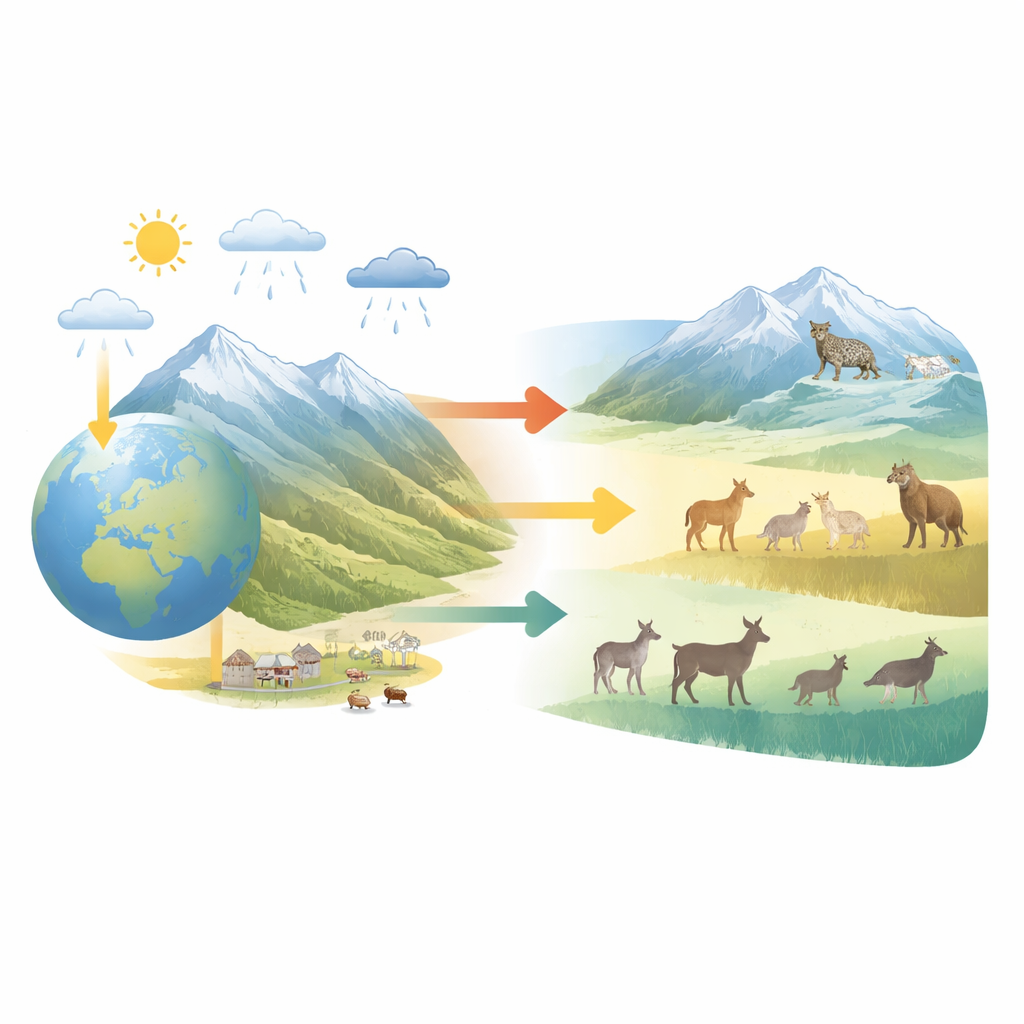
Watching Wildlife Across Four Countries
The researchers focused on 27 species of mammals and terrestrial birds, from snow leopards and ibex to grouse and partridges. They compiled more than two thousand recent sightings from field surveys, camera traps, international databases, and regional literature. Using a modeling approach called MaxEnt, they related each species’ known locations to maps of climate, vegetation, topography, snow cover, and human impact. They then used future climate projections for the 2070s, under an intermediate warming scenario, to estimate how suitable habitat might expand, shrink, or shift in space.
Where Animals Live Now—and Where They May Go
Today, the main strongholds for most of these animals are in the northwestern Altai and around the four-country border. Some species, such as moose, occupy relatively small pockets, while others, including snow leopards and Siberian ibex, are widespread across the range. When the team overlaid all species’ habitats, they found a clear gradient: species richness is highest in the northwest and drops toward the southeast, where suitable areas are scarce. This pattern already hints that the northwest, with its colder, snowier highlands, functions as a regional refuge for cold-adapted wildlife.
Winners, Losers, and Shifting Snow
Under future climate conditions, almost every species is projected to lose some of its current habitat but also gain new ground elsewhere, leading to shifting ranges rather than simple disappearance. Eleven species—including brown bears, red foxes, alpine pikas, and several grouse—are expected to see a net increase in suitable area. Seventeen others, such as moose, snow leopards, ibex, and Pallas’s cats, are projected to lose more habitat than they gain, in some cases by over 90 percent. The largest losses concentrate in the central Altai, while many gains appear further northwest or at higher elevations. By tracking the “center of mass” of each species’ range, the study shows that most animals are likely to move uphill or toward higher latitudes, with some shifting more than 90 kilometers. 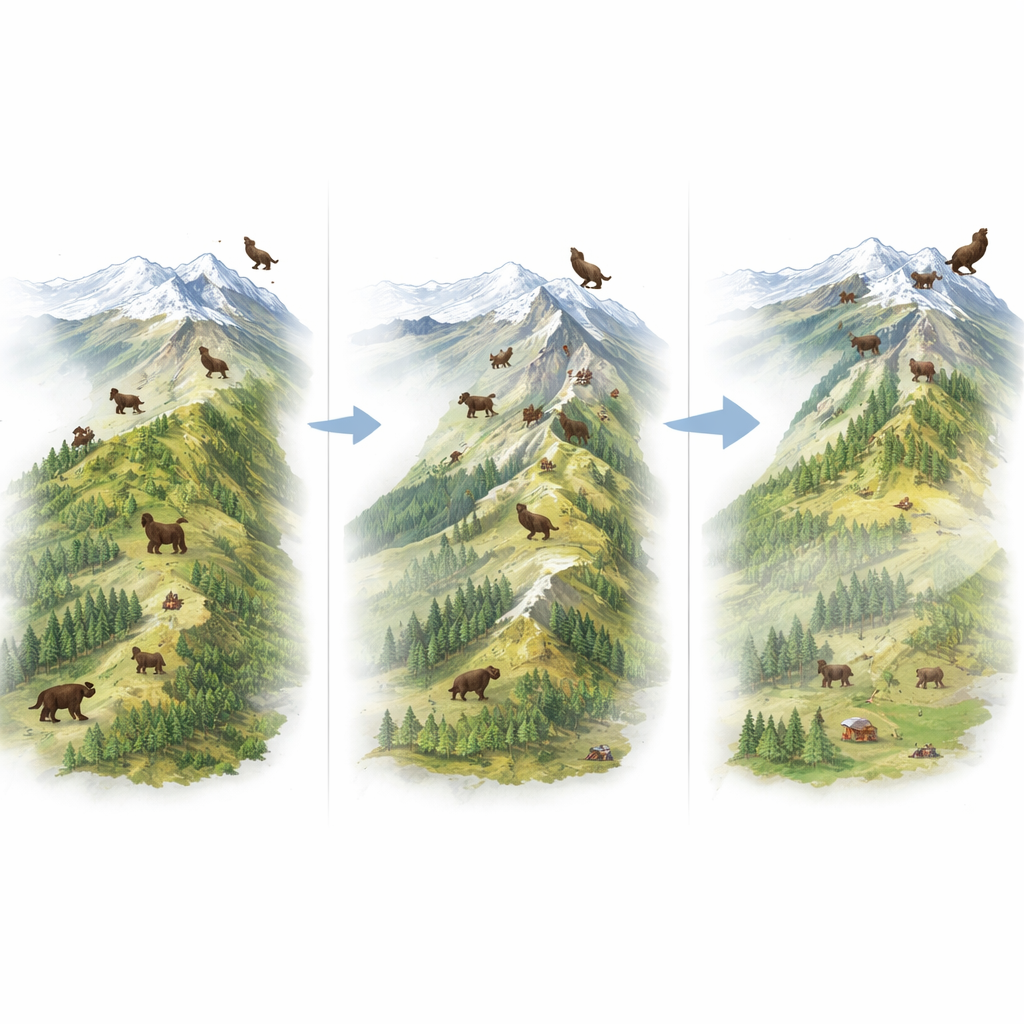
How People and Snow Steer the Map
Behind these movements lie three main forces: human pressure, winter precipitation, and snow cover. A composite human impact index—reflecting population, infrastructure, land use, and access routes—emerged as the single most important influence for many species. Large mammals like moose, bears, and wolves tended to avoid heavily used areas, while smaller mammals and ground birds often tolerated or even favored moderately grazed or altered landscapes, which can create more open vegetation and new food sources. Winter conditions also mattered. Precipitation during the coldest quarter, largely falling as snow, helped explain where species occur, as did the number of days with significant snow on the ground. For some animals, deeper or longer-lasting snow provides shelter and stable sub-snow microclimates; for others, it hinders movement and foraging. The balance of these effects, combined with changing temperatures and vegetation, will reshape where animals can persist.
Why Shared Protection Is Urgently Needed
Because the most suitable present and future habitats cluster near the junction of China, Kazakhstan, Mongolia, and Russia, the animals are effectively ignoring national borders even as those borders constrain conservation. The study shows that many current protected areas are fragmented and do not fully cover the transboundary zones where species richness is highest today or is projected to concentrate under warming. The authors argue that a coordinated network of cross-border reserves in the central and northwestern Altai is needed to protect both existing refuges and future migration routes. They recommend reducing harmful human impacts—especially intensive grazing and infrastructure—in key corridors so that species can track shifting climates through the landscape. In everyday terms, their conclusion is that climate change is already pushing wildlife uphill and northward, and only a cooperative, international approach can keep this mountain crossroads a living home for bears, cats, ungulates, and birds in the decades to come.
Citation: Tao, X., Liu, X., Cui, S. et al. The effects of human activity and snow cover on the distribution of mammals and terrestrial birds in the Altai Mountains under climate change. Commun Biol 9, 555 (2026). https://doi.org/10.1038/s42003-026-09803-8
Keywords: Altai Mountains, climate change, species distribution, snow cover, transboundary conservation