Clear Sky Science · en
Thioredoxin and its partner protein are essential for zoospore flagellar formation in Actinoplanes missouriensis
How Some Bacteria Build Tiny Tails on Demand
Many bacteria move using long, whip-like tails called flagella. For a soil-dwelling microbe named Actinoplanes missouriensis, building these tails at exactly the right moment is a matter of survival: its spores must suddenly become swimmers when rain or water appears. This paper uncovers how a pair of small proteins act like a molecular on–off switch to control when those swimming tails are built.
From Quiet Spores to Sudden Swimmers
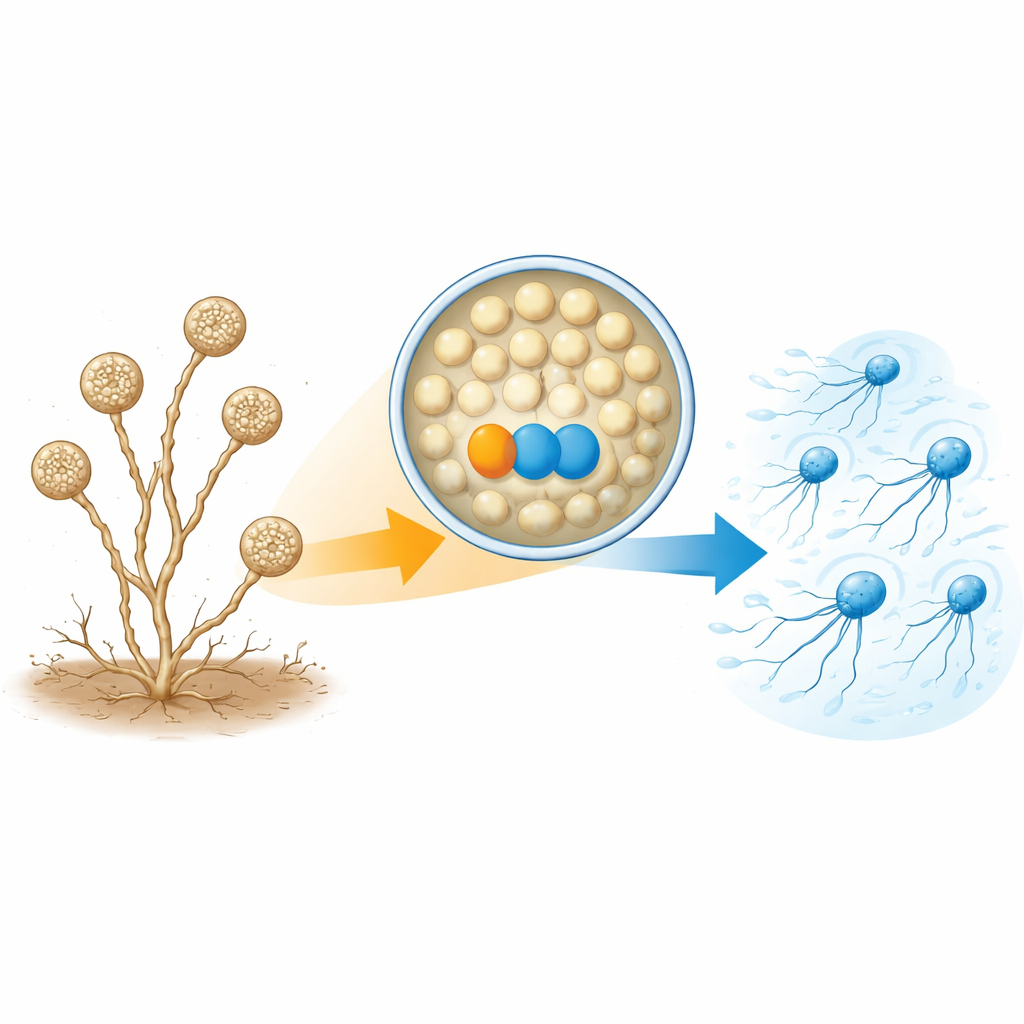
A. missouriensis normally grows as branching filaments in soil. Under dry conditions, it makes round structures called sporangia at the tips of these filaments. Inside each sporangium, hundreds of round spores form and prepare for life outside. When water arrives, the sporangium opens, releasing spores into the liquid. These spores quickly sprout flagella and become “zoospores” that can swim for a short time, helping them spread to new places before settling down to grow again. Because this swimming phase is brief and tightly timed, the cell must carefully control exactly when and how flagella are assembled.
A Protein Pair Needed for Building Tails
The authors focused on two proteins that are much more abundant in swimming zoospores than in germinating cells. One is a thioredoxin, called TrxA, and the other is its partner protein, named PtxA. When the researchers deleted the genes for either TrxA or PtxA, the spores still formed normally inside sporangia and were released on cue—but they did not swim. Electron microscopy showed why: most spores from these mutants simply lacked flagella, or had only a few short ones. Yet the messenger RNA levels for flagellar genes, and the amount of at least one key flagellar building block protein (FliC), were essentially normal. This means TrxA and PtxA are not turning flagellar genes on or off; instead, they are required for the actual assembly of the flagellar structures.
A Non-Redox Job for a Classic Redox Protein
Thioredoxins typically work by using a pair of cysteine amino acids to shuffle disulfide bonds in other proteins. To test whether this classic redox activity was needed here, the team purified TrxA and showed in a test-tube assay that it behaves like a normal thioredoxin: it can reduce a standard protein substrate. When they changed one or both key cysteines, TrxA lost this redox ability. Surprisingly, bacteria carrying these “redox-dead” versions of TrxA still produced fully flagellated, motile spores. In contrast, swapping part of TrxA with the closest similar thioredoxin from another bacterium did not rescue flagella formation, even though the substitute protein had normal thioredoxin activity. By systematically exchanging regions between the two proteins, the authors narrowed the crucial feature down to a short five–amino acid stretch in TrxA, with the sequence EKVEQ, that is conserved across many species of Actinoplanes.
A Molecular Switch That Protects a Key Flagellar Part
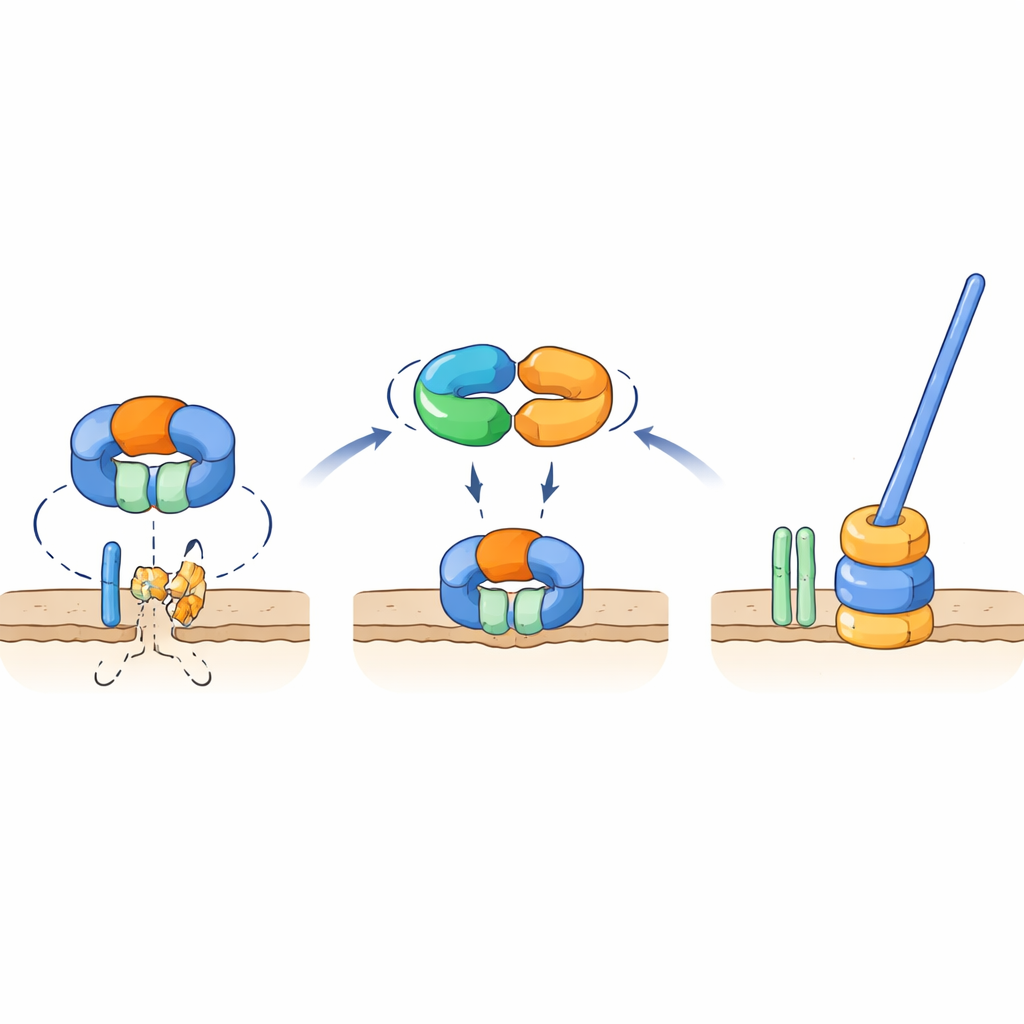
Genetic and interaction tests showed that TrxA and PtxA physically bind each other, and that the EKVEQ motif is essential for this partnership. Using a bacterial two-hybrid system, the researchers found that TrxA and PtxA also interact with ClpC, a chaperone component of the Clp protease complex—a molecular machine that unfolds and feeds proteins into a barrel-shaped “shredder.” To probe how this relates to flagella, they exposed the non-motile TrxA and PtxA mutants to UV light and selected rare suppressor strains whose spores regained motility. Many of these suppressors carried mutations in ClpC or in FliR, a membrane protein that forms part of the flagellar export gate at the base of the tail. Introducing those same mutations back into TrxA- or PtxA-lacking strains restored motility, and deleting fliR in an otherwise normal background abolished flagella altogether. These findings support a model in which, under non-flagellating conditions, the ClpC-containing protease degrades FliR, preventing the assembly of the flagellar base. When conditions favor flagella formation, the TrxA–PtxA complex binds to ClpC, dampening its proteolytic activity so that FliR can accumulate and the export gate—and then the full flagellum—can be built.
Why This Matters for Microbial Life and Protein Evolution
This work reveals a finely tuned system that lets a bacterium rapidly switch between a dormant spore and an active swimmer by guarding a single vulnerable component of the flagellar machine. It also shows a thioredoxin performing a job that does not depend on its usual chemistry: instead of acting as a redox catalyst, TrxA uses a short conserved motif to form a regulatory complex with PtxA and to control a protease. That kind of role-switching highlights how existing protein families can be repurposed during evolution into new regulatory modules, allowing bacteria like A. missouriensis to coordinate complex life-cycle transitions with just a handful of carefully placed molecular interactions.
Citation: Kimura, T., Maeda, S., Suzuki, R. et al. Thioredoxin and its partner protein are essential for zoospore flagellar formation in Actinoplanes missouriensis. Commun Biol 9, 532 (2026). https://doi.org/10.1038/s42003-026-09784-8
Keywords: bacterial motility, flagellar assembly, protein regulation, thioredoxin, protease control