Clear Sky Science · en
Modulating reflexes enables speed control in simulated human walking and running
Why this matters for how we move
Everyday life is full of smooth changes in how fast we move: strolling, speeding up to catch a bus, easing into a jog, or breaking into a run. We rarely think about what our nervous system must do to manage these shifts without tripping us up. This study uses detailed computer simulations of a human body and spinal cord to ask a simple but deep question: could fast, automatic feedback loops in the spine—our reflexes—by themselves handle most of this speed control and even help switch between walking and running?
Looking inside the body’s "auto-pilot"
When we walk or run, the brain does not micromanage every muscle. Instead, the spinal cord contains circuits that automatically adjust muscle activity based on signals from muscles and tendons. These reflexes react to how long and how hard muscles are working, and they help keep us upright and moving. Other circuits called central pattern generators can produce rhythmic activity on their own, and higher brain centers add planning and fine tuning. Because all of these systems are tightly intertwined in real people, it is almost impossible to test reflexes in isolation in the lab. The authors turn to a neuromusculoskeletal computer model instead: a physics-based virtual human with bones, joints, and nine major leg muscles per side, all driven only by reflex-like feedback between muscle pairs.
Testing what reflexes can do on their own
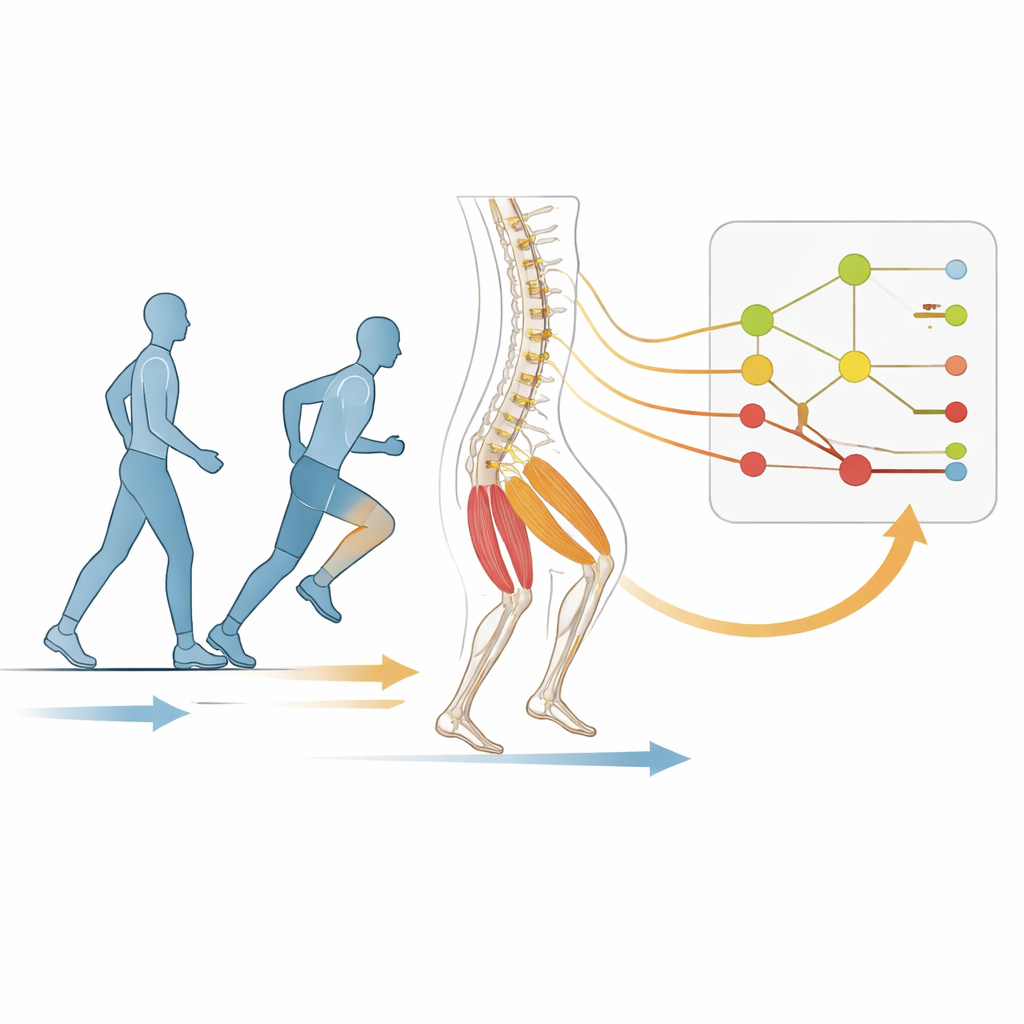
In the model, each reflex pathway takes in muscle length or force and sends an excitatory or inhibitory signal back to the same or an opposing muscle, scaled by a gain and shifted by an offset. There are 71 such adjustable numbers in total. The team first searched for combinations of these values that produced stable walking and running at very slow and very fast speeds. They found that by changing only these reflex gains and offsets, the model could walk steadily from about 0.45 m/s to 1.93 m/s and run from 2.0 m/s to 3.4 m/s—a range that covers typical human walking speeds and reaches into realistic running speeds for many people. Notably, the limiting speeds for walking and running lined up near the usual human walk-to-run transition speed, even though this was never built into the model.
From many knobs to a focused control strategy
Although 71 parameters are available, the authors wanted to know whether the nervous system would really need to adjust all of them to control speed. They analyzed many successful walking and running solutions and asked which reflex pathways changed the most across speeds. Using a statistical method, they identified a smaller group of "key" reflexes whose gains carried most of the variation related to speed. Remarkably, allowing only 30 of these key parameters to vary preserved almost the full range of achievable walking and running speeds. The researchers then fit simple mathematical curves that linked each key reflex setting to the overall speed of the model. This created a compact speed modulation function: feed in a desired speed, and it spits out a full set of reflex gains and offsets for the controller.
Changing speed on the fly and switching gaits
Next, the team tested whether this speed modulation function could be used in two ways. In "offline" mode, they chose a target speed before the simulation, generated reflex parameters from the function, and then ran the model. In "online" mode, they changed the target speed during the simulation and continuously updated the reflex parameters while the virtual person was already walking or running. In both modes, the model adjusted its speed smoothly over a substantial range, especially for running, where actual and target speeds matched closely. Walking showed a less perfect match but still followed the requested changes in shape and direction. By abruptly switching the full set of reflex parameters from a fast walk solution to a slow run solution, they also produced smooth transitions between walking and running without additional high-level timing rules.
What this means for our understanding of movement
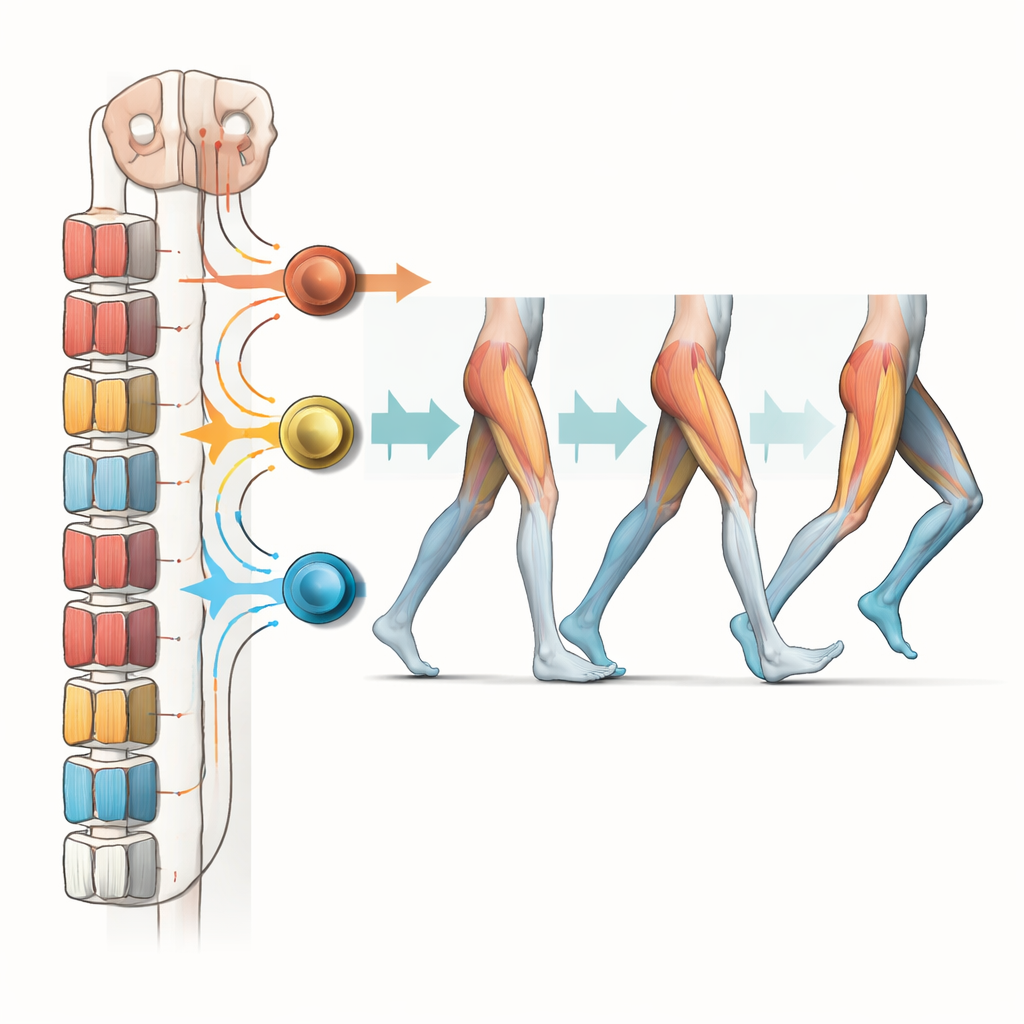
The study does not claim that real humans rely only on reflexes; our nervous system also uses rhythm-generating circuits, balance sensors, and brain commands. But these simulations demonstrate that, in principle, carefully tuned and modulated reflexes alone can control speed and support gait transitions in a realistic body. This suggests that spinal feedback may shoulder more of the work of everyday movement than previously appreciated, leaving higher brain centers to focus on planning and decision-making. The results also point toward simpler, more robust control strategies for legged robots and prosthetic devices that lean heavily on reflex-like feedback rather than complex central controllers.
Citation: Bunz, E.K., Bruel, A.J., Ijspeert, A.J. et al. Modulating reflexes enables speed control in simulated human walking and running. Sci Rep 16, 13028 (2026). https://doi.org/10.1038/s41598-026-48509-z
Keywords: human locomotion, spinal reflexes, gait speed, neuromusculoskeletal modeling, walking to running transition