Clear Sky Science · en
Increasing landslide susceptibility and intensity under climate change for Aotearoa New Zealand
Why storms on steep hillsides matter to everyday life
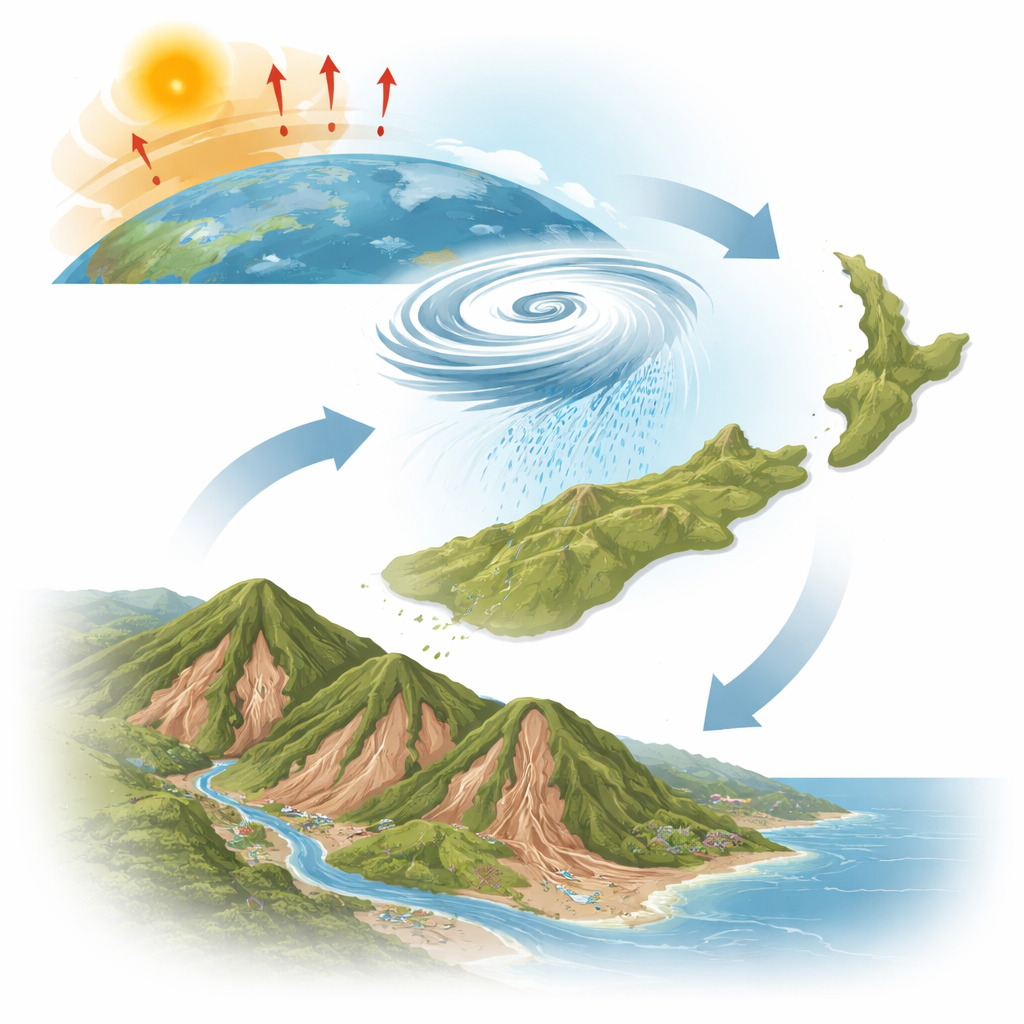
When a powerful storm hits steep country, hillsides can suddenly give way, sending mud, rocks, and trees crashing downhill. This kind of shallow landsliding can cut roads, damage homes and farms, choke rivers, and put lives at risk. In early 2023, Cyclone Gabrielle did exactly that in Aotearoa New Zealand, triggering hundreds of thousands of landslides in the North Island. This study asks a pressing question: as the climate warms and intense rainstorms become more common, how much worse could such landslide disasters become, especially in already hard‑hit regions like Hawke’s Bay and Tairāwhiti?
Looking closely at a record‑breaking storm
The researchers use Cyclone Gabrielle as a real‑world test case. After the storm, more than 145,000 individual landslides were carefully mapped from aerial and satellite imagery, creating one of the most detailed storm‑related landslide inventories ever assembled. At the same time, forecasters produced high‑resolution estimates of where and how much rain fell, hour by hour, across the landscape. By combining these two rich datasets, the team could see not just that landslides happened, but exactly where they clustered, how dense they were, and how this pattern lined up with the storm’s rainfall and the shape and cover of the land.
How rain, slopes, and land cover work together
The study shows that both the land itself and the rainfall matter, but in different ways. Steep slopes and certain land uses, such as pasture, largely control where landslides can happen. Heavy bursts of rain, especially the maximum that falls in a single day, then determine how many of those potential failures are actually triggered and how big the affected areas become. The models reveal a clear threshold: as 24‑hour rainfall increases, the chance and intensity of landsliding rise quickly up to about 300 millimetres in a day, and then level off. Beyond that point, extra rain does relatively little to increase the number or size of landslides, suggesting that many slopes are already pushed close to their limits.
Imagining the same storm in a warmer world
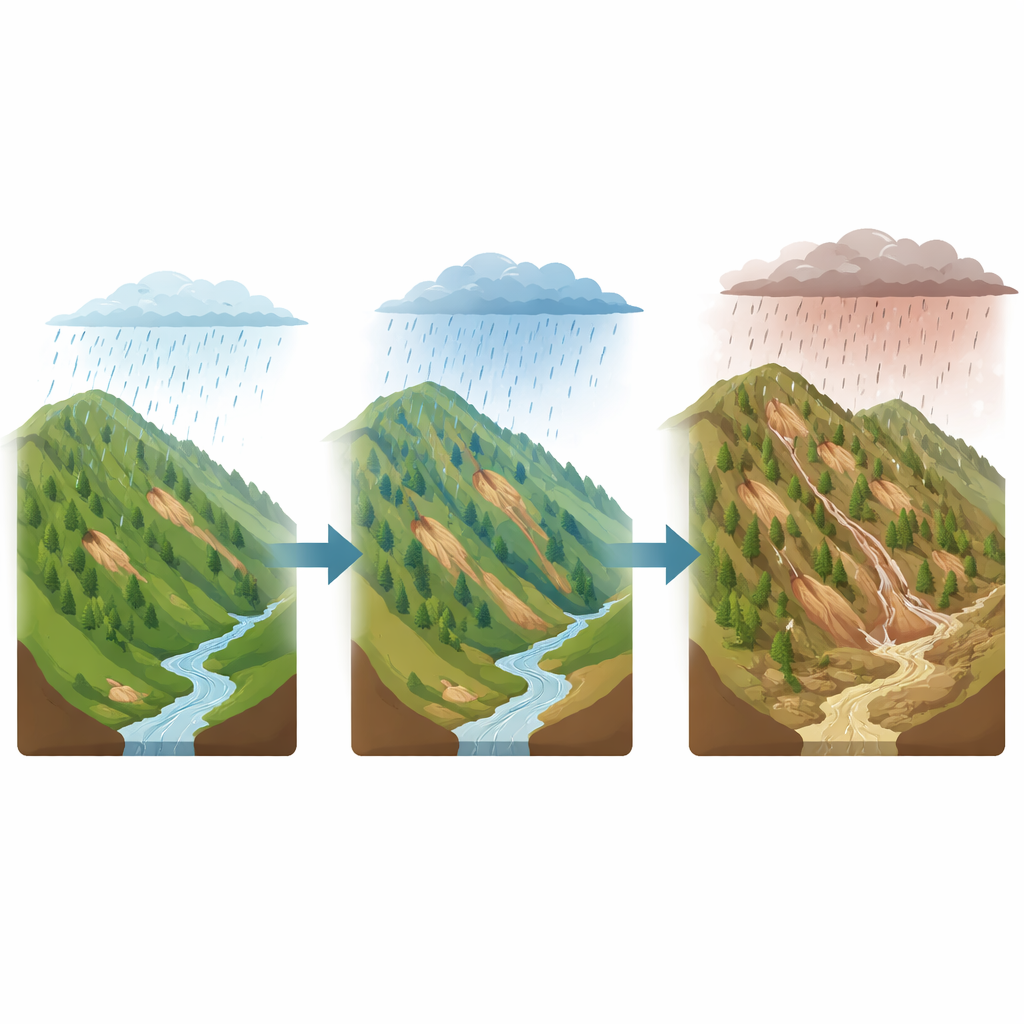
To explore the future, the team uses a “storyline” approach. Rather than averaging many different climate projections, they ask a specific question: what if a storm very much like Cyclone Gabrielle occurred in a world that is 2 degrees Celsius warmer than before industrial times (about 1 degree warmer than today)? Using a high‑resolution weather model, they simulate such a future version of Gabrielle in which the air is warmer and moister, boosting rainfall near the storm’s core while reducing it at the edges. They then feed this altered rainfall into their landslide models to see how hillsides in Hawke’s Bay and Tairāwhiti would respond.
More slides, packed more tightly into known danger zones
The results suggest that a warmer atmosphere would significantly increase landslide hazard during a Gabrielle‑type event. Depending on the exact simulation, the total number of landslides in the study area rises by roughly 50,000 to 90,000 compared with the 2023 storm, with total landslide‑affected area also growing. Areas experiencing the very highest landslide densities — the top five percent of values — expand by up to about a third. Crucially, these new or intensified landslide patches are not scattered randomly. They tend to appear right next to places that already slide easily, often on slopes of 20 to 40 degrees. Forested hills, by contrast, show a much weaker response, hinting that targeted tree planting on vulnerable slopes could help blunt some of the added risk.
What this means for communities and planning
For non‑specialists, the takeaway is sobering but actionable. Climate change is likely to make powerful rainstorms like Cyclone Gabrielle more intense, and when such storms strike steep, already fragile landscapes, they can trigger many more landslides packed into existing trouble spots. The study quantifies how big that increase might be and pinpoints where it is most likely to occur. This kind of evidence can guide land‑use rules, investment in hillside planting and slope management, and protection of roads, rivers, and settlements in harm’s way. In short, it shows that preparing for a warmer future in Aotearoa New Zealand means planning not only for higher floods, but also for more sliding hills.
Citation: Dreyer, L., Robinson, T., Katurji, M. et al. Increasing landslide susceptibility and intensity under climate change for Aotearoa New Zealand. Sci Rep 16, 11683 (2026). https://doi.org/10.1038/s41598-026-46684-7
Keywords: landslides, climate change, extreme rainfall, Cyclone Gabrielle, New Zealand