Clear Sky Science · en
Adolescent envy-like social comparison stress induces HPA axis hypoactivity and anxiety in female mice: implications for somatic symptom disorder
Why watching others thrive can hurt
Most of us know the uneasy feeling that comes from seeing other people enjoy opportunities we do not have. Social media has made this kind of constant comparison a daily experience, especially for teenagers. This study uses mice to explore what happens in the body and brain when young individuals repeatedly see others living in better conditions than they do, and it uncovers striking differences between males and females that may help explain why certain stress-related physical complaints are more common in women.
A window into social comparison
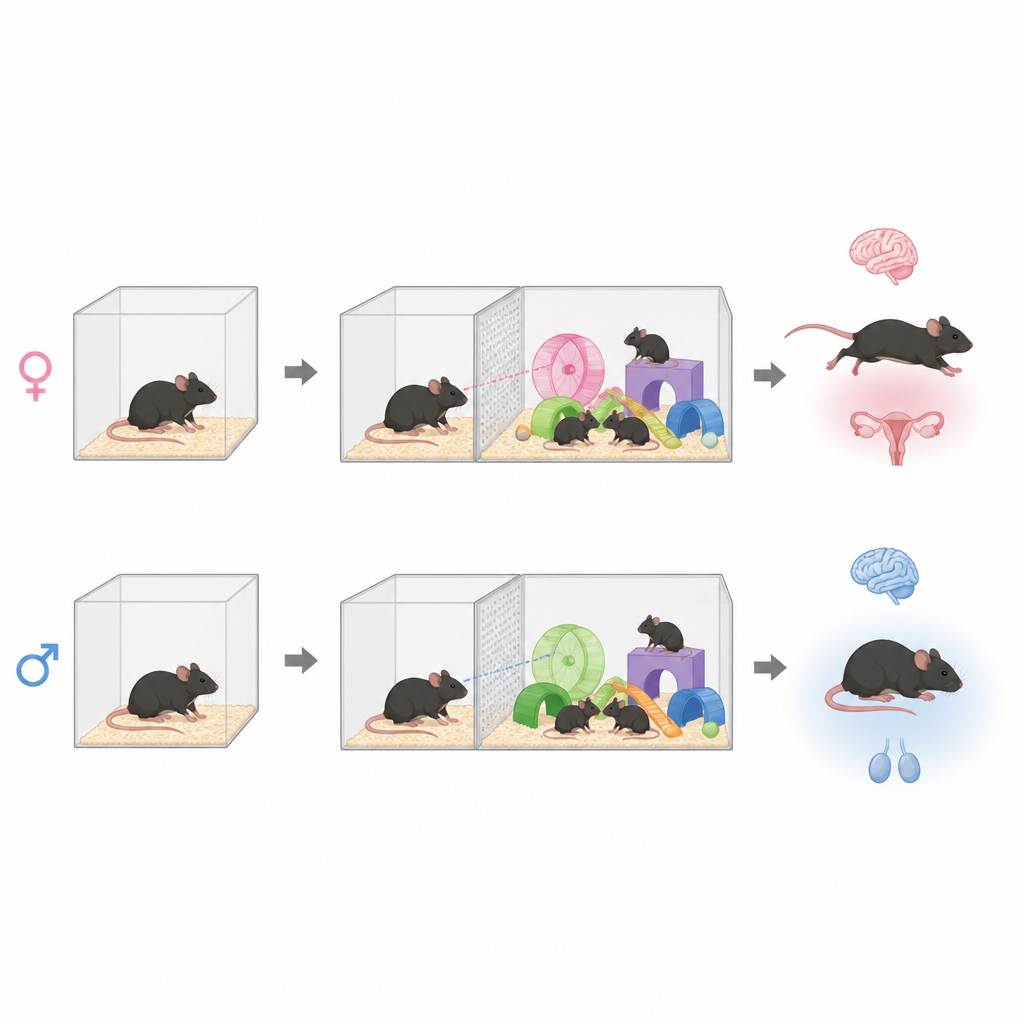
To mimic the stress of social comparison without physical threat, researchers raised young male and female mice in three kinds of housing. Some lived in plain cages alongside other plain cages. Some had cages filled with toys, tunnels, and shelters that changed every few days. A third group lived in plain cages but could constantly see their age-matched neighbors enjoying the enriched playground next door while never being allowed to enter it. The team calls this setup “envy-like” stress, not because they can prove the mice feel envy, but because the situation mirrors human frustration at watching others do better. The mice stayed in these conditions from just after weaning through adolescence, then underwent a long series of tests of movement, anxiety, memory, mood-like behavior, and blood measures of stress hormones.
Different costs for males and females
The same stressful setup produced very different outcomes in male and female mice. Males that spent adolescence watching enriched neighbors grew into adults that were unusually active in an open arena, ventured more into its exposed center, and showed less interest in social contact with unfamiliar mice. They also performed worse on a simple spatial memory test, even though they moved around the maze more than controls. Females, in contrast, did not become hyperactive or less social. Instead, they showed clear signs of increased anxiety in a test that measures willingness to leave a dark safe compartment for a brightly lit one, hesitating longer and spending less time in the bright space. Their performance on the memory task did not worsen, but they explored the maze less overall, and they also had poorer balance and coordination on a rotating rod.
From feelings to the stress system and the body
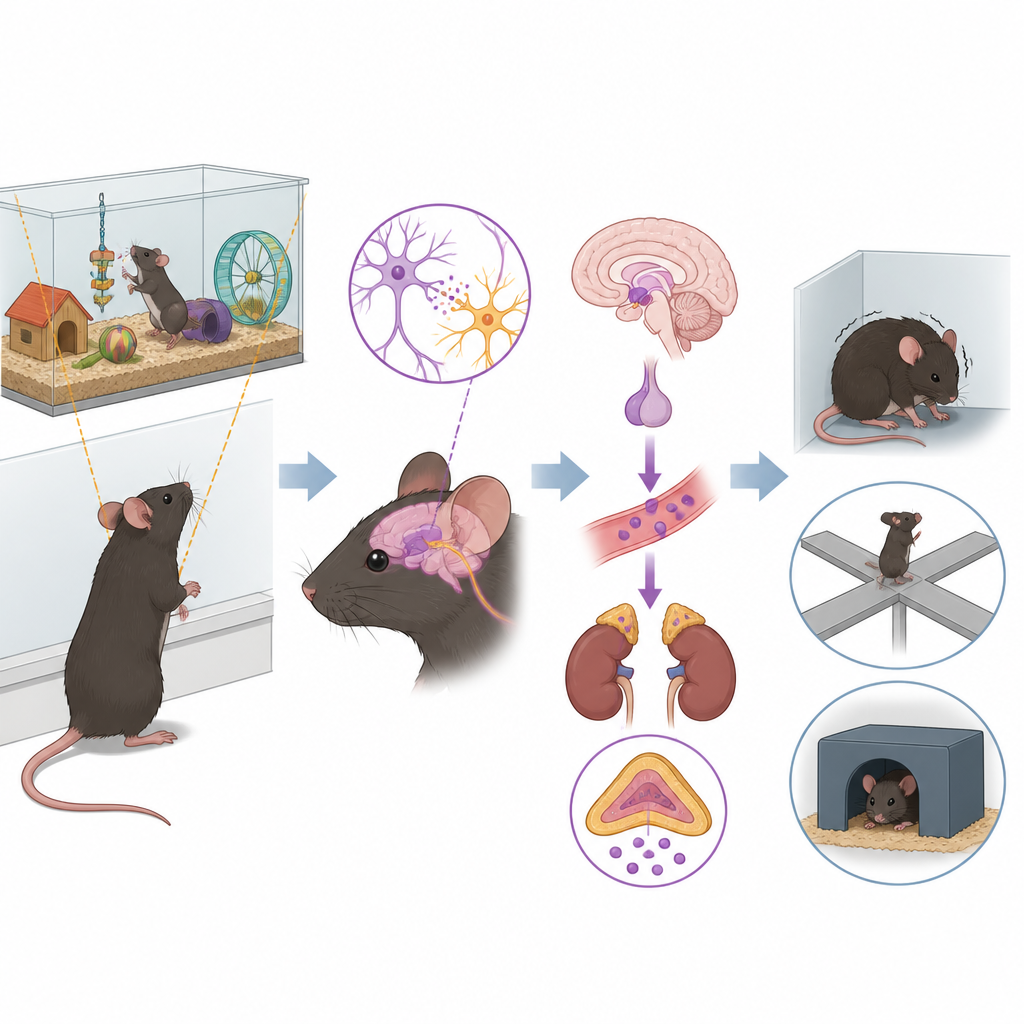
The researchers next looked at the animals’ stress hormone system, known as the hypothalamic–pituitary–adrenal (HPA) axis, which helps the body respond to challenges. Blood samples taken at rest showed that males exposed to envy-like stress had normal levels of the key hormones corticosterone and ACTH. Females, however, had significantly lower levels of both, pointing to an unusually quiet stress axis. This kind of “turned down” hormonal pattern has been reported in some people with long-lasting stress-related conditions, including somatic symptom disorder and post-traumatic stress disorder. In everyday terms, the stress system in these female mice seems to have adapted to repeated psychological strain by running on low power, even while their behavior shows more anxiety and subtle bodily difficulties such as impaired coordination and altered muscle strength.
Links to unexplained physical symptoms
Somatic symptom disorder involves persistent physical complaints, like fatigue or pain, that are distressing but not fully explained by medical tests, and it affects women more often than men. The mix of heightened anxiety, weakened motor performance, and reduced baseline stress hormones seen in female mice raised in the envy-like setting resembles some features described in these patients. Importantly, the mice were never restrained or attacked; their stress came purely from seeing others in better surroundings. This suggests that ongoing social comparison by itself, especially during adolescence when the brain and stress systems are still maturing, can leave lasting marks on both behavior and body function in a sex-specific way.
What this means for human stress
While mice are not people and we cannot know what they feel, this work shows that simply witnessing others’ advantages, without direct harm, can shape stress biology and behavior differently in males and females. For females in particular, chronic exposure to such psychological stress during adolescence produced an anxious, physically burdened profile with a muted stress hormone system that echoes patterns seen in some human stress-related disorders. The model therefore gives researchers a new tool to probe how modern forms of social comparison might translate into real bodily symptoms, and why young women may be especially vulnerable.
Citation: Ueno, H., Tanaka, Y., Kitano, E. et al. Adolescent envy-like social comparison stress induces HPA axis hypoactivity and anxiety in female mice: implications for somatic symptom disorder. Sci Rep 16, 15771 (2026). https://doi.org/10.1038/s41598-026-46643-2
Keywords: adolescent stress, social comparison, envy-like stress, somatic symptom disorder, HPA axis