Clear Sky Science · en
A multi-method approach to characterising dynamic human–shark interactions at a remote oceanic island
Why people and sharks sharing space matters
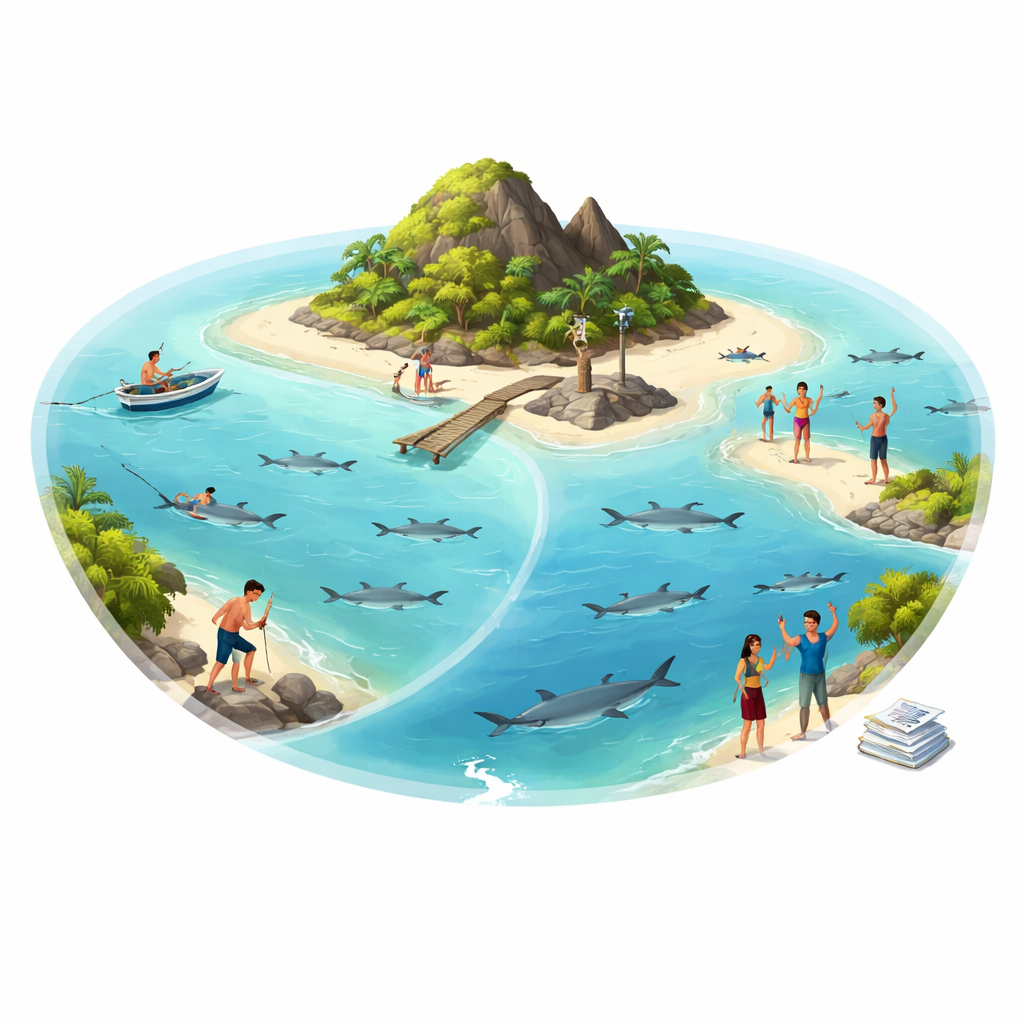
When most of us think about sharks, we picture dramatic news headlines or movie monsters, not everyday life at a small island. Yet for the residents of Ascension Island, a tiny volcanic speck in the tropical Atlantic, sharks are regular neighbours. This study asks a simple but urgent question: how often do people and sharks cross paths, how has that changed over the last century, and what does it mean for both safety and conservation?
A remote island and its returning sharks
Ascension Island sits far from major continents and is surrounded by one of the world’s largest marine protected areas. For decades, many locals rarely saw sharks close to shore. But in 2017, two serious, non-fatal shark bites in quick succession jolted the community and drew global media attention. The species thought to be involved, the Galapagos shark, has historically been linked to very few unprovoked bites worldwide, so this sudden cluster was unusual. Without long-term records, it was hard to know whether sharks had truly become more common near people, or whether recent encounters simply felt new to a generation unused to seeing them.
Piecing together many kinds of clues
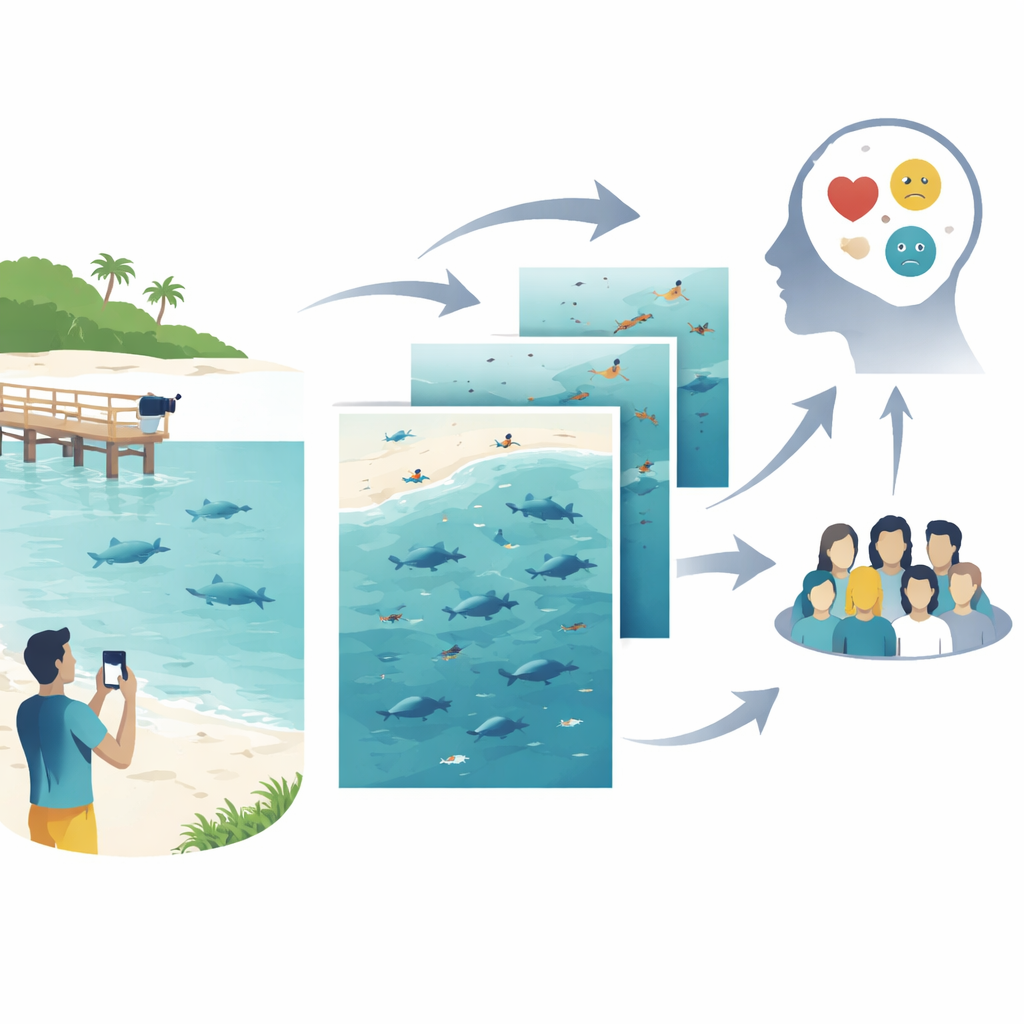
To answer that, the researchers assembled an unusually wide set of clues. They combined modern tools—remote time-lapse cameras overlooking the island’s main pier, social media photos and videos, online surveys, and interviews with residents—with historical archives reaching back to the early 1700s. From more than 34,000 camera images, over a hundred social media posts, and nearly two hundred written accounts, they built a timeline of when sharks were seen, where they appeared, what they were doing, and how people felt about them. This “many lenses” approach helped them cross-check patterns and avoid relying on any single, biased source.
Shifting shark numbers across months, years, and decades
The picture that emerged is one of strong ups and downs rather than a steady trend. On short time scales, camera footage showed that nearshore shark activity in 2024 was low for much of the year, then surged in July and August, especially at night, before dropping again. Social media posts from 2010 onward showed both seasonal pulses and big spikes in particular years, notably in 2016 and 2021, driven largely by sightings along the more populated west coast and around the Georgetown pier. Looking further back, archival documents and long-term memories point to frequent shark sightings in the early and mid‑1900s, a marked lull in the late twentieth century—especially the 1990s, when many residents reported seeing none—and then a clear resurgence since about 2010.
From stolen fish to worries about swimming
It was not just how often sharks appeared that changed, but how they behaved and how people experienced them. Accounts from the 1700s to the present describe sharks stealing bait and hooked fish—a long-running problem for local fishers that has earned sharks the nickname “the taxman.” But many fishers also recalled periods when such losses were rare, suggesting that this impact rises and falls over time. More recent stories describe sharks approaching boats closely, bumping hulls, and seeming bolder or more aggressive during periods when many individuals gathered in shallow bays. At the same time, other reports and videos show calm encounters where sharks cruise past swimmers and divers without incident, reminding us that most meetings are uneventful even when animals are plentiful.
Changing feelings in a small community
To understand how all of this affects people’s outlook, the team used computer-based “sentiment” analysis on hundreds of snippets of text from newspapers, archives, social media, and surveys. Overall, recent decades show a shift away from the uniformly fearful tone of early records toward more mixed—and often surprisingly positive—views. Many residents acknowledge the risks but also express respect and even affection for sharks as part of the island’s identity and a sign of a healthy sea. Sentiment dips after high-profile incidents, such as the 2017 bites, but tends to rebound within a few years, hinting at a kind of social resilience or growing acceptance.
How this helps people and sharks live together
This study concludes that human–shark encounters around Ascension Island are both natural and highly variable, shaped by long-term changes in shark abundance, short-term environmental shifts, fishing practices, and human perceptions. By weaving together cameras, social media, interviews, surveys, and historical documents, the authors show that it is possible to reconstruct a rich picture of risk and coexistence even in a remote, data-poor setting. For local managers and residents, the findings support more flexible, context-aware decisions—such as adjusting swimming or fishing practices during high-activity periods—rather than reacting only after rare bites make the news. More broadly, the work shows that conflict is not an inevitable outcome of seeing sharks inshore; with good information and ongoing dialogue, people and large predators can continue to share the same waters.
Citation: Clarke, L., Collins, C., Burns, P. et al. A multi-method approach to characterising dynamic human–shark interactions at a remote oceanic island. Sci Rep 16, 13010 (2026). https://doi.org/10.1038/s41598-026-46394-0
Keywords: human–shark interactions, Ascension Island, marine protected areas, shark conservation, human–wildlife conflict