Clear Sky Science · en
The short-term effect of near infrared irradiation on arteriovenous fistula in hemodialysis patients: a pilot, prospective study
Why light therapy for dialysis access matters
People with severe kidney disease often depend on hemodialysis, which requires a sturdy “lifeline” in the arm called an arteriovenous fistula. Over time, this lifeline can narrow or clot, putting treatments and health at risk. The study described here explores whether a short session of gentle near infrared light, shone on that access site, is safe and whether it might briefly calm inflammation in the blood vessels that keep dialysis flowing.
The lifeline in the arm
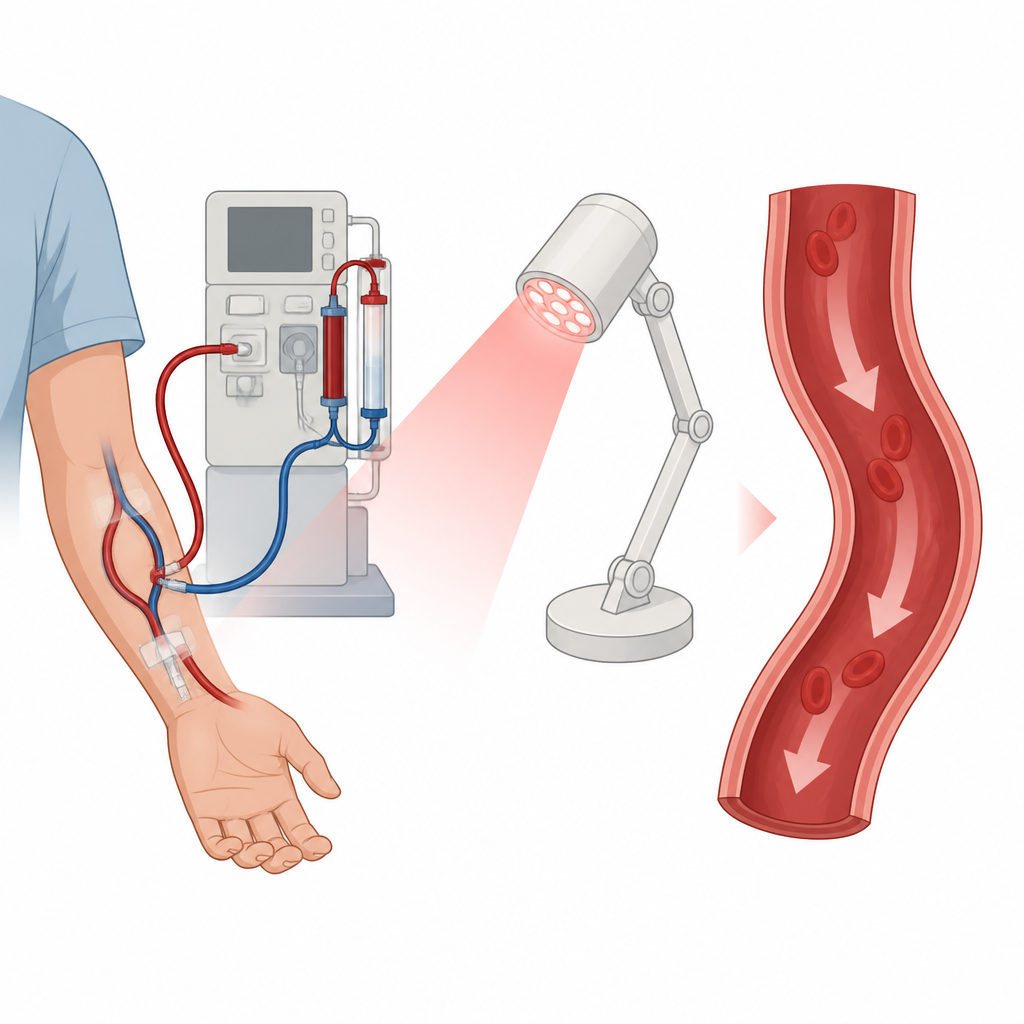
Hemodialysis works by routing blood from the body through a machine that filters waste and returns cleaned blood. To do this several times a week, many patients receive a fistula, in which an artery is joined to a vein so the vein becomes stronger and easier to use. Fistulas are preferred over plastic grafts or catheters because they usually last longer and have fewer infections. Yet a sizable fraction fail within a few years, often because the vessel wall thickens or does not widen enough, causing reduced blood flow and higher risk of blockage.
A closer look at gentle light treatment
Near infrared light is invisible to the eye but can pass several millimeters into tissue. In other settings, such light has been used to ease pain, speed wound repair, and reduce inflammation. Those effects are thought to occur because cells respond to the light by changing how they handle oxygen, free radicals, and signaling molecules that control blood vessel tone and immune activity. Based on this, the researchers asked whether a single 30 minute near infrared session directed at the fistula arm of dialysis patients would be safe and might nudge local inflammation toward a more balanced state.
How the study was done
The team enrolled 42 adults on regular hemodialysis at a single hospital in Beijing and randomly assigned them to two groups. Both groups continued their usual treatments. In the near infrared group, a lamp producing a broad band of light was positioned about 30 centimeters above the fistula and used during the first part of a dialysis session for half an hour. Nurses monitored skin temperature at the site and watched for redness, pain, or other problems. Before and after the light exposure, the researchers measured blood flow in the arm by ultrasound, recorded pressure readings from the dialysis machine, and drew blood from the fistula arm and the opposite arm to analyze many markers of inflammation and blood vessel function.
What the researchers observed
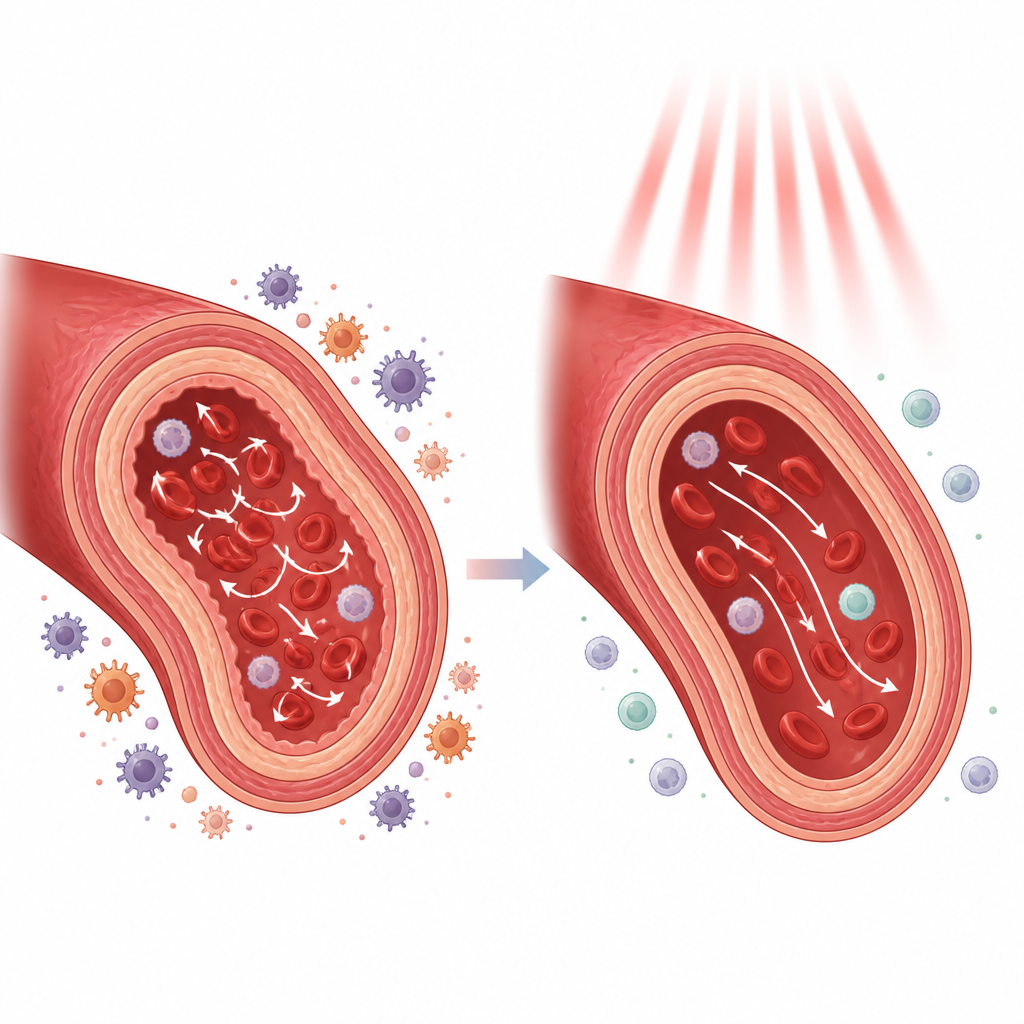
The light treatment warmed the skin slightly but kept temperatures below 38 degrees Celsius, and no patient reported discomfort, suggesting that a single session is safe and well tolerated. Measures of blood flow through the fistula did not change over the short time frame. However, venous pressure during dialysis rose in the control group but not in the light treated group, hinting that the vessels exposed to near infrared light might have relaxed instead of tightening. In blood tests, an important pro inflammatory signal called interleukin 6 decreased in the treated group while it tended to rise in controls. At the same time, levels of an anti inflammatory signal, interleukin 10, increased at the fistula site in treated patients. The pattern of another marker, interleukin 8, suggested that the rise in this inflammatory signal was blunted by the light exposure. In addition, the balance of certain immune cells (the CD4 to CD8 ratio) shifted in a way that is often associated with a more regulated immune response.
What this could mean for patients
This small pilot study shows that shining near infrared light on the dialysis access site for 30 minutes appears safe in the short term and can gently shift several blood markers toward lower inflammation, even though it did not immediately change blood flow. For patients and clinicians, the work hints that a simple, non drug procedure might someday help preserve the health of the fistula that makes dialysis possible. Larger and longer studies will be needed to learn whether repeated light treatments can truly keep these vital blood vessels open and working well over months and years.
Citation: Chunyan, F., Zhenbin, J., Zhenling, D. et al. The short-term effect of near infrared irradiation on arteriovenous fistula in hemodialysis patients: a pilot, prospective study. Sci Rep 16, 15766 (2026). https://doi.org/10.1038/s41598-026-45571-5
Keywords: hemodialysis, arteriovenous fistula, near infrared light, vascular inflammation, photobiomodulation