Clear Sky Science · en
Spatiotemporal analysis of nontraditional security issues evolution globally: evidence from news big data
Why everyday life and global safety are connected
From terrorist attacks and pandemics to cyber‑attacks and climate‑fueled disasters, many of today’s threats to safety no longer look like traditional wars between armies. This study tracks how such "nontraditional" dangers have risen, spread, and changed shape around the world since 2000, using millions of news reports to reveal when and where global trouble has flared—and where it has eased. 
Looking at world risks through the news
The authors treat global news coverage as a giant sensor for stress points in societies. Drawing on the GDELT database, which automatically records events mentioned in news stories from around the world, they focus on 79 types of incidents that capture non-military threats: terrorism, mass protests, humanitarian crises, cyber incidents, major crimes, and more. For 153 countries and 24 years, they count how often such events occur and how strongly they are portrayed, building two measures: a simple event count and a Nontraditional Security Impact Index, which reflects both how widely an event is reported and how severe or hostile it appears.
Turning messy events into a single impact score
To build their impact index, the researchers first total how many separate articles cover each kind of event involving a country in a given year. They then adjust these tallies by how conflictual or cooperative the coverage seems, using sentiment and impact scores that GDELT assigns to each event. After normalizing these pieces so that no single year or event type dominates the picture, they combine them into one yearly number for each country and a matching global value. This lets them compare, on the same scale, how strongly nontraditional security problems press on different places and how that pressure changes over time. 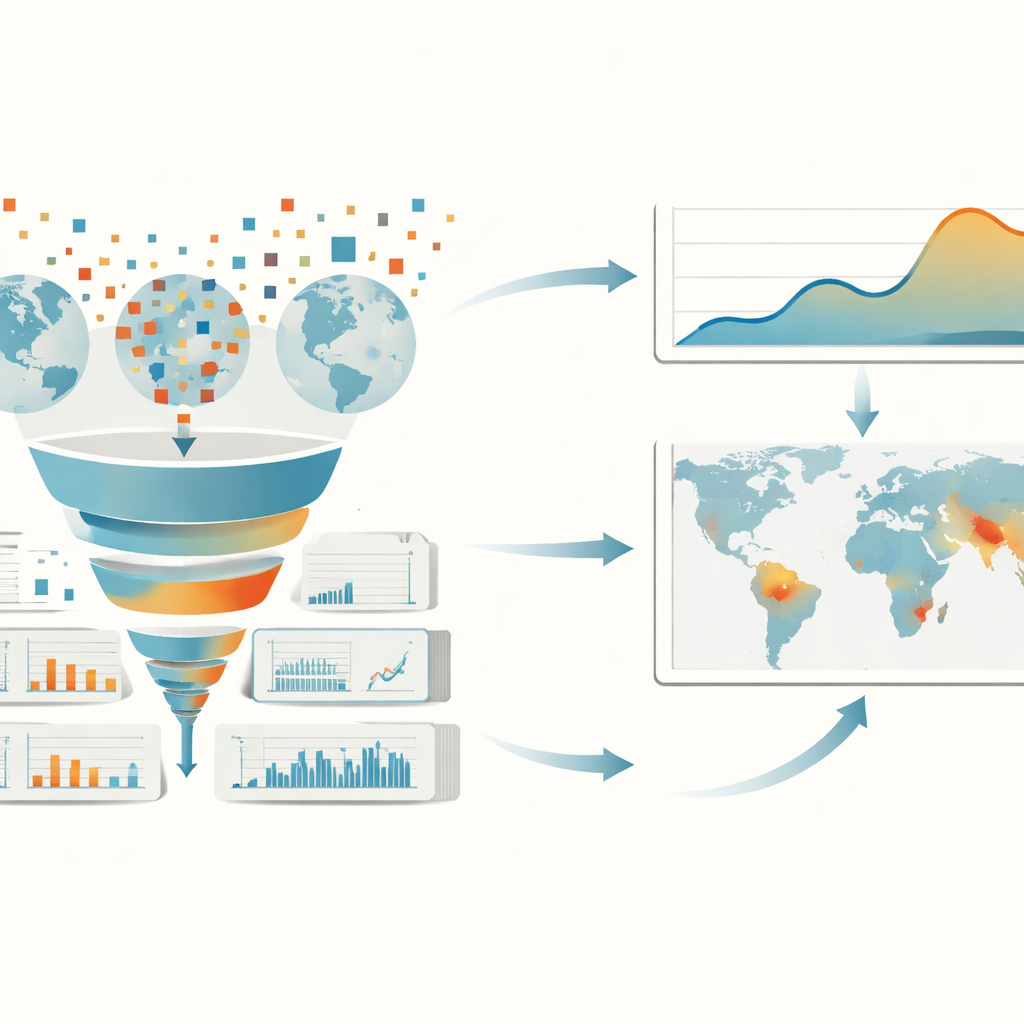
Five chapters in a turbulent two decades
When the authors plot their results, a clear story emerges. From 2000 to about 2006, overall risk levels are relatively low and concentrated in a few countries such as Iraq and Palestine, reflecting the Iraq War and its aftermath. Between 2007 and 2012, both the number and impact of incidents surge, driven by terrorism, uprisings, and financial turmoil centered in the Middle East, North Africa, and South Asia. After 2013, events become more frequent but somewhat less intense, and new hotspots appear in Sub‑Saharan Africa and other regions. From 2017 onward, the global index gradually falls and stabilizes, even as crises like the COVID‑19 pandemic and the war in Ukraine keep certain countries under high strain. The authors divide this arc into five phases: an initial calm, an outbreak stage, a transitional period, an easing period, and a tentative "new normal" after 2022.
Where global trouble clusters—and why it matters
Maps of the index show that nontraditional security problems rarely strike at random. Over time, high‑impact incidents increasingly cluster in neighboring countries, especially in the Middle East, Sub‑Saharan Africa, and parts of South and East Asia. Statistical tests confirm that this grouping became stronger after about 2015, suggesting that crises in one country often spill over to its neighbors or share deeper regional roots. At the same time, some regions that once saw intense trouble show clear easing in recent years, possibly linked to economic recovery, regional diplomacy, and large cooperation efforts such as infrastructure and trade initiatives. The study is careful not to claim direct cause and effect, but it notes that broader international engagement often coincides with lower impact scores.
Limits of seeing the world through headlines
Because the analysis depends on media reports, it reflects what the news chooses to highlight, not a perfect census of real‑world suffering. Countries with restricted press freedoms or little global attention may appear quieter than they truly are, while highly watched regions can look disproportionately troubled. The authors try to correct for these biases by normalizing the data and by treating their index as a measure of perceived rather than absolute risk. They argue that this perspective is still crucial, since what governments and the public see in the news strongly shapes where aid, diplomacy, and security efforts are directed.
What this means for people and policymakers
The study concludes that nontraditional security threats have become more common, more interconnected, and more regionally concentrated over the past two decades, but that their overall global impact has eased and stabilized since around 2017. For non‑experts, the takeaway is that today’s major dangers—from terrorism and cyber‑attacks to pandemics and climate shocks—are shared problems that cross borders and link distant societies. For decision‑makers, the work offers a reproducible way to monitor these risks over time and space, highlighting where sustained, cooperative responses are most needed and reminding us that early warning now depends as much on data and information flows as on traditional intelligence.
Citation: Li, J., Li, Z., Li, S. et al. Spatiotemporal analysis of nontraditional security issues evolution globally: evidence from news big data. Sci Rep 16, 13126 (2026). https://doi.org/10.1038/s41598-026-42600-1
Keywords: nontraditional security, global risk hotspots, news big data, terrorism and social unrest, spatiotemporal security trends