Clear Sky Science · en
Thermo-mechanical modelling and experimental production of aluminium circular form detail using three-level hierarchical WAAM model
Printing Big Metal Parts with Fewer Surprises
Large custom metal parts are vital for airplanes, ships, cars and industrial machinery, but they are usually expensive and slow to make. Wire arc additive manufacturing (WAAM) promises to “3D print” such parts from welding wire, building them up bead by bead. However, too much heat can warp the metal, crack it, or ruin the shape. This paper shows how computer simulations, organized in three smart stages, can predict these problems in advance and guide the safe printing of a circular aluminum wall, bringing heavy-duty metal printing closer to reliable everyday use.
Why Metal 3D Printing Needs Better Planning
Unlike plastic 3D printers, WAAM uses an electric arc to melt metal wire and lay it down in thick lines, or beads. This makes it attractive for large components such as cylindrical housings, rods, and structural rings, where traditional machining wastes material and time. But the same powerful heat source that melts the wire can also overheat the growing part. Layers may soften or even partially melt again, building up hidden stresses that later bend or crack the part. Up to now, many studies have examined only one scale at a time—either a single bead, a layer, or the whole component—making it hard to transfer lessons from the computer model to a real industrial print.
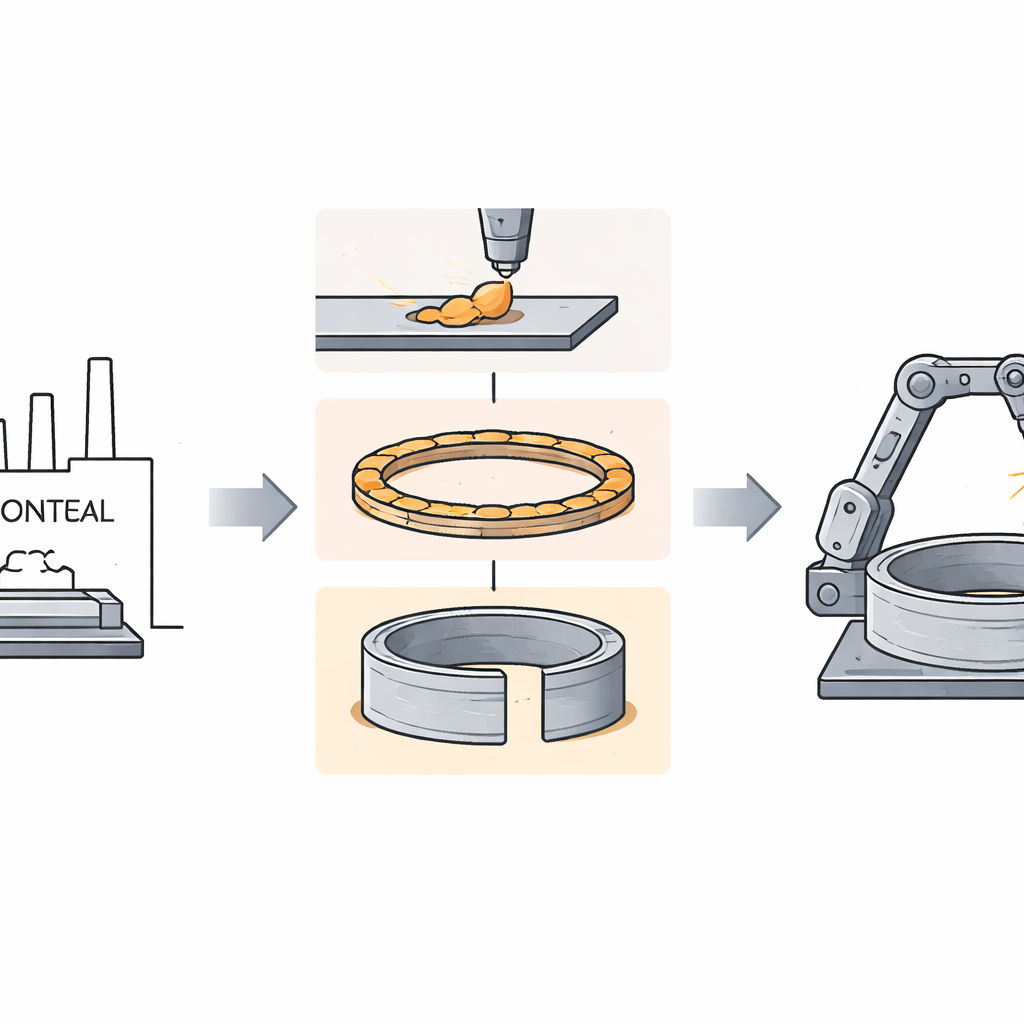
Three Steps: From Single Line to Full Wall
The authors propose a three-level “hierarchical” model that mirrors how a real print grows: first a single bead, then a full layer, and finally the entire wall. At each level, they use the same underlying physics—how heat flows and how the metal expands and contracts—but ask different questions. At the bead level, they check whether the chosen voltage, current, and travel speed give a realistic melt zone and safe stress levels in the base plate. At the layer level, they arrange many beads along a circular path and track how the temperature at a key point rises and falls as the torch passes by. At the wall level, they stack ten such layers into a 30‑millimeter‑high, 60‑millimeter‑wide circular wall with a deliberate 3‑millimeter gap, mimicking real openings for sensors or access slots that disturb heat flow.
Finding and Fixing Hidden Heat Buildup
By running detailed simulations in commercial finite element software, the team discovered that the first two levels behaved well: temperatures rose and fell in a controlled way, and leftover stresses stayed within safe limits. Trouble appeared only at the full-wall level. As more layers were added, heat no longer had time to escape; temperatures in lower layers crept upward until they neared the melting point, causing partial remelting and threatening to distort the wall. Because this was seen in the virtual model before any metal was printed, the researchers could test different cooling strategies by computer. They tried pausing after each layer and letting the entire part cool to various target temperatures. Cooling to very low temperatures was safe but impractical, while higher targets did not prevent overheating. A middle value—cooling down to about 60 degrees Celsius—struck the best balance, stopping cumulative heat buildup without making the process unreasonably slow.
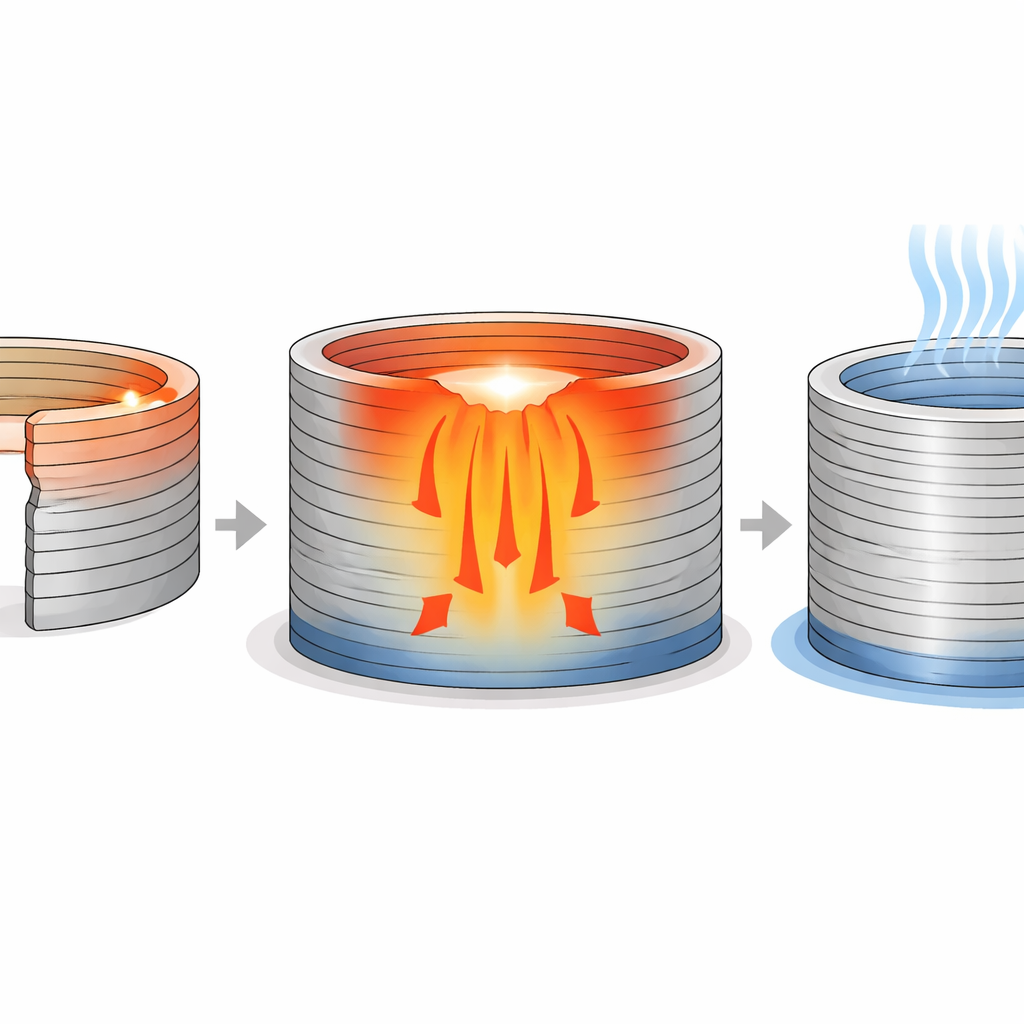
From Screen to Workshop
Armed with the simulated settings, the team printed the actual aluminum wall using a robotic welding system and infrared temperature monitoring. They kept the same electrical and motion parameters as in the model and applied the layer-by-layer cooling rule. Measurements showed that peak temperatures and interlayer temperatures closely matched the predictions, and the finished wall agreed with the planned shape within a few percent for height, diameter, bead width, and layer thickness. No cracks or serious distortions appeared, though a small flaw at the end of one bead highlighted real-world effects that the idealized model does not yet capture, such as slight changes in wire feed or robot motion during start and stop.
What This Means for Future Metal Printing
In simple terms, the study shows that carefully staged computer simulations can act as a rehearsal for complex metal 3D prints. By moving from bead to layer to wall and checking stability at each step, engineers can spot dangerous heat accumulation early, choose practical cooling rules, and avoid wasting time and material on failed parts. The approach also cuts computing time and data storage compared with simulating the full piece from scratch at once. As this three-level strategy is expanded to new shapes, materials, and automated control software, it could help make large-scale metal printing more predictable, efficient, and ready for everyday industrial use.
Citation: Anikin, P., Bastos, F. & Shilo, G. Thermo-mechanical modelling and experimental production of aluminium circular form detail using three-level hierarchical WAAM model. Sci Rep 16, 12561 (2026). https://doi.org/10.1038/s41598-026-42149-z
Keywords: wire arc additive manufacturing, metal 3D printing, thermal simulation, process cooling, residual stress