Clear Sky Science · en
A study on area-wide management of subterranean termites through baiting strategies in a tropical region
Why hidden house-eaters matter to everyone
Most of us never see subterranean termites, yet they quietly chew through homes, campuses, and even city trees, racking up billions of dollars in damage each year. In tropical countries like Malaysia, these insects thrive in warm, moist soil under buildings and landscapes. This study follows a rare, campus-wide experiment to see whether a carefully planned baiting program—rather than heavy spraying of chemicals—can wipe out termite infestations across an entire university and keep them from coming back.
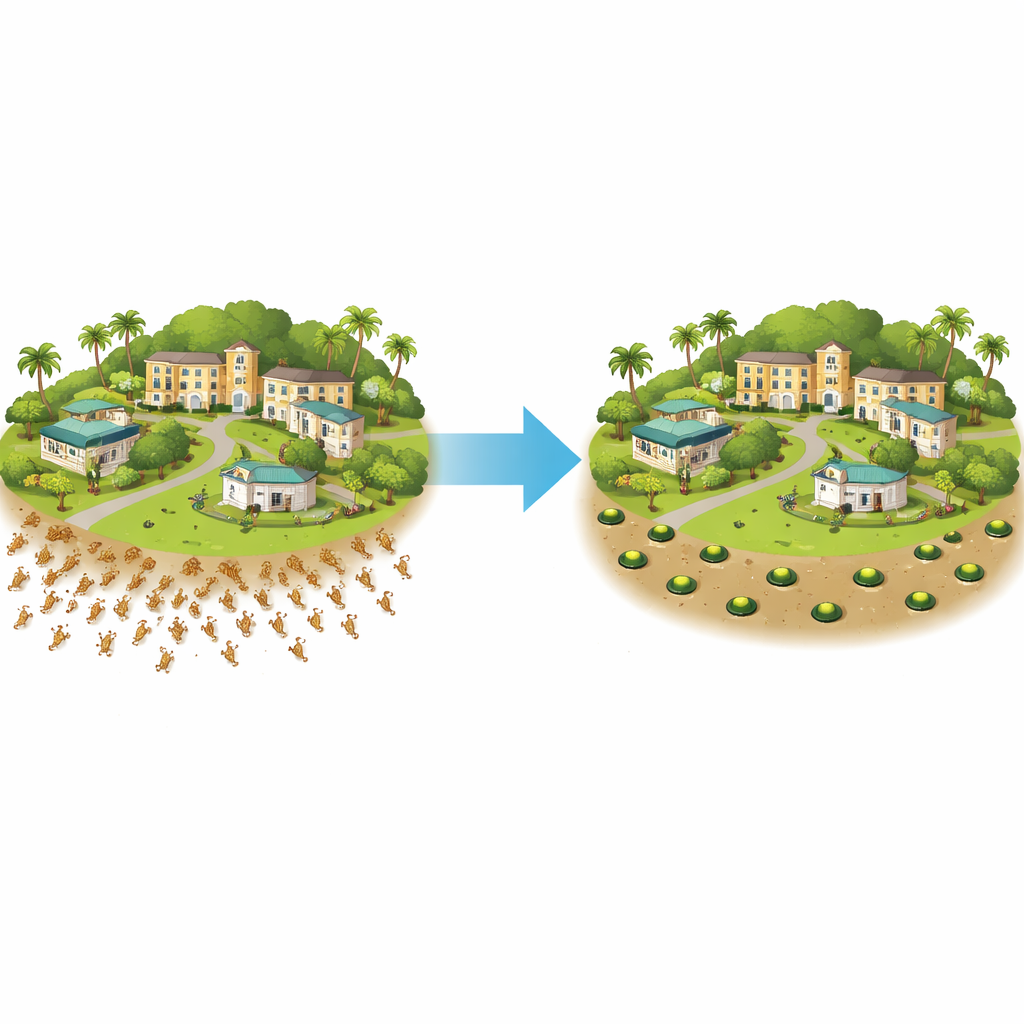
A campus under silent attack
The research took place at Universiti Malaysia Perlis’s main campus, a roughly 4.25-square-kilometer site that used to be a rubber plantation. When the campus was built, large colonies of subterranean termites, especially Coptotermes species, remained in the soil and began attacking buildings, trees, and landscaped areas. Earlier spot treatments with conventional sprays had failed to stop the problem. Because termite colonies can number in the hundreds of thousands and many nests may share the same area, the team chose an area-wide approach: treat the entire campus as a single problem, rather than chasing one damaged building at a time.
How the baiting plan worked
Instead of flooding the soil with liquid insecticides, the team used bait stations that rely on a slow-acting compound called chlorfluazuron. This ingredient does not kill termites immediately; rather, it interferes with their molting, gradually dooming the colony as exposed workers share food with nestmates. Outdoors, the researchers installed 11,511 in-ground stations near buildings, trees, and open landscaped zones, spaced about five meters apart and organized into 21 zones covering the campus. Each station first contained small wooden pieces and a natural attractant to lure termites. Once termites were detected, those stations were filled with bait dough made from alpha-cellulose and chlorfluazuron. Indoors, 40 above-ground bait stations were attached directly to infested spots on walls or structural wood whenever active termites were found during monthly inspections.
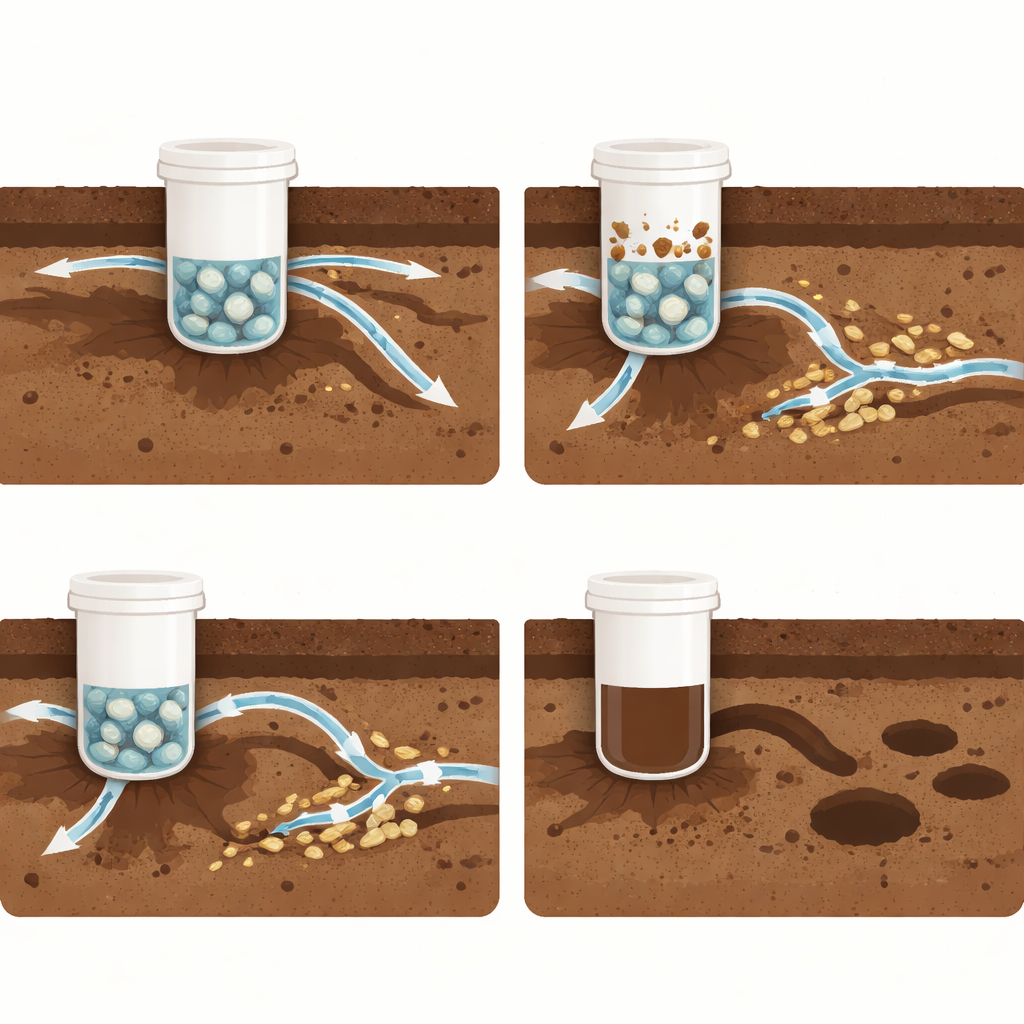
Watching colonies rise and fall
The team monitored the in-ground stations every three months from April 2021 to March 2024, recording which stations were active and how long it took for feeding to stop. At first, only a handful of stations showed activity, but this rose as more foraging tunnels intersected the bait network. Over time, a clear pattern emerged: active stations began to fall silent as colonies collapsed. By about 16 months into the program, all termite activity in in-ground stations had ceased, and no new activity was seen for the remaining year of the study. On average, once termites started feeding at an in-ground station, it took around 40 days for their activity at that station to disappear. Stations near buildings took a bit longer to clear than those near trees or open landscape, likely because structures provide richer food and more sheltered conditions for termites.
Clearing infestations inside buildings
Above-ground stations told a similar story inside campus structures. Early in the project, many indoor stations were active, especially in engineering buildings and student housing, where termites had been damaging wood fittings. After baiting began, the number of active indoor stations dropped sharply after the first six months. From March to December 2022, no new indoor infestations were detected. Only two fresh problem spots appeared between January and March 2023, and these were eliminated with bait. Overall, indoor stations took about 65 days on average to stop termite activity once feeding began—slightly longer than outdoor stations, again reflecting the richer, more complex shelter found within buildings.
What this means for safer termite control
By the end of the three-year monitoring period, the campus showed no detectable termite activity in either soil stations or buildings, and no reinvasion was seen for at least 15 months after the last signs of termites. For a large, heavily infested tropical site, this outcome is striking. It shows that a well-designed, area-wide baiting program using a slow-acting compound can quietly dismantle termite colonies over a year or two, without saturating the environment with broad-spectrum sprays. For homeowners, facilities managers, and city planners, the message is clear: patient, coordinated baiting across an entire property or neighborhood can offer long-lasting protection from these hidden house-eaters while reducing collateral damage to other soil life.
Citation: Salim, H., Alymann, A.A., Ong, SQ. et al. A study on area-wide management of subterranean termites through baiting strategies in a tropical region. Sci Rep 16, 11073 (2026). https://doi.org/10.1038/s41598-026-40987-5
Keywords: termite control, bait stations, urban pests, tropical ecosystems, integrated pest management