Clear Sky Science · en
One Health approach on toxocariasis and ophthalmic assessment in owners and dogs
Why pet owners and neighbors should care
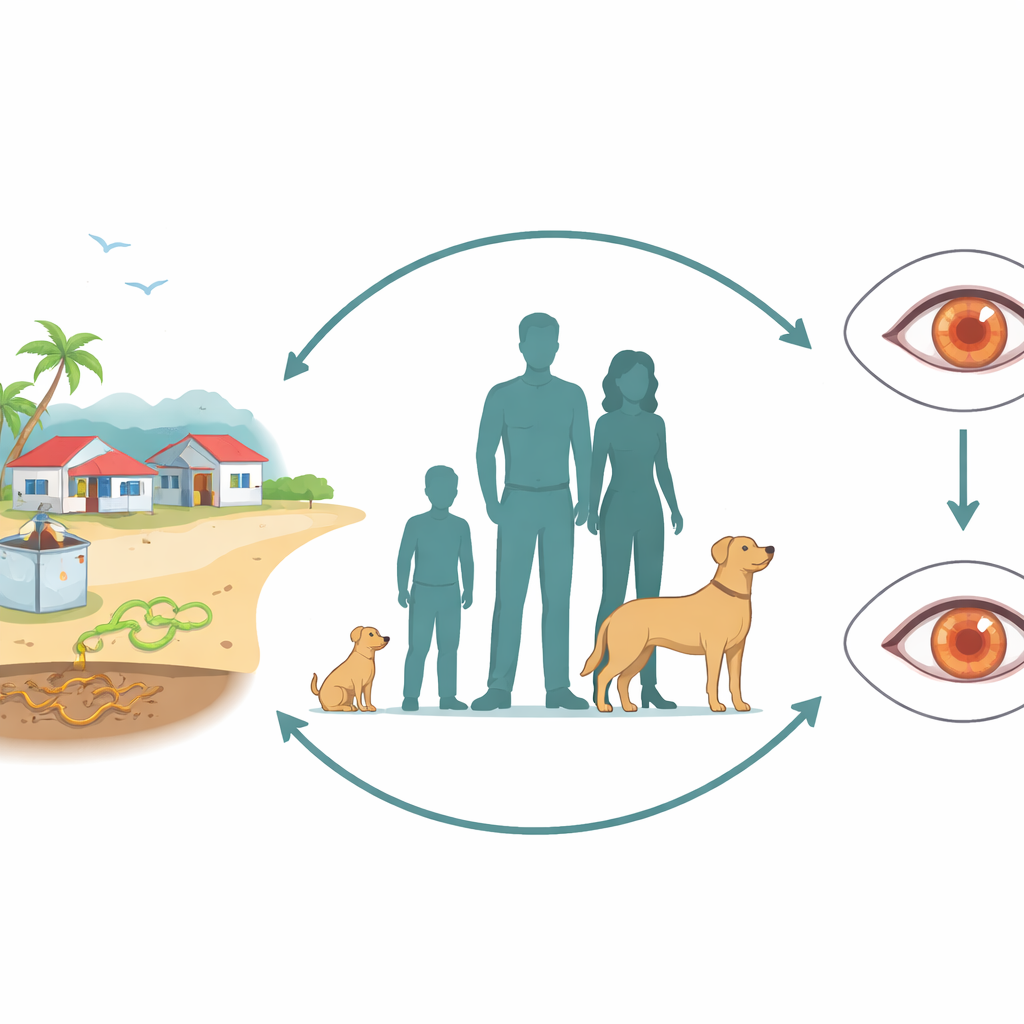
Many of us share our homes, yards, and even beds with dogs, often without thinking about invisible passengers that can travel between pets, people, and the places we live. This study looks at one such hitchhiker—parasites from the Toxocara family—that can quietly infect both humans and dogs and sometimes leave lasting damage in the eyes. By examining owners and their dogs together in a small coastal city in southern Brazil, the researchers show how water, soil, and everyday habits can link the health of people, pets, and the environment in surprising ways.
A worm that moves from ground to body
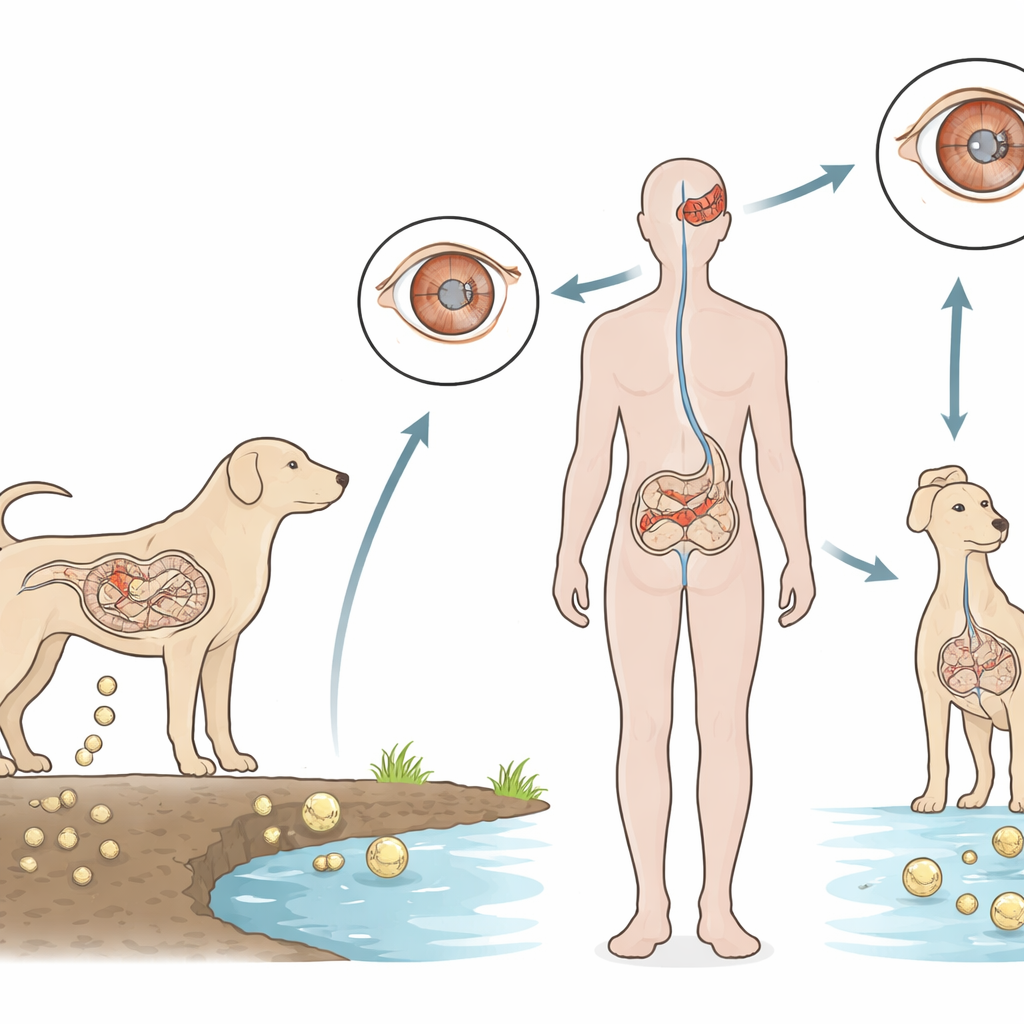
Toxocara are roundworms whose eggs are shed in the feces of infected dogs and cats. Once in moist soil, sand, or water, the eggs can become infectious and accidentally swallowed by people, often through contaminated hands, food, or drinking water. Inside the body, the immature worms do not grow into adults but instead wander through organs and tissues. Most people never notice, but in some, the immune system’s reaction can inflame the liver, brain, or eyes, occasionally leading to permanent vision loss. Because the same parasite can involve animals, humans, and the local environment, it is an ideal target for a “One Health” approach that looks at all three together.
Owners and dogs in a coastal community
The team carried out a cross-sectional survey in Morretes, a humid Atlantic Forest city with many low-income households and free-roaming dogs. They tested blood from 342 residents for antibodies against Toxocara, examined 237 dogs’ eyes, and checked 216 dog feces and 236 hair samples for parasite eggs. All human participants answered detailed questions about income, education, water sources, soil contact, hygiene, and pet ownership. Veterinarians also performed complete eye exams on the dogs to document any surface or retinal changes, including a little-studied condition called Florida Spot Keratopathy, which appears as multiple cloudy spots on the cornea.
Hidden infections and eye changes
About one in three residents (32.7%) had antibodies indicating current or past contact with Toxocara, confirming that exposure is common even when people feel healthy. Higher education appeared protective, while using water from artesian wells and frequent contact with soil increased the odds of infection. Owning both dogs and cats raised the likelihood of exposure, consistent with pets acting as sentinels of environmental contamination. Actual parasite eggs were rare in owned dogs: under 3% of feces and hair samples contained Toxocara eggs, but dogs given untreated water were much more likely to be positive. Purebred dogs and those with more controlled outdoor access were less frequently contaminated, likely reflecting different care and living conditions.
What the eyes revealed in people and pets
Eye examinations told a more nuanced story. Only one person showed a classic scar strongly suggestive of ocular toxocariasis, yet roughly one in ten had retinal marks that could reflect past inflammation from Toxocara or other infections. In dogs, eye problems were strikingly common: more than 8 out of 10 had some abnormality, mostly chronic surface issues such as scars or pigment changes. About 8% had fundus changes—deep lesions in the back of the eye—and these retinopathies were significantly linked to Toxocara positivity. Dogs with such retinal signs were much more likely to share a household with a Toxocara-seropositive owner, hinting that people and pets are exposed together to the same contaminated environments, even if direct transmission between them is hard to prove.
A surprising corneal condition in local dogs
The study also uncovered an unusually high rate of Florida Spot Keratopathy in dogs (5.1%), far above levels reported in large clinic-based surveys elsewhere. These distinctive cloudy spots on the cornea did not track with Toxocara infection, suggesting a different environmental trigger tied to life in this coastal setting. Street access, rather than age, vaccination, or deworming, was the only clear factor associated with these lesions. While the exact cause remains unknown, the pattern reinforces the idea that the local outdoor environment can shape eye health in pets, and possibly in their owners.
What this means for everyday life
Seen through a One Health lens, the findings show that toxocariasis is not simply a dog problem or a human problem, but a shared risk rooted in water, soil, sanitation, and pet care. In Morretes, many residents carry immune traces of past exposure, while a subset of dogs shows eye changes that may act as early warning signs of heavy parasite presence in the community. For lay readers, the takeaway is practical: safe drinking water, regular deworming of dogs and cats, proper disposal of pet feces, and handwashing after soil contact can all cut the chances that Toxocara eggs ever reach human eyes. By paying attention to the health of pets and the cleanliness of their surroundings, communities can help protect their own vision as well.
Citation: Bach, M.B., Kmetiuk, L.B., Freitas, A.R. et al. One Health approach on toxocariasis and ophthalmic assessment in owners and dogs. Sci Rep 16, 10300 (2026). https://doi.org/10.1038/s41598-026-40986-6
Keywords: toxocariasis, One Health, zoonotic parasites, dog eye disease, water and soil contamination