Clear Sky Science · en
Seismic survey noise reduces fin whale vocalisations offshore northwestern Spain
Why quieter oceans matter for giants of the deep
Far offshore northwestern Spain, powerful sound blasts are regularly fired into the ocean to map the seafloor and the rocks beneath it. These surveys help us understand Earth’s structure and find resources, but their noise spills into the underwater world where whales rely on sound to communicate, navigate, and find mates. This study asks a simple but far-reaching question: when the ocean suddenly fills with industrial noise, do fin whales — among the largest animals on Earth — still call to one another in the same way?
Big ships, loud tools, and a busy underwater soundscape
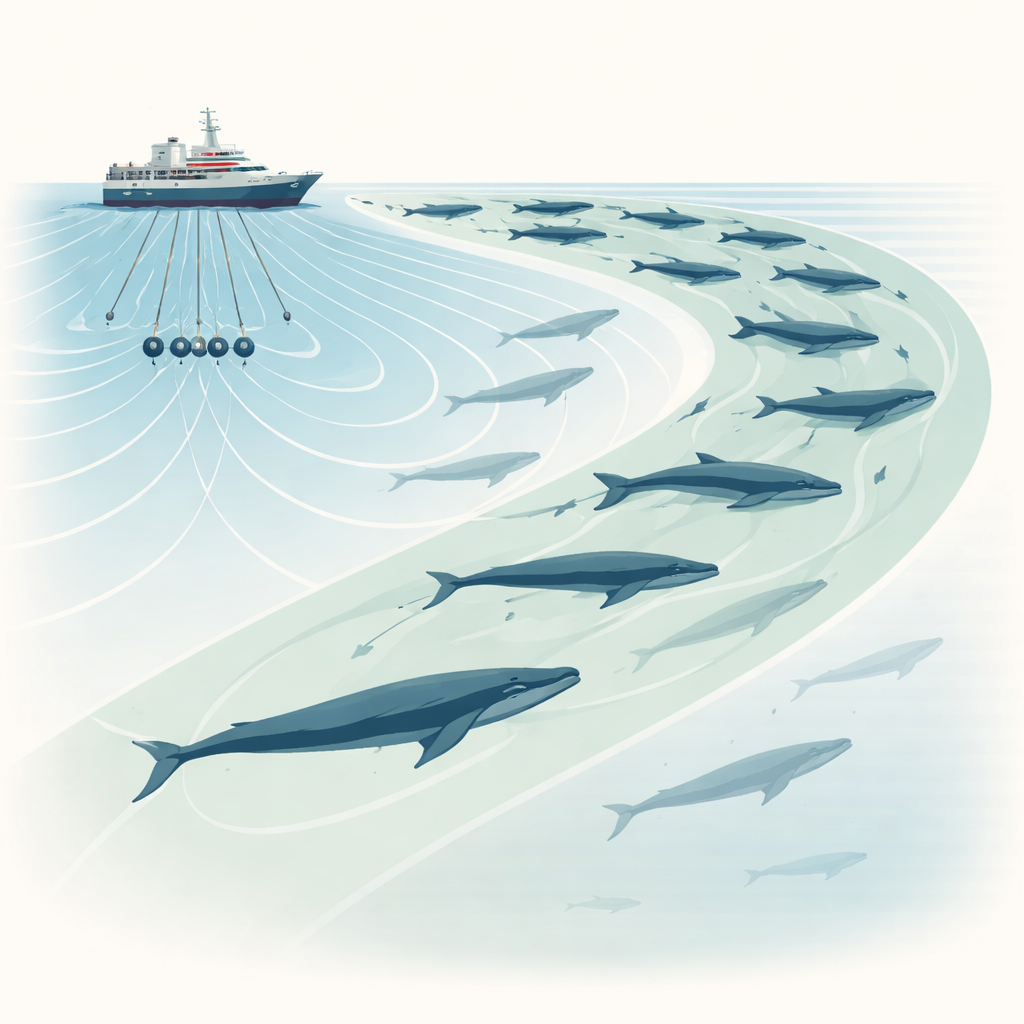
Human-made noise in the sea has been rising for decades as shipping, construction, and resource exploration expand. Seismic surveys are among the loudest contributors. A ship tows an array of airguns that fire rapid bursts of compressed air into the water every few seconds. These blasts send low-pitched sound waves deep into the seabed, but they also travel sideways through the ocean over vast distances. Unfortunately, the boom of these airguns overlaps in pitch with the deep calls produced by baleen whales such as fin, blue, and humpback whales. Because these animals depend on low-frequency sound to communicate, there is concern that survey noise could drown out their calls, alter their behavior, or push them away from key habitats.
Listening to whales with seafloor microphones
To investigate what happens during one such survey, researchers drew on a 2013 experiment off the coast of Galicia in northwest Spain, an area known as a migratory corridor for fin whales. During this project, 72 instruments were placed on the seafloor to record both the survey’s echoes and the ocean’s natural sounds. The authors focused on three of these recorders, spaced tens of kilometers apart, and examined 63 days of continuous data that covered two noisy “shooting” periods when airguns were active and two quieter breaks when the ship was in port or the work had finished. They searched for a particular low, pulsing sound — the so‑called 20-hertz pulse — thought to be an important part of fin whale communication, especially for males.
Teaching a computer to hear whale voices
Because the recordings spanned thousands of hours, the team used a modern pattern-recognition approach to find whale calls. They first hand-labeled about 50 hours of audio, marking short segments that contained fin whale pulses and those with only background noise or airgun blasts. These examples were used to train a convolutional neural network, a type of artificial intelligence that excels at spotting patterns in images — in this case, visual representations of sound called spectrograms. The trained model reached high accuracy and was then turned loose on the full 63‑day dataset, scanning every 30‑second slice of sound for the presence or absence of fin whale calls, hour by hour and instrument by instrument.
Whale calling drops sharply when airguns fire
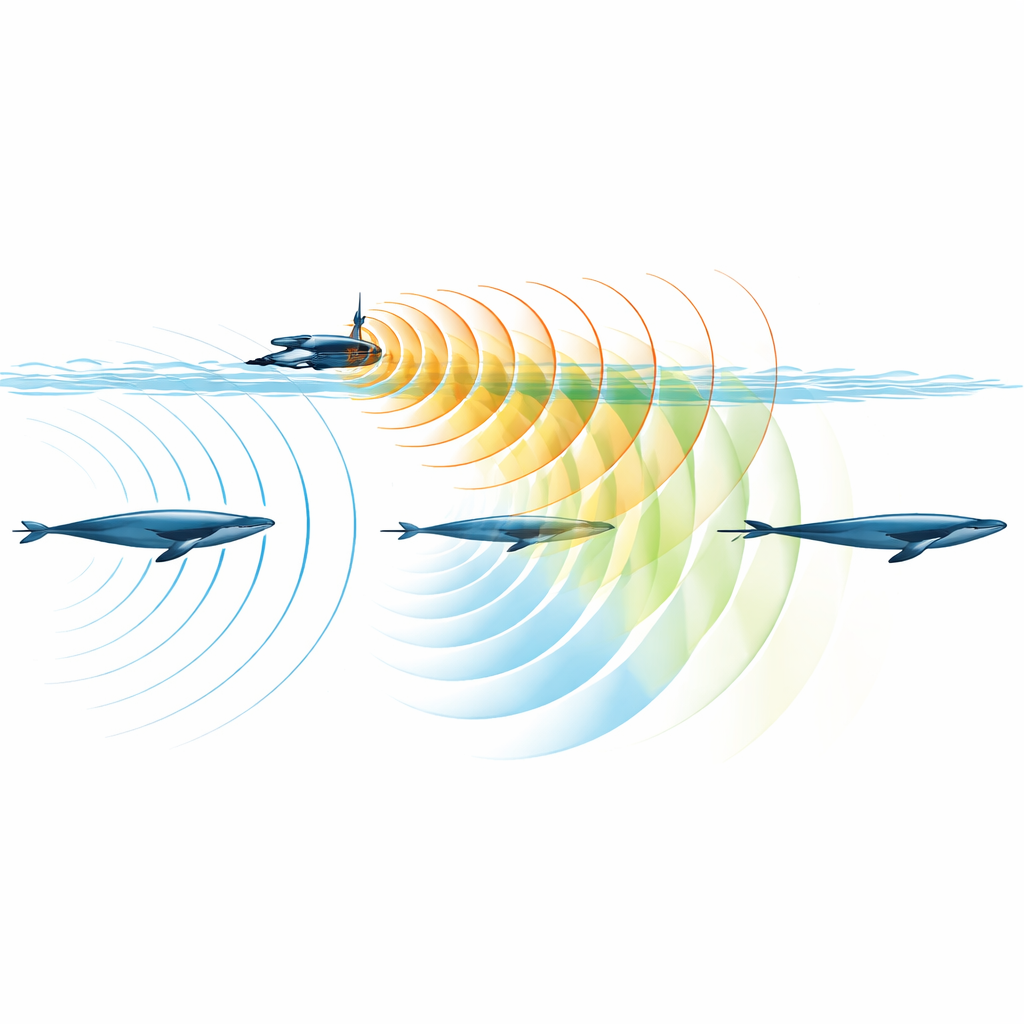
The pattern that emerged was striking. Across all three seafloor instruments, the number of time segments containing fin whale calls fell steeply during noisy survey days and rebounded when the guns fell silent. On average, detections dropped by about 70 percent during shooting compared with quiet periods. This difference remained even after the team applied a conservative correction for “masking” — the idea that some calls might simply be hidden beneath the loud airgun blasts rather than truly disappearing. Statistical modeling that accounted for differences among instruments and day‑to‑day variation confirmed that the reduction in calling during shooting was highly unlikely to be due to chance.
Fast responses, no sign of getting used to the noise
The timing of the changes suggests that fin whales reacted quickly to the start and end of survey activity. Calling often declined within a day or two after shooting began, and increased shortly after it stopped, including during short pauses caused by bad weather or repairs. Importantly, this response repeated in both noisy survey legs, with no clear sign that whales were becoming accustomed to the sound. The data alone cannot reveal whether whales lowered their voices, shifted their calls to other pitches, or left the area altogether, but it is clear that the soundscape during surveys was very different from the whales’ usual acoustic environment.
What fewer calls may mean for whales and people
For lay readers, the key message is simple: when we fill the ocean with intense industrial noise, fin whales call far less often in places where they would normally be heard. The study does not yet show exactly how this affects their ability to find mates, coordinate migration, or feed efficiently, but any prolonged disruption to communication in a vulnerable, wide‑ranging species is a cause for concern. Because seismic surveys are widely used and their sound can travel hundreds of kilometers, the authors argue that managing when and where surveys occur — and developing quieter technologies — will be important steps in protecting these ocean giants while still meeting human needs for scientific and resource exploration.
Citation: Edwards, E.A., Feakes, A.M., Olcay, A.A. et al. Seismic survey noise reduces fin whale vocalisations offshore northwestern Spain. Sci Rep 16, 10449 (2026). https://doi.org/10.1038/s41598-026-40903-x
Keywords: fin whales, seismic survey noise, marine mammal communication, underwater acoustics, anthropogenic ocean noise